Manitoba Premier Howard Pawley’s Conservative opponent Sterling Lyon liked to call him a Bolshevik. Even the Soviets had abandoned the phrase in the 1950s, but Pawley had that effect on some people.
His leftist credentials were impeccable. Pawley once played a juror in a theatrical production of Twelve Angry Men, Henry Fonda’s denunciation of anti-Latino bigotry. In 1962 he served as president of Winnipeg’s Fair Play for Cuba Committee.
It was a popular quip in Manitoba that Pawley’s cabinet dare not meet at the International Peace Garden for fear of arrest by North Dakota marshals. Pawley’s northern affairs minister was a Vietnam draft evader, his attorney general was an ex-Communist organizer.
Yet Pawley never looked like a bomb-throwing Marxist. His campaign slogan was “Great People, Great Land.” No subversion there. As a legislator he reformed family law in Manitoba to mandate the equal sharing of assets in cases of separation. No radicalism here.
He was earnest, honest and plain spoken, with all the habits of a small-town solicitor from Stonewall, Manitoba: no smoking, no drinking, no carrying on. Pawley joined the Kinsmen Club. His wife Adele worked as a tax preparer for local farmers.
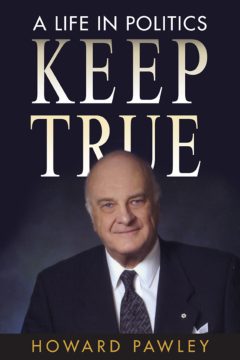
These intriguing contradictions are captured in Keep True. The political anger was genuine. One Pawley initiative that allowed an NDP-approved arbitrator to impose a first contract in new union shops was bitterly opposed by small manufacturers. Yet if Pawley adopted policies that enraged critics – his approval rating once hit 12 percent – he was also the kind of man you’d like as a neighbour.
Pawley was a skilled memoirist. He recounts indelible vignettes of his rural childhood, a portrait of curly-haired Howard chosen as a poster boy for Crown Syrup Co. in 1935 and the remembrance of a stern grandfather who rebuked him for breaking the Sabbath by listening to the Charlie McCarthy Show on the radio.
He recalls walking to Grade One, four miles there and back, and the time he stumbled across his father in the barn, killing a chicken for the evening meal. It was “hanging by its legs from the ceiling by a chord, a steady trickle of blood dripping from its slashed throat,” Pawley wrote. He could not bear to eat chicken the rest of his life.
Pawley also had a Napoleonic sense of destiny. He ran and lost elections in 1957, 1958 and 1965 and again in ’88, when Pawley campaigned as an anti-free trade candidate for Parliament and lost by 3,900 votes. He recounts these failures plainly. It is an attractive quality.
Keep True is the memoir of a Prairie New Democrat. If Pawley was a mild personality, his memory is sharp-elbowed. He recalled Brian Mulroney as a schemer and reminds readers that 57 percent of Canadians actually voted against free trade.
Most indelible is the image of Pawley the small-town lawyer who gave Manitoba its public auto insurance program in the teeth of opposition by insurers and members of the Canadian Bar Association. Manitoba became only the second province to introduce the measure, after Saskatchewan pioneered it in 1946.
A reporter recalled Pawley would drive from farm to farm in a battered Chevrolet, then “wade through slush and talk to people who had never met a cabinet minister. He would figure out the insurance rates for everybody’s car and show how they were going to save money.” It was not, on reflection, the kind of thing a Bolshevik would do.
By Holly Doan
Keep True: A Life In Politics, by Howard Pawley; University of Manitoba Press; 278 pages; ISBN 9780-88755-7248; $27.95