Conspiracy is mythology, but after sundown. Even when wholly fiction, both satisfy some human need to explain a ridiculous, implausible world. Author Richard Syrett calls it “the madness unleashed by creative genius.” He is a gifted essayist.
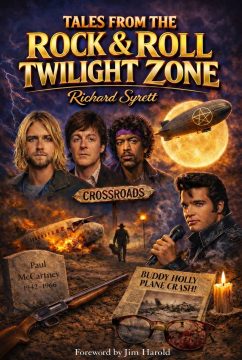
Syrett is a Toronto broadcaster, producer and podcaster, and enthusiastic chronicler of the underworld of popular culture. “Pop keeps people distracted and docile, background noise for factory life,” Syrett quotes an interview subject. The result is Tales From The Rock ‘n Roll Twilight Zone, a forensic probing of “the eerie coincidences, the suspicious circumstances, the whispers that something darker was at work.” The result is jarring.
Take The Beatles’ 1964 tour that included dates in Vancouver and Montréal. “Rebellious yet safe, exotic yet relatable,” writes Syrett. “Their lyrics spoke of love and longing, but their cultural impact went deeper, normalizing experimentation and questioning authority. By the late 1960s, as their music evolved into psychedelic anthems, the band was linked to the counterculture’s embrace of drugs and dissent. Was this evolution organic or guided?”
Rock ‘n Roll Twilight Zone questions whether the “British invasion” was not about clever Capitol Records marketing at all. “It was psychological warfare designed to destabilize the American family, discredit religion and flood youth culture with drugs, sex and apathy,” writes Syrett. “The guitars were merely delivery systems for the message.”
“Rock and roll had been cheeky rebellion,” writes Syrett. “By 1967 it was mystical rebellion, the soundtrack of self-destruction.” And John Lennon? “He sang about peace while living inside a storm of projection and expectation. He stepped, daily, across the thin membrane between man and symbol. And symbols, once formed, do not belong to themselves.”
Rock ‘n Roll Twilight Zone spans the soundtrack of the Sixties onward. It questions whether Jimi Hendrix and Elvis Presley were killed by managers. It recounts an improbably incompetent investigation of Buddy Holly’s 1959 plane crash. It pauses where rockabilly star Johnny Horton, 35, was so paralyzed by premonition of violent death he gave a friend his guitar. “You can have it,” he said. “I won’t be here much longer.” Horton was killed by a drunk driver weeks later.
Syrett is such a vivid and compelling writer even the coldly rational would keep it up through 380 pages. Here is his account of The Rolling Stones’ disastrous 1969 concert at California’s Altamont Speedway that left four dead including one teenager stabbed near the stage. It was the epilogue to the mythology of Woodstock that same year.
“There was no myth to buoy Altamont,” writes Syrett. “No pastoral camera sweeps of smiling crowds. No mass chorus harmonizing the world into gentleness.”
“Altamont looked like a hollow, an enormous bowl where a fire had burned and gone out, leaving only a thin rim of ember-glow along the ridge. The stage looked like an abandoned altar. Dust hovered like smoke from a ritual that had ended badly. Wind rolled over the hills in cold sheets, as if something old were turning in its sleep. One witness would later describe it as ‘the Sixties walking off the stage without saying goodbye.’”
By Tom Korski
Tales From The Rock ‘n Roll Twilight Zone, by Richard Syrett; Trine Day LLC; 380 pages; ISBN 9781-63424-5494; $31.99