Subsidized media today are so self-pitying it is no surprise they missed the biggest scoop of their lives, the death of subsidized media. Spy the columns and TV punditry and you encounter the same excuses. It was Russian bots or internet poaching of Chevrolet dealer ads or misinformation or Instagram micro-shocks or inflation. It was always someone else’s fault.
Tara Henley, podcaster and former CBC producer, gets the answers. “If media want to restore public trust, we have to examine our own actions,” she writes. “Unpacking our role is essential for making sense of the crisis in media.”
“Most people do not distrust the media for vague, rote reasons but instead for achingly specific ones,” writes Henley. “Indeed, they frequently cite the specific wording in the specific stories that they believe falls short.”
Canadians do not expect infallibility. They expect hard work and honesty. It is not too much to ask. The Trust Spiral notes the descent of media under withering scrutiny blew wide open in the pandemic, an “overheated moment.”
Carefully, methodically, citing sources, Henley builds her case in this forensic autopsy of what killed newsrooms. The result is excellent. She even pinpoints the date.
“During Covid, narrative conformity tended to be more pronounced here,” writes Henley. “As a result, vaccine mandates rolled out without any serious press scrutiny, contributing to one of the biggest media mistakes in Canada in recent years. That debacle involved the 2022 Freedom Convoy.”
Media were already on the federal payroll under a $595 million subsidy scheme. Media treatment of protestors was already prescribed by Justin Trudeau in his 2021 campaign: “These are extremists who don’t believe in science,” he said. “They are often misogynists, also often racists.”
Henley chronicles the result. “There was a feeling among the press corps that the story was uniquely distasteful, and that any alternative conclusions about the truckers were basically boorish,” she writes. “This dynamic was ultimately self-reinforcing. Those outside the media may not comprehend how subtle and insidious such a dynamic can be in enforcing ideological uniformity.”
Proof of this was made plain in a March 9, 2022 Carleton University symposium, “Journalism Under Siege,” where a panel of subsidized reporters recounted their Freedom Convoy experiences. Luckily for historians and the public, it can still be found on YouTube.
Panelist Justin Ling, a Toronto Star freelancer who falsely claimed protestors were armed with shotguns, spoke to the School of Journalism. “Most of what I do is follow misinformation, follow conspiracy theories, follow extremist groups, and all the ones I’ve been looking at, and a few I hadn’t even heard of, were getting together, were all getting on the same page, and were saying, ‘It’s time to go to Ottawa,’” he said.
Ling went on. “These are individuals who for two years now have been hearing propaganda that says masks don’t work, Covid-19 is not as serious as they tell you, the government is using this to restrict our civil liberties and perhaps enact a permanent sort of lockdown, and then later that Covid-19 vaccines are dangerous and ineffective and killing people in scores,” he said. “And they’re getting this information from a totally alternative press. Not just an ‘independent’ press, but a press that exists in a totally alternate reality, one where they get to make up their own facts.”
Problem: The Public Health Agency of Canada itself stated “the effectiveness of the use of non-medical masks has not been well demonstrated.” It assured Canadians that Covid infection rates could be kept to 10 percent, and endorsed a $75 million Vaccine Injury Support Program for Canadians killed and injured by Covid shots. The “civil liberties” question? That was settled in the protestors’ favour by the Federal Court of Appeal last January 16.
The Trust Spiral drives the nail in the coffin. “The chasm between reporters and the people they cover predictably has a negative impact on the quality of coverage, and on public trust,” writes Henley. “But it also has a more subtle and insidious effect: It discourages journalists from challenging those in power. And this, in turn, leads to further failures.”
“A segment of the public now regularly espouses the idea that the Canadian media is a ‘mouthpiece’ for the Prime Minister’s Office, an accusation that Lana Payne, national president for Unifor, Canada’s largest private sector union, has said her members in the media now face,” writes Henley. “It’s a criticism all too familiar to many journalists. ‘The first thing any idiot on Twitter says is, ‘Oh, I guess you’re waiting for your paycheque from the government,’” the Globe & Mail newspaper columnist Andrew Coyne told me. ‘Now obviously, that’s loony and cheap. But it feeds that perception – and to some extent it’s a reality.’”
By Tom Korski
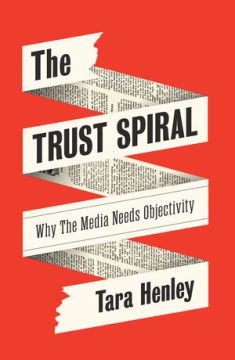
The Trust Spiral: Why The Media Needs Objectivity, by Tara Henley; Polity Press; 128 pages; ISBNM 9781-5095-70935; $17.99