
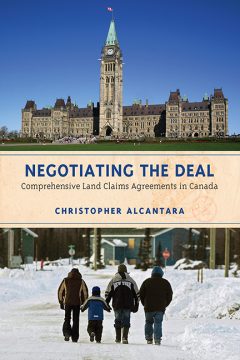
When Idle No More protestors shut down the country’s main rail line and besieged the Prime Minister’s Office, Canadians were heard to mutter: Why can’t we solve Indigenous issues? Author Christopher Alcantara finds one answer in Negotiating The Deal, a step-by-step recounting of the maddening process that passed for land claim settlements. It was not really a process at all, and more of a game to drive mice crazy.
Alcantara documents a made-in-Canada fiasco called In All Fairness, the system developed by Parliament to settle claims by Indigenous people who never signed colonial treaties but lived here for millennia and clearly had legitimate demands. Only in 1973 did the Supreme Court recognize such claims, prompting then-prime minister Pierre Trudeau to marvel: “Perhaps you had more legal rights than we thought.”
The idea was to replace “undefined and highly ambiguous Aboriginal rights” with “specific, defined treaty rights.” It seemed a tidy process. Government would come to terms on land transfers, taxing powers, municipal planning, grants and resource royalties.
Why did it so often fail? Perhaps a lack of “trust relationships,” writes Alcantara. The mystery is that it ever worked at all.
Consider this: In 2006 the Inuit of Labrador signed a treaty for 72,520 square kilometres of land, a five percent royalty on one of the world’s richest nickel mines at Voisey’s Bay and $296 million in federal loans and grants. The deal took 28 years to finalize. By comparison, India took three years to negotiate independence from Britain.
“There is no consensus as to why some groups have been able to achieve settlements and why others have not,” writes Alcantara. There was one common trap. Negotiators hired by Parliament and the provinces were paid by the hour and never punished for failure.
In a “deductive approach,” Negotiating The Deal recounts the process. First, a group like the Inuit of Labrador must prove they a) are an identifiable group, b) live on the land and c) have been there a long time. Then they submit a statement of intent to all governments. Then everybody must sign a framework agreement detailing what is up for negotiation. Then they reach agreement-in-principle, leading to a final agreement, with ratification votes all ‘round.
What could go wrong? Everything, which leads to a second trap. Politicians were in charge. In the case of Labrador Inuit, the entire process dragged through the terms of eight premiers of Newfoundland and Labrador. When the Inuit submitted their initial land claim in 1973 – everyone agreed it was an eloquent and well-researched document – subsequent talks lasted 13 years. As Professor. Alcantara notes, a “motivated” political leader can at any time “unilaterally alter a mandate to speed up or delay the process.”
By Holly Doan
Negotiating The Deal: Comprehensive Land Claims Agreements In Canada, by Christopher Alcantara; University of Toronto Press; 208 pages; ISBN 9781-4426-12846; $24.95