
Parents and teachers are to blame for young Canadians’ gullibility in falling victim to predatory financial practices, say lawmakers. Senate hearings on a government bill to appoint a federal “financial literacy leader” erupted in laments over the ignorance of young credit-card holders and uselessness of educators: “Basically it is adding and subtracting.”
Mom Wins Child Care Case
The Federal Court has ruled childcare is grounds for protection under the Canadian Human Rights Act, in the case of an Alberta mother fired for refusing a work reassignment because she had to tend to her children. A federal judge called it “a prima facie case of discrimination.”
Drive-Thru Licensing?
A federal proposal to speed licensing times for vitamins and natural health products may not be the best for consumers, say advocacy groups. The Department of Health proposes that licensing be shortened to 180 days or less compared to current waits of two years.
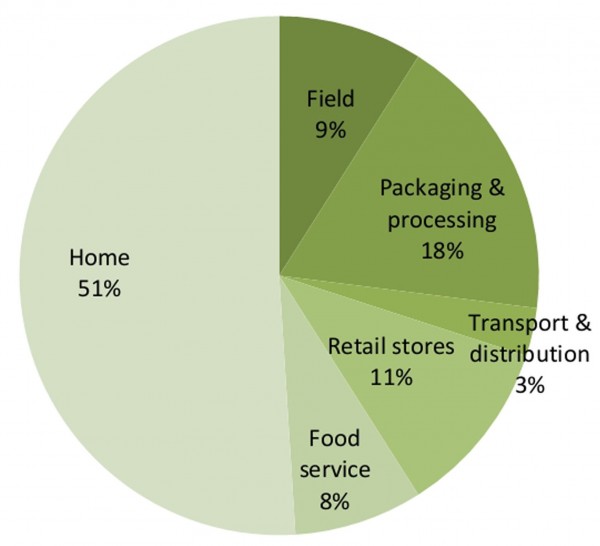
One Unappetizing Pie Chart
Canadians are urged to curb food waste following a new national study that estimates $27 billion worth of food is pointlessly spoiled each year – the equivalent of $774 for every person: “It makes no sense — ethically, economically or environmentally.”
“Who Is Responsible For What”?
Tough-on-crime legislation and other campaigns by senior levels of government have added half-a-billion dollars to the cost of municipal policing, say Canada’s cities.
The Federation of Canadian Municipalities, in a submission to the Commons’ public safety committee, said downloading has left local police departments with unsustainable costs.
“Legislative changes at the federal and provincial levels impact on the cost of providing local police services,” said Berry Vrbanovic, past-president of the federation; “Local police forces are dealing with crimes that were once the exclusive purview of the RCMP.”
The federation estimates policing costs nearly doubled between 1999 to 2009, to some $12.3 billion nationwide.
“Front-line police are seeing frustrating trends as cracks with Canada’s mental health and homelessness systems play out in our streets,” Vrbanovic told MPs. “Studies have shown the police have become society’s 24-7, de-facto front line mental health workers. Municipalities do not have the reach or resources to take on more, or to address the social and economic factors that affect crime rates.”
Vrbanovic said it is difficult “to find efficiencies and effectiveness in policing when we don’t have a clear understanding of who is responsible for what and who is paying for what.”
The Department of Public Safety last month convened a summit, Strengthening Canada’s Policing Advantage, to review crime-fighting costs.
Sixty percent of policing budgets are carried by local ratepayers, by federation estimate. 
By Staff
‘Worst Procurement Ever’
Defence analysts in Ottawa are observing “the worst procurement in history,” the refit of Canada’s fleet of search-and-rescue helicopters that is now into its third decade. Review of the purchase has dragged on through five successive prime ministers: “It is time to consider other options.”
Extra Charity Tax Credits?
MPs recommend charitable Canadians be offered more tax credits — up to 10 percent more under a “stretch” credit that would reward tax-filers who give more each year. Only 1 in 5 Canadians tax-filers now give to charities.
Feds Open Wireless Hearings
Consumers, not federal regulators, should decide whether cellphone companies maintain existing contract terms with clients, says an industry group. The remarks opened hearings on contracts affecting Canada’s 27,000,000 cellphone and data text subscribers.
No More Stop ‘N Go On Public Works: Industry
Renewal of federal subsidies for public works is “critical” to sustaining the nation’s engineering sector still recovering from past recessions, an industry group has told MPs: “It’s very difficult…when you’re funding infrastructure programs that run for a couple of years and stop.”
A Big Wind
Federal regulators have further delayed a landmark study on the health impact of noise from wind turbines. Health Canada confirmed that, six months after announcing the study, it has opted to modify terms of the review – delaying the report till late 2014.
Another Story They Missed: Media Grants Under Review
A federal program that has paid six-figure grants to the nation’s largest media corporations is under scrutiny, says the minister of heritage. “We want to make sure that those larger companies are not in any way abusing the system at the sacrifice of smaller publications,” the minister told Blacklock’s.
Mail Fee Will Cost Home Owners $25M: Industry
Canada Post will not disclose its anticipated revenue from a fee for mail delivery to new homes. In a new policy introduced Jan. 1, Canada Post is charging home builders $200 for every new single-family residence. And the profit? “I don’t think we’ll be giving you that,” the Crown agency told Blacklock’s.
Is Fish Flu Spreading?
A virus outbreak in farmed Atlantic salmon is raising concern with experts consulted by Blacklock’s, including fears the infection may spread to wild salmon and other fish populations: “There is a risk.” A similar outbreak in Chile cost the industry $2 billion, noted one scientist.
Beef Probe Closed To Public
No public hearings are planned in a federal oversight review of the government’s handling of the biggest beef recall in Canadian history. The review follows Blacklock’s disclosure that fewer federal veterinarians were assigned to field inspection last year prior to an outbreak of E.coli at a Brooks, Alta. slaughterhouse.
“This Is A Hot Topic”
A federal appeal for new standards on sustainable purchasing has received enthusiastic response. It follows a Crown agency’s call for interest in developing a voluntary, consensus-based code on fair, eco-friendly policies: “This is a hot topic.”