An acronym trademarked by a Canadian public relations group resembles a shorthand term for Korean Communists, though the volunteer agency says the similarity is purely coincidental.


An acronym trademarked by a Canadian public relations group resembles a shorthand term for Korean Communists, though the volunteer agency says the similarity is purely coincidental.
A federal labour relations referee is gaining greater powers to expedite settlements in the first major revision to regulations since 2001. “This looks like a good-faith effort to modernize the rules,” said one labour lawyer; “I don’t see monkey business.”
Weight Watchers Canada is lobbying Parliament for “consideration” in the next budget that Blacklock’s sources indicate would include tax credits for diet programs and supplements. The government already offers a fitness tax credit for children’s hockey and other sports. Federal data show Canada is the fourth fattest nation on earth.
Nearly three quarters of federal guards on the Canada-US border speak English only, documents show. But managers in the transport industry call the unilingual trend an economic fact of life. “To ship across the border you must comprehend the national language of the United States – which is English,” said one trucking executive.
More than a quarter-million jobs grew from canola last year, the nation’s most valuable crop. New federal data show nationwide, food processing is now the country’s biggest manufacturing sector.
Builders are bypassing more than half a dozen federal laws and scores of regulations in planning a new bridge from Windsor, Ont. to Detroit, the busiest border crossing in the country.
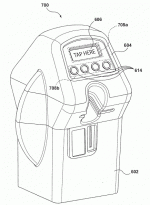
Industry Canada is reviewing a patent from a Nova Scotia firm for tap ‘n’ go electronic parking meters that promise speedier service. “This may be ‘whiz-bang’ for older drivers,” said the device’s co-inventor, “but certainly young people are embracing tap ‘n go technology.”

The Canadian Police Association is expressing interest in a device invented by two Alberta men that alerts highway patrol officers and passersby to any motorist who fails to comply with mandatory seatbelt laws.
Necessary repairs to urban roads and utilities are so costly the unfunded expense would break Canadian cities without federal aid, mayors say.
“If we tried to finance it all with property taxes no one could afford to live in their homes,” said Mississauga Mayor Hazel McCallion.
City leaders joined the Federation of Canadian Municipalities (FCM) in pressing for renewal of federal public works subsidies, due to expire in 2014.
McCallion, 91, a twelve-term mayor, said it will take $50 billion to upgrade infrastructure in Greater Toronto “if we’re going to make an impact on gridlock.”
The federal government has promised some renewal of a $33 billion Building Canada program to expire in two years, though terms and conditions of subsidies have not been detailed.
“We’re falling behind,” said Kitchener Mayor Carl Zehr, who joined McCallion and other municipal leaders in appealing for federal assistance in Ottawa. Zehr said his city “cannot afford” repairs without federal help.
“It’s like a ticking time bomb,” said Zehr. “Without good infrastructure, the economy will start to suffer.”
Municipalities in a Nov. 13 report, The Road To Jobs And Growth, said federal planners “must break the old cycle of short-term thinking and one-off funding that caused Canada’s municipal infrastructure deficit to balloon over the past two decades.”
The FCM has requested 20-year funding projections with focused investment, including $1 billion to reduce commute times in Canada’s largest urban areas.
“Infrastructure is crumbling; traffic congestion is brutal,” said Vancouver Mayor Gregor Robertson, chair of the federation’s Big City Mayors’ Caucus. “This is a significant threat to our economy, to attracting new investment, and to the quality of life of all Canadians.”
The federation estimates 1 in 4 urban roads is congested and half need immediate repair, despite cities’ investment of $12 billion a year in infrastructure.
“Cities are ready to do our part,” said Robertson. “We call on the federal government to stay with us.”
The nation’s mayors and councilors have urged cabinet to detail terms of renewed public works subsidies by next spring, to permit time for planning, engineering and tendering of contracts. 
By Alex Binkley
Cuts to tax credits for scientific investment have dropped Canada to 17th in a global ranking of research and development incentives among industrialized countries, says an industry group: “If you’re an R&D company — hopefully the kind of company we want to attract — you are not coming to Canada.”
The public works department faces a trade inquiry over claims an agent “overstepped his technical capabilities” in demanding goods be held to a tolerance specification of a thousandth of an inch. “I’ve never heard of something so stupid,” a defence contractor told Blacklock’s.
The Department of National Defence is restricting a Chinese “news agency” from its briefings pending a review of the organization’s Ottawa press credentials. Xinhua confirmed to Blacklock’s it was barred from attending a briefing where Minister of Defence Peter MacKay unveiled Canada’s first military satellite, Sapphire.
The nation’s home builders warn forecasts on “affordability” are now so skewed “the impact is very serious over time,” said an executive. The Canadian Home Builders’ Association concludes housing affordability “is worse today than at any time since the early 1990s” despite misconceptions in Parliament and the public over low mortgage rates.
Health Canada is changing the rules on food additives after lobbying by industry that complained of red tape. In one instance, an additive for infant formula to prevent clogging in feeding tubes took almost four years to be approved after federal scientists determined it was safe.
Canada’s long-promised balanced budget is now delayed another year. Finance Minister Jim Flaherty confirmed the budget shortfall will be some $5 billion worse than thought. And the government forecast continued sluggish growth in the economy through next year.