It was an unnerving moment at a Victoria hearing of the Truth and Reconciliation Commission on Indian Residential Schools. An aging priest was to testify. There were no abuses at his school, he explained. Frankly the care was excellent, he recalled. There were Indigenous staff, and parents could visit anytime.
“Tell the truth!” voices shouted from the back. “Shame on you!” “Tell the truth!”
It was a significant moment, writes Professor Ronald Niezen. The old man’s testimony set off the audience. “He interrupted the boundary that separated the oppressed as a collectivity from those who have moral responsibility for their suffering,” writes Niezen. “He questioned the foundational historical premise of the Commission itself, captured succinctly in the title of an interim historical report, They Came For The Children.”
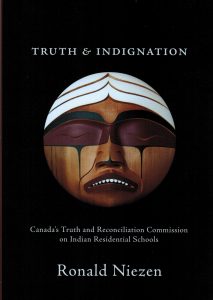
Niezen is an anthropologist at McGill University. His book is as unnerving as the priest’s testimony. The Truth and Reconciliation Commission, created from a class-action lawsuit, was neither a forensic audit nor a criminal investigation nor a fact-finding exercise. There was little reconciliation, and even truth was subjective. At one hearing a commissioner patiently explained the difference between “factual truths” and “relative truths,” Niezen writes.
“More than in any other truth commission, the Truth and Reconciliation Commission on Indian Residential Schools is concerned with mental illness,” the author writes. As a result, testimony from former students was “complicated by the permissiveness of the hearings, and by the fact that there are no explicit limits to what one may or may not say into the microphone and before the cameras.”
No one disputes that abuses occurred. Niezen documents these outrages: The child forced to eat vomit, or the abused boy who froze to death while trying to walk home. The result was multiple apologies drafted by liability lawyers, and flat payments of $10,000 to all former students for the first year spent at school, with $3,000 for each year thereafter.
He interviews former priests and nuns, too, who express bafflement that they were as a class depicted as sadists. “In my school in five years I never heard of physical abuse and sexual abuse,” one priest tells Niezen. “Years later this comes and all of a sudden you find out you are a criminal. That makes me mad. I’ve lost hours and hours of sleep over that business.”
The author goes further, noting the absence of any focus on the prominent role of the Government of Canada as the architect of the program. Truth & Indignation is an attempt by an eloquent observer to document what became of the Truth and Reconciliation process. Oddly, the Commission almost resembles the Indian Residential Schools themselves, a cruel, ambiguous, institutional response to conflict and failure.
In the end readers are left with the words of the shaken priest, Brother Tom Cavanaugh, attempting to tell his story in Victoria:
- Witness: “There didn’t seem to be any other viable alternative in providing a good education for so many children who lived in relatively small, isolated communities.”
- Audience Members (sobbing): “Truth!” “Tell the truth!” “You’re not telling the truth!”
- Witness: “The Native staff who were related to a number of the children along with the other staff, I felt, provided a good education, as well as excellent care and guidance.”
- Audience: “Tell the truth! Shame on you! We never sent our children to a Residential School.”
- Witness: “Parents were encouraged to visit the school and rooms were available, if they wished to stay overnight with their children.”
- Audience: “Tell the truth!”
By Holly Doan
Truth & Indignation: Canada’s Truth and Reconciliation Commission on Indian Residential Schools, by Ronald Niezen; 192 pages; ISBN 9781-44260-6302; $24.95