
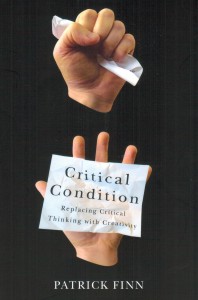
If they were re-inventing Parliament it might not look like the Texas hold ‘em version we have now, a rectangular chamber of adversaries seated face-to-face, seeking advantage and winner-takes-all. This is the product of “critical thinking,” writes Patrick Finn: “A mode of thinking that is governed by a critical approach to all incoming information that has winners and losers.”
“Our system of government is based on a form of critical thinking first established in ancient Greece,” explains Finn, associate professor at the University of Calgary’s School for Creative and Performing Arts. “Does anyone think it is still working? Or are we continually asking ourselves why this system will not allow us to work together more effectively?”
Critical Condition is an engaging book that challenges the very premise of Parliament, the courts, universities, you name it – the school of “us-versus-them thinking,” as Finn puts it. He depicts the practice as pointless, unproductive, suspicious and mean: “No matter how we disguise it, it reeks of violence.”
“I admit to having enjoyed a few victories of this type myself,” Finn writes. “In one of my lowest academic moments, I once made a fellow student weep and run out of the room when I savaged him for ridiculing the work of James Joyce.”
Critical Condition proposes instead “loving thinking,” a keenly practical alternative despite the moniker that comes with a kick-me sign. It is a consultative system that invites creative problem-solving broadly applied to a unique problem. This is precisely how Canada helped win World War Two, and why townspeople sandbag riverbanks in flood season. No name-calling; no point-scoring, no matter who takes the credit.
“If our leaders were educated to believe that solutions were the goal, and not attacks, defences and victories, then they would be predisposed to find ways to act,” Finn writes. “If we trained all students to view critical quagmires as negligence, then our negotiators would no longer begin with lists of non-negotiable items. Creativity makes no room for the non-negotiable. Great ideas require no protection other than the room to breathe and the right to live.”
“Politicians often speak of issues that will kill a campaign as ‘the third rail,’” writes Finn. “They are referencing the power rail of the subway or train that kills on contact. How did we arrive at a place where critical thought has become the third rail of intellectual life? How did it become this strong?”
“If we want to compete, why not get serious about our competition?” writes Finn. “Let us compete against cancer, against pollution, against civil war, against domestic violence, against poverty.”
By Holly Doan
Critical Condition: Replacing Critical Thinking With Creativity, by Patrick Finn; Wilfrid Laurier University Press; 117 pages; ISBN 9781-77112-1576; $14.99




