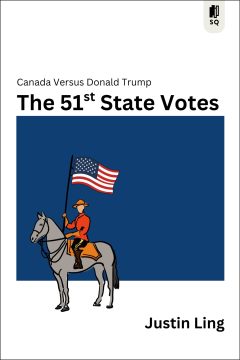
Freelancer Justin Ling, a Toronto Star contributor, has written a lively campaign memoir. His account puts heavy emphasis on Conservative Party media relations. This is thin ice, but Ling skates on.
The campaign was the first in which a majority of the Canadian Parliamentary Press Gallery faced unemployment if the Liberal Party lost re-election. Millions in media subsidies were at stake. Pierre Poilievre “vowed to defund the CBC and criticized the entire Parliamentary Press Gallery for being bought and paid for as ‘Trudeau’s media allies,’” says The 51st State Votes. Ling could apply for a grant, but complains he couldn’t get an interview with the Conservative Party leader.
Here was the Press Gallery conundrum in a nutshell: The government gives us money and story ideas, the opposition doesn’t even recognize our genius. How can we settle that score? Ling could not know everything that occurred in the campaign. There are many anecdotes. Here’s one.
Collin Lafrance, a House of Commons manager, on April 7 emailed Press Gallery bureau chiefs for a confidential mid-campaign talk. “It was suggested we might have a follow-up meeting during the campaign,” he said. Five bureau chiefs enthusiastically agreed. I replied to all:
- “Hello. This is a bad idea. You are in an election campaign. Subsidized media are a campaign issue. The Prime Minister has said as much. To recap: A government employee, Mr. Lafrance, proposed a secret meeting of subsidized media to discuss coverage of a campaign in which subsidized media are a live issue. Ask yourself, how will I explain this when the electors find out? If anybody has grievances about access to politicians, join the club, then save it for your memoirs. If group therapy is required I suggest you pick it up after April 28.”
Nobody replied. No meeting was held. It is unknown if Lafrance was acting at the direction of then-Commons Speaker Greg Fergus, twice censured for partisan hackery.
Press Gallery members are coated in conflict. Ling’s Toronto Star client is heavily reliant on government concessions – the publisher once put his losses at a million a week – and Ling himself received funding from the Michener Awards Foundation to help cover campaign expenses. The Foundation offered $35,000 grants to “qualified journalists.”
Ottawa is a small town. Awards Foundation president Margo Goodhand, a former Winnipeg Free Press editor, once wrote of Justin Trudeau: “I wish him well. I need him to stand up to the bullies.” Trudeau was “emotional and empathetic,” she wrote, “earnest and forthright enough, an open book compared to Prime Minister Stephen Harper.” Other Foundation directors and executives include the chief lobbyist for the subsidized press, ex-managing editor of the CBC, ex-Toronto Star editor and a former iPolitics editor named in 2024 as a Senate publicist.
“The 45th Canadian election was nothing short of an existential exercise,” writes Ling. The choice was clear.
Pro-subsidy Mark Carney was “authentic,” “cerebral,” “comforting,” “folksy” though “folksy charm isn’t something easily learned,” “personable” and “self-effacing,” a campaign dynamo “mobbed at each stop,” writes Ling. “The more Canadians saw him, the more they liked him.” Ling recalls at one rally, “I saw young men brandishing copies of his book Values keen for an autograph.”
Anti-subsidy Pierre Poilievre was “condescending” with a “tough guy routine” and “rhetorical shimmy-shake” who campaigned with “press heavies,” writes Ling. It was all wrong: “He severely limited reporters who did show up from asking questions. He declined the vast majority of sit-down interviews with real journalists.”
The 51st State Votes is preoccupied with journalists’ feelings. There are 23 references in 78 pages of text.
Ling concludes Poilievre was “dour,” “inauthentic,” “inflexible,” a “master of slogans,” “paranoid” and “tightly managed” by “little Napoleons,” a caricature who “opted to emulate Musk” and resorted to policies that were “morally repugnant and practically stupid.” Press relations? They were the worst.
“He turned up his nose at journalists and the media, eschewing them in favour of online influencers and conspiracists,” writes Ling. The Opposition Leader “began making time for a bizarre litany of streamers, podcasters and people with popular Facebook pages.”
Postscript: Liberals won re-election, subsidized media got another season and the minority Parliament slogs on. Of course this show has to end sometime. It may not be the curtain-crasher they have in mind.
By Tom Korski
The 51st State Votes by Justin Ling; Sutherland House; 100 pages; ISBN 9781-9983-65739l; $19.95