
Illegal cannabis use by high schoolers has grown with Parliament’s legalization of recreational marijuana for adults, says a University of Waterloo study. Researchers said the rise contradicted a steady decline in marijuana use by teenagers in previous years: “There is a type of normalization.”
Monthly Archives: March 2019
14 Subsidies For Kindling
A federal agency today will announce another subsidy for a New Brunswick kindling factory that’s received more than $1.6 million in aid to date. The firm that sells bagged firewood has 12 employees.
The Atlantic Canada Opportunities Agency yesterday did not comment on the latest funding for Fiready Inc. of Clair, N.B. The small company has received federal grants and loans on an almost-annual basis since it opened in 1999, a total thirteen separate subsidies.
Federal assistance for Fiready Inc. does not include $866,693 in firewood purchases made by Parks Canada for campers’ use at Fundy and Kouchibouguac National Parks, according to accounts. Subsidies to date included:
- • in 1999 a $291,230 loan to “purchase equipment and install a dry kiln to produce firewood”;
- • in 2003 a $99,999 grant to “hire a research and development director”;
- • in 2003 a $72,768 loan for “building expansion”;
- • in 2005 a $24,974 loan to “purchase and install equipment”;
- • in 2006 a $91,000 loan to buy an “eco-efficient boiler”;
- • in 2007 a $23,250 grant to “undertake a lean training initiative”;
- • in 2009 a $53,321 loan for “corporate image redesign and production plant upgrade”;
- • in 2010 a $15,937 grant for “management skills redevelopment”;
- • in 2015 a $350,000 loan to buy a new boiler;
- • in 2015 another $50,000 loan to buy a new boiler;
- • in 2016 a $206,000 loan to “purchase equipment to improve the wood drying process”;
- • in 2017 a $56,915 loan to “acquire technology for wood drying”;
- • this past January 27, a $303,250 loan to buy a bagging machine.
Accounts show the company received an additional $200,000 in loans from the Business Development Bank, and subsidies worth $160,000 from the Government of New Brunswick. The province in 2015 described Fiready kindling as a “value-added wood product”: “Smart investments such as this one demonstrate our commitment to moving New Brunswick forward,” said then-Labour Minister Francine Landry.
“You’ve got to be innovating and reducing production costs to stay viable,” Ian Clair, the company’s production manager, said in a 2015 statement.
Fiready Inc. in corporate statements explained it recycles scrap wood from New Brunswick lumber mills and bags it as firewood that is “clean, dry, insect and mildew-free”. The kindling comes with tips on how to light a fire: “Place two firewood sticks next to each other in the fireplace. Light one end of the fire-starter with a match. Insert the lit fire-starter between the two sticks of firewood.”
By Staff 
Firing For Rudeness Okay
A federal labour board has upheld the firing of a human resources case officer for rudeness. Witnesses said the woman barked at coworkers, complained about Excel software and sent needlessly aggressive emails: “She did not know that using all capital letters was inappropriate.”
Gov’t Considers Cash Curbs
The Department of Public Safety in an Access To Information report proposes that Parliament limit the amount of cash Canadians can carry. Staff also suggested a new federal registry of businesses dealing in large volumes of cash as a crime prevention measure: “Large denominations are especially an issue.”
Skipped Accountability Date
Cabinet will not meet an MPs’ deadline for quick action on dealing with gross mismanagement by federal executives. Public Works Minister Carla Qualtrough in a letter to the Commons public accounts committee said work is incomplete: “The Titanic was heading for an iceberg; anyone would have said, ‘Oh my God.'”
Feds Expand Rental Probe
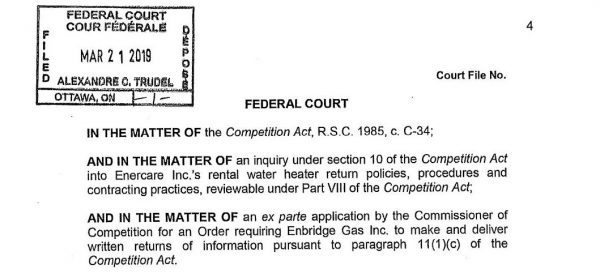
The Competition Bureau is expanding a probe of sales practices in home water heater rentals. The investigation has been ongoing since 2012. The Bureau in Federal Court asked that Enbridge Gas Distribution Inc. disclose contracts and fees: “We don’t think people should be locked into rental agreements.”
Dep’t Bought Huawei Plan
Foreign Affairs is the only federal department to buy a Huawei internet plan, accounts show. Staff did not explain the purchase dating from 2016, prior to the Vancouver arrest of a Huawei executive that led to Canadians’ detention in China and a billion-dollar trade dispute: “The Chinese government arrests people to use as bargaining chips.”
A Sunday Poem: “Spectrum”
Changes are coming
to Ontario’s autism program.
Families will get $20,000 a year
for children 5 and under,
$5,000 for youth 6-18.
But parents say
intensive therapy could reach $80,000.
The Social Services Minister,
and the Premier,
appear detached.
As though in their own world.
(Editor’s note: poet Shai Ben-Shalom, an Israeli-born biologist, examines current events in the Blacklock’s tradition each and every Sunday)
Review: 300 Yrs Of Fornication
Canadians don’t think of themselves as some of the most liberal people on earth, but we’re pretty close: gay marriage, nude theatre, cuss words in Parliament, no social aristocracy of any kind, and every liquor store has an ample parking lot.
When former Attorney General Vic Toews left his wife to take up with a younger woman he not only escaped shunning – Toews was appointed a judge – his friends said they were shocked, shocked anyone dare read Toews’ divorce papers, though they are public documents. This does not happen in America.
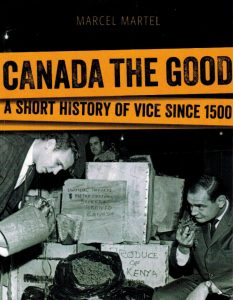
Our uniquely Canadian concept of liberty and vice is documented by Professor Marcel Martel of York University’s Department of History. Canada The Good is a sweep through three centuries of gambling, drinking and fornication. There emerges a kind of consensus that Canadians should be let alone to do what they want in the privacy of their homes.
When Parliament held an 1898 plebiscite on prohibition a majority voted to ban booze, and MPs promptly ignored the result. In Catholic Québec and New Brunswick, liquor was never much restricted. In Protestant Ontario and Alberta, dry laws were so successfully enforced the crime rate fell. It seemed everybody was happy.
“How should society prevent or reverse the disintegration of morality?” writes Martel. “Moral reformers considered various means for slowing down and hopefully reversing the degeneration process. Through their churches, they encouraged people to change their behaviour. According to Protestant morality, everyone should practice self-restraint.”
Martel’s research is delightful. Who is not wiser on knowing Canada’s first lottery was licensed in 1732, or that Confederation-era Halifax had 600 working prostitutes, or that Parliament’s 1869 Act Respecting Vagrants targeted any “night walker wandering in the fields…not giving a satisfactory account of themselves.” They just don’t write Acts like that anymore.
Canada The Good delves into the roots of much of the anti-vice law that persisted until cannabis was legalized in 2018. If the country maintained a “repressive anti-drug agenda”, as Martel puts it, the source dated from a 1908 debate in the House of Commons that resulted in Canada becoming one of the first countries to criminalize the sale of opium under threat of hard labour.
Also striking is how much of our historic campaign against wickedness reflects the character of one man, John Thompson, the justice minister who wrote the first Criminal Code in 1892. Professor Martel does not profile Thompson, though his story is documented elsewhere.
A rum-drinking Catholic with nine children and a hearty laugh, Thompson wrote the Code to reflect a world that long lingered in our criminal law. Alcohol was nobody’s business, homosexuality and birth control were outlawed, the public humiliation of stocks and pillories was abolished, and spanking children was okay if done in the home.
“The regulation of vice has changed over time,” notes Martel. “This should give us pause for reflection.”
By Holly Doan
Canada The Good: A Short History Of Vice Since 1500 by Marcel Martel; Wilfrid Laurier University Press; 210 pages; ISBN 9781-5545-89470; $29.99
Eye Mandatory Rights Panels
Parliament should mandate human rights committees in federally-regulated workplaces, the Canadian Labour Congress said yesterday. The Congress in a report said panels would combat “group hatred” against Muslims: ‘They are not asking for special treatment.’
Enviro Review List Is Secret
Federal regulators have drafted a secret list of projects subject to new environmental reviews, the Senate energy committee was told yesterday. The list is so secret even the Manitoba cabinet can’t see it, said the province’s Trade Minister Blaine Pedersen: “Surely to goodness between governments we can share this.”
Not Fair, Say Broadcasters
The Canadian Association of Broadcasters yesterday protested federal payroll subsidies for local newspapers are unfair to private TV and radio newsrooms. Cabinet proposes to spend up to $95 million a year on direct grants to dailies deemed reliable by a government-appointed panel: “Who is to say that print is more important?”
Star Contract Questioned
Conservative MPs on the Commons government operations committee seek a hearing on a 2018 federal contract to pay the Toronto Star to cover parliamentary committees. The contract was cancelled after the Procurement Ombudsman intervened.
“Much like the National Post is supportive of the Conservative Party, the Toronto Star is a known mouthpiece for the Liberal Party,” said Conservative MP Kelly McCauley (Edmonton West): “It plays into the controversy of the government putting aside $595 million of taxpayers’ money towards a media bailout.”
A federal agency, the Office of the Superintendent of Financial Institutions, last October 25 approved a sole-sourced contract to pay a Torstar Corporation subsidiary iPolitics INTEL to attend public meetings of the Senate banking and Commons finance committees. Staff said only the Star was “capable of performing the work” though 43 other news organizations are accredited to cover Parliament Hill committees. Hearings are open to the public.
“Government should not be sole-sourcing contracts without a specific reason, and there are legit reasons – something like Microsoft,” said MP McCauley. “The product’s not available from anyone else, there’s only one company to do the business, etcetera.”
The contract was cancelled December 5 following Blacklock’s complaint to the Procurement Ombudsman. Cabinet in an Inquiry Of Ministry tabled in the Commons said the contract was worth $71,190 and not $355,950 as originally reported, and acknowledged a total 80 employees already monitor parliamentary committees on behalf of 21 federal departments and agencies.
“What was the original purpose of the contract?” said MP McCauley. “Which minister initially approved the contract? Does the government have enough employees to monitor parliamentary committees without hiring the Toronto Star?”; “I have to wonder why we would sole-source the Toronto Star to do this work when there are private media people out there who could have easily done that,” said McCauley.
Notice of the contract was issued fifteen days after Torstar Corporation chair John Honderich published a commentary appealing for federal subsidies. “I think we’d prefer some real action on these files,” wrote Honderich. Torstar Corporation lost $31.5 million last year, according to public filings.
The Commons committee adjourned without voting on McCauley’s motion to investigate circumstances surrounding the contract. Liberal MPs indicated they would not support it.
Cabinet in its March 19 budget proposed a $595 million, five-year newspaper bailout including payroll subsidies for dailies deemed to meet unspecified journalistic standards. Criteria were not detailed.
By Staff
Senate Likes Disability Bill
The Senate yesterday gave Second Reading to a cabinet bill on accessibility, and referred it to hearings of its social affairs committee. The Commons passed the bill unanimously last November 27 though MPs noted it will not take effect for years even if it becomes law: “No one group should have to fight to enjoy the full rights of citizenship.”
37% Say Too Many Foreigners
A growing minority of Canadians complain the country is letting in too many immigrants, says in-house research by the Department of Immigration. More than a third of Canadians surveyed, 37 percent, said too many immigrants are coming to Canada. The rate was 26 percent in a 2014 department poll: ‘Attitudes are very important.’