
Federal regulators have privately polled Canadians on whether to charge companies for clean-up of plastics. In-house focus groups commissioned by the Privy Council Office asked: ‘How would you feel about legislation to make companies responsible for damage?’
Monthly Archives: February 2020
Gov’t Hiked Ad Budget 49%
Federal agencies hiked pre-election advertising last year by 49 percent, says a Treasury Board report. Spending on Canadian newspaper and magazine ads increased but remains a fraction of ad buys with Facebook, Google and other U.S. social media corporations: “It seems to be going south.”
Spent $3.1M On Pharmacare
The Department of Health has spent $3.1 million to date on an unannounced pharmacare plan, according to records. Most spending went for production of a 2019 report that recommended Parliament offer free life-saving medication like cancer drugs by 2022: “These figures are approximations.”
Probe Targets Chemical Firms
Federal anti-trust investigators have opened a mammoth probe of the nation’s largest farm chemical manufacturers accused of targeting a start-up discounter. Records in the case include an email from a Winnipeg executive with Univar Canada Ltd. who wrote suppliers: “If anyone thinks socialism is going to feed the world just call Russia.”
Tax Cut Worth $90 This Year
A federal tax cut billed as significant savings for middle-class Canadians is worth $90 this year, the equivalent of $1.73 a week, says the Parliamentary Budget Office. Prosperity Minister Mona Fortier suggested taxpayers use the proceeds to buy food: “Buy healthy food, send kids to camp.”

Senator Talked Back In Class
The Senate ethics committee recommends Senator Lynn Beyak be suspended again for talking back in sensitivity training class. Beyak was awarded an Indigenous Awareness certificate but remained a poor student, said an instructor: ‘I want to move forward and not be stuck in the past.’
Orders Water Bottle Boycott
Environment Minister Jonathan Wilkinson has told department employees to lead by example on plastic waste by boycotting bottled water. Records show other federal departments bought water by the caseload: “More needs to be done within government.”
Lawyers A “Violence Risk”
The Department of Justice has hired consultants at $166,337 to conduct internal “violence risk assessments” among staff. Attorney General David Lametti told the Commons the investigations involved lawyers’ offices in two cities: ‘There was a workplace violence complaint.’
Asian Jibes No Cause To Fire
A federal labour arbitrator has overturned the firing of an Air Canada flight attendant for hurtful remarks to an Asian coworker. The words were unpleasant but not worth termination, said the ruling: “You must live in Markham.”
Book Review: High Noon At Lakeside
One day in 2004 two co-workers – one black, one white – had an unpleasant physical alteration at a slaughterhouse in Brooks, Alta. The black man was fired. About 200 Sudanese employees protested the wrongful dismissal. “Management told them, go back to your jobs or we’ll fire you,” one witness recalled. They refused. Sixty were fired.
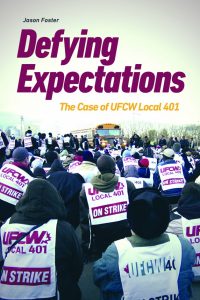
The incident set in motion an extraordinary series of events documented in Defying Expectations by Prof. Jason Foster of Athabasca University. Foster is a former policy director with the Alberta Federation of Labour, and a skillful writer whose account reads like a screenplay. The Brooks plant was the least promising candidate for a union drive anywhere in Canada. Merely posting an NDP lawn sign was an act of bravura.
There was no “eureka moment”, writes Foster. Local 401 of the United Food & Commercial Workers union was a “grocery store local” facing long odds in organizing industrial workers who didn’t speak English, in a province with an 11 percent private sector unionization rate, with an employer, Tyson Foods, so unfriendly to labour it posted a banner outside the Brooks plant that read, “Proudly Union-Free”.
“The Lakeside strike was no ordinary strike,” writes Foster. “The plant is located in Brooks, a sleepy southern Alberta town previously known for cattle and oil well servicing and deeply entrenched in Alberta’s conservative rural culture. The employer, Tyson Foods, was virulently anti-union and had fought hard for two decades to keep the plant union-free.”
Local 401 had no time for fine speeches and excellent PowerPoint presentations on long-term sectoral trends. “Perhaps they were too busy fighting immediate battles,” Foster explains. The president of Local 401, then and now, is Douglas O’Halloran, a combative former meatpacker. On gaining the presidency in 1989, he was handed elegant business cards identifying him as CEO of the local. “Fuck that,” said O’Halloran. “Get me new cards.”
The UFCW tried for years to organize the Lakeside plant from 1992 and “almost annually after that” with failed membership drives in 1999, 2000, 2001 and 2002. “If the drive got to a vote the results were rarely close,” writes Foster. “The company waged aggressive counter-campaigns, using tactics that included threats and intimidation.”
The successful 2005 drive was gritty. Management ploughed makeshift roads through surrounding fields to bus replacement workers through a back gate; O’Halloran was injured in a high-speed chase with plant managers determined to serve him with Court papers; and African and Asian strikers had everything to lose. Many were refugees who’d slept in trailers outside the plant. “The immigrants had nowhere to go,” a union staffer recalled.
This tale of the Lakeside strike is riveting, too easily caricatured as black-and-white conflict in a small Prairie town with a fighting Irish union man and desperate immigrant jobseekers. It is much better than that. “I can do anything for union because my soul is with them,” the author quotes one Lakeside worker, speaking in broken English. “I am closer with them than my family.”
By Holly Doan
Defying Expectations: The Case of UFCW Local 401, by Jason Foster; Athabasca University Press; 195 pages; ISBN 9781-7719-91995; $34.95