
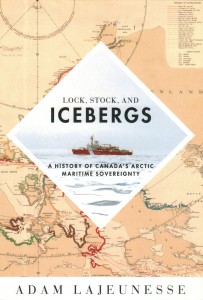
Review: Ice-Land

Parliament claims ownership of every rock and iceberg in the Arctic, just as the Beijing Politburo claims every island in the South China Sea. True, Norwegians were the first to travel the Northwest Passage. And American submarines have secretly sailed through Arctic waters since 1958. And Russians have been planting flags at the North Pole since 1962 – but the idea is stuck fast. We pretend to own the Arctic, and the world pretends to care.

Unlike the People’s Daily, Canadians are capable of critical self-analysis of nationalistic land claims – which brings us to Lock, Stock and Icebergs, a fresh look at our stake in the unspoiled North. Author Adam Lajeunesse of the University of Waterloo in meticulous research points out how tenuous our Arctic “territorial integrity” is, and how haphazard Parliament has been in enforcing it.

Consider a case of murder.

In 1970 two U.S. Navy contractors working at an American weather research station on a polar ice flow called Fletcher’s Island quarreled over 15 gallons of homemade raisin wine. Researcher Mario Escamilla shot and killed his co-worker. The murder occurred 200 miles west of Ellesmere Island, in Canadian waters.

Canada’s foreign ministry learned of the shooting two weeks after the fact and produced this tepid memo uncovered by Lajeunesse: “Fortunately the press has not yet raised the question as to whether or not criminal jurisdiction in this case rests with Canadian or American authorities…It has been agreed that for the time being any inquiries from the press would be answered by indicating the Canadian government is aware of the case and that officials are examining all aspects of the question.”

The killer was tried and convicted in a Virginia court.  Escamillo’s lawyers argued prosecutors had no jurisdiction since the killing took place outside the U.S. The Department of External Affairs sent a milquetoast note explaining while it “continues to reserve its position on the question of jurisdiction,” Canada would not press the point. The result was “laughter in the courtroom,” a Canadian diplomat wrote: “Fortunately for Canada the Escamilla case was a relatively isolated incident.”

“What exactly did Canada have, or think it had?” writes Lajeunesse. “With regard to the Arctic lands, the answer was ‘everything’. All lands north of 60, east of Alaska and west of Greenland including every island of the Arctic Archipelago, discovered nor not, were considered Canadian. The justification for Canadian ownership over these lands varied over the decades but the essential fact remained: the government was intent on staking and maintaining its claim to the entire region. With regard to the Arctic waters, however, the question of ownership was far less certain.”

Reading Lajeunesse’s work recalls a snippet of dialogue from the 1981 film Gallipoli, in which a farm boy off to fight the Germans encounters a lone prospector in the fly-specked Great Australian Desert:

  • PROSPECTOR: “Can’t see what it’s got do with us.”
  • BOY: “If we can’t stop ‘em there, they could end up here.”
  • PROSPECTOR (scanning the wasteland): “And they’re welcome to it.”

Lock, Stock and Icebergs notes our northern jingoism is now part of Canada’s cultural narrative. When the U.S. Coast Guard icebreaker Polar Sea sailed the Northwest Passage in 1985 “in a perfectly friendly cooperative spirit,” critics howled. It was “part of the cronyism between Brian Mulroney and the Americans,” said then-Liberal leader Jean Chretien. The Montreal Gazette called it “a major flop by a spineless government” that was “enough to enrage even a lukewarm Canadian nationalist.”

Lajeunesse is an honest chronicler of our claim to an icy empire. “No country is actively challenging Canadian sovereignty,” he writes; “In large part, this tranquility is due to global indifference. Climate change and resource development have attracted global attention to the region, but few nations outside of the Arctic states themselves have had much vested interest in the area.”

By Holly Doan

Lock, Stock and Icebergs: A History of Canada’s Arctic Maritime Sovereignty, by Adam Lajeunesse; University of British Columbia Press; 420 pages; ISBN 9780-7748-31093; $34.95

We Charity Uproar In Senate

The Senate last night erupted in protest after a legislator called Prime Minister Justin Trudeau a bribe-taker. Sharp words came during debate on a motion to investigate federal funding for We Charity: “I’d be more than happy to see him in a court of law.”

This content is for Blacklock’s Reporter members only. Please login to view this content. (Register here.)

Travel & Publicity Cost $1.5M

Infrastructure Minister Catherine McKenna in a report to Parliament said a federal bank created to finance public works instead spent more than $1.5 million on travel and publicity. Two-thirds of the Canada Infrastructure Bank office budget went to salaries and benefits: “We were expecting to see roads, bridges.”

This content is for Blacklock’s Reporter members only. Please login to view this content. (Register here.)

Bank Pays $500,000 Penalty

Federal regulators yesterday disclosed the Bank of Montreal paid a $500,000 fine for misconduct in the sale of credit card insurance. The Bank had appealed to keep the matter private: “I note this issue came to light as a result of a customer complaint.”

This content is for Blacklock’s Reporter members only. Please login to view this content. (Register here.)

Admit ‘Leakage’ In Web Tax

The Canada Revenue Agency yesterday said it expects “some” tax-dodging under a proposal to charge the GST on e-commerce. “We always have some compliance challenges,” Revenue Commissioner Bob Hamilton told the Commons public accounts committee: “There is always some leakage in the tax system.”

This content is for Blacklock’s Reporter members only. Please login to view this content. (Register here.)

Air Sector Buried In Debts

Canadian airports will take on $2.8 billion in debt with a disastrous decline in passenger revenues, the Commons transport committee was told yesterday. Cabinet has extended airport rent relief, though the industry said it was in no position to pay rents in the first place: “The outlook is bleak.”

This content is for Blacklock’s Reporter members only. Please login to view this content. (Register here.)

Kenya Investment Lost $51M

A Kenyan door-to-door sales company that received federal subsidies lost more than $50 million on business operations, records show. The Canadian agency that approved the funding yesterday defended it as a good investment: “It has high potential.”

This content is for Blacklock’s Reporter members only. Please login to view this content. (Register here.)

CBC A “Make-Work Project”

CBC-TV has become a $1.3 billion-a year “make-work project,” a Senator yesterday told the Chamber. The network in a Second Quarter Financial Report said it was facing program cuts after TV ad revenues fell nineteen percent in six months: “The CBC is producing programming Canadian taxpayers are not watching and don’t want.”

This content is for Blacklock’s Reporter members only. Please login to view this content. (Register here.)

Spent $2M On Sneeze Guards

Federal agencies spent millions on sneeze guards and plexiglass shields amid conflicting advice from the Public Health Agency on whether to wear masks. Dr. Theresa Tam, chief medical officer, has now recommended Canadians open windows as a pandemic precaution: “You have to be careful.”

This content is for Blacklock’s Reporter members only. Please login to view this content. (Register here.)

Challenge “Toxic” Plastic Ban

Environment Minister Jonathan Wilkinson yesterday vowed “aggressive action” in blacklisting plastics as toxic. MPs on the Commons environment committee questioned the impact on everyday products from baby bottles to intravenous tubes: “This is going to be extremely complicated.”

This content is for Blacklock’s Reporter members only. Please login to view this content. (Register here.)

Suspended For Pot At Work

A Saskatchewan labour panel has upheld a ten-day suspension for a grocery store clerk suspected of smoking marijuana at work. Labour boards nationwide have issued mixed rulings on cannabis use since Parliament legalized it in 2018: “This is serious indeed.”

This content is for Blacklock’s Reporter members only. Please login to view this content. (Register here.)

11,000 Passenger Complaints

Airline passengers owed billions for pre-paid tickets on cancelled flights have the choice of accepting vouchers or “nothing at all,” says a federal regulator. Members of the Commons transport committee yesterday accused the Canadian Transportation Agency of bending rules to save airlines from refunding cash payments to customers: “I wonder how you can possibly construe this as a fair situation.”

This content is for Blacklock’s Reporter members only. Please login to view this content. (Register here.)

Covid Furloughs Now $1.1B

Paid pandemic furloughs for federal employees who were neither sick nor working from home have now cost $1.1 billion, the Parliamentary Budget Office said yesterday. Analysts estimated 113,362 staffers took time off at full pay and benefits averaging $481 a day: “We’ve made sure to take care of our employees.”

This content is for Blacklock’s Reporter members only. Please login to view this content. (Register here.)

CBC-TV Ad Crash Continues

CBC-TV ad revenues continue a historic collapse, falling nineteen percent in six months. CEO Catherine Tait said programming cuts are contemplated despite record subsidies: “We need the public to feel safe and to know that we are a beacon for truth.”

This content is for Blacklock’s Reporter members only. Please login to view this content. (Register here.)



