
Cabinet should suspend the carbon tax on farmers, food processors and retailers, the Commons agriculture committee was told yesterday. Long term impacts of higher fuel charges compared to U.S. competitors are unknown, said the senior director of Dalhousie University’s Agri-Food Analytics Lab: “That is why I am recommending a pause on the carbon tax for the entire food industry from farm gate to stores and restaurants.”
Monthly Archives: February 2024
Find Bitcoin Buyers’ Remorse
Bitcoin traders’ enthusiasm for cryptocurrency is fading, says in-house Canada Revenue Agency research. Pollsters blamed “media portrayals” and wild price fluctuations: “Results suggest media portrayals of cryptocurrencies have led to an erosion of consumer confidence.”
Secret Report Alleges Bribery
A confidential federal report alleges bribes were paid in the $54 million ArriveCan program. Conservative MP Larry Brock (Brantford-Brant, Ont.) yesterday read portions of the confidential document into the record of the Commons government operations committee as Liberal MPs expressed astonishment: “Wow,”
Feds Go Slow On Labour Bill
Cabinet will not speed passage of a landmark bill to ban use of replacement workers in the federally regulated private sector, Labour Minister Seamus O’Regan said yesterday. His remarks followed one MP’s prediction the bill will never become law before the next election: “We are taking our time.”
Won’t Itemize GG’s High Life
Cabinet is rejecting an all-party demand for more public accounting of Governor General Mary Simon’s expenses. Spending at Rideau Hall jumped 11 percent last year to $37.6 million: “The Governor General has shown a lack of respect for taxpayers.”
Dep’t Cites 56 For Misconduct
The Department of Foreign Affairs reprimanded 56 employees for wrongdoing last year, according to new records. Proven allegations ranged from bid-rigging to nepotism: “Fear of reprisal and a belief that complaints do not make a difference are consistently the top reasons why employees do not report bad behaviour.”
Military Attrition Up To 19%
The military is losing thousands of volunteers to attrition, new figures show. Regular members who quit the Canadian Armed Forces outnumbered new recruits by as much as 19 percent in the past three years: “We’ve actually seen greater attrition.”
Memos Verify MP’s Warning
China inquiry documents confirm accounts by ex-Conservative MP Kenny Chiu (Steveston-Richmond East, B.C.) that he was likely targeted by Communist Party agents in the 2021 campaign. Liberal MPs had ridiculed Chiu’s story as a “Trump-like tactic to question election results.”
Can’t Discuss Every Incident
Public Safety Minister Dominic LeBlanc in testimony at the China Inquiry would not commit to full disclosure of illegal conduct by foreign agents. “We are not going to publicly confirm the veracity of what appeared in some media articles,” said LeBlanc.
Paid For Advice On Homeless
A federal homeless relief program paid millions to consultants, documents show. Overall spending on consultants jumped 13 percent last year despite cabinet’s promise to cut spending on consultants: “This is not about doing more with less.”
List Campuses By Foreigners
The Department of Immigration issued study permits to 982,880 foreign students last year, new records show. The department for the first time listed Canadian universities and colleges with the highest number of foreign students ahead of looming cuts to permits: “There are clearly some institutions that shouldn’t exist.”
MPs Demand Crime Busters
MPs are demanding Prime Minister Justin Trudeau detail a financial crime-busting program he promised three years ago. Creation of the Canada Financial Crimes Agency was first proposed in the Liberals’ 2021 re-election platform: ‘It is Canada’s first ever nationwide Agency to investigate these highly complex crimes.’
‘Hand that Holds the Camera’
The Canadian Space Agency
presents pictures from above
in celebration of
Canada Day.
I look closely.
They resemble views of Earth
offered for free
by satellite-imaging services.
Taken by the commander
of the International Space Station
is what makes them special,
I presume.
By Shai Ben-Shalom

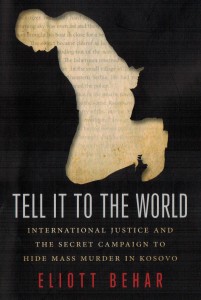
Review: One Cold Morning In Kosovo
In spring 1999 a paramilitary group called the Scorpions descended on Podujevo, Kosovo, a mid-sized city the size of Medicine Hat. Albanians were rounded up. It was a cold morning and one small boy named Shpetim, age 9, jammed his hands in his pockets to keep warm. The gesture seemed to irritate the gunmen.
They ordered Shpetim to empty his pockets and out tumbled the boy’s collection of marbles – plunk, plunk, plunk. The boy’s mother, unsure of what to do, bent down and tried to gather them up as they scattered, writes Eliott Behar. Later they shot Shpetim in the head.
Behar is a former Ontario Crown prosecutor who recounts his two years’ work as a war crimes attorney at The Hague. Behar was raised in Toronto, the son of an architect. His family numbered Holocaust survivors. He is a skillful writer with a police reporter’s eye for detail.
“Spend time listening to the men who directed these atrocities, and listen to the collective narratives and beliefs of the citizens who either carried out these acts or endorsed them from the sidelines, and you begin to see that they were themselves, even before the bloodshed began, driven to act by their own sense of injustice and victimhood,” Behar writes. He spent so much time listening to chain-smoking witnesses, Behar notes his Court robes always faintly smelled of Kosovar tobacco.
All participants in genocide are “in thrall to narratives of injustice and victimhood that made them feel entitled to act as they did, and that seemingly silenced the demands of their individual consciences,” writes Behar. “It is a mentality with the power to infect not just the leadership but also the facilitators and willing executioners amongst the general population.”
Canada was oblivious to the viciousness of civil war when it committed forces to the 1999 NATO bombing of Serbian cities. Few Canadians could spot Belgrade on a map. Fewer still had any nuanced understanding of the ancient and justifiable hatreds in the region. “I have no politics,” a Serbian friend once told me. In the Balkans, politics are fatal.
The facts: The Serbian cabinet in 1999 devised a secret plan to roust 800,000 civilians, mainly Muslim, from their Kosovar villages, and later attempted to cover it up. The expulsions were “forced, well-coordinated and part of a systemic campaign,” notes Tell It To The World. The chief architect, former Yugoslav president Slobodan Milosevic, died of a heart attack at trial seven years later: “It was, to be sure, a striking and disappointing anti-climax,” Behar writes. “No factual findings were ever made and no verdict was ever delivered.”
Milosevic’s interior minister shot himself before he could be brought to trial. A deputy prime minister was sentenced to 22 years. Yes, there were atrocities on both sides, and Serbians as a people were not collectively complicit in atrocities. It was a Serbian newspaperman who first uncovered the conspiracy, and Serbian parliamentarians who provided much of the evidence against Serbian murderers.
“Crimes had taken place on all sides of the conflict and many Serbs had also been victims themselves – victims of violence by Croats, by Bosniaks and by Kosovo Albanians,” Behar writes. “But it was also true that the mass murders and deportations I had described had happened, and that they had been directed and overseen by Serbian authorities. The evidence was clear.”
In a town called Suva Reka, a police constable Velibor Veljkovic remembered the day orders came to round up Albanians. Police went down the street, shooting terrified townspeople. Veljkovic had been on traffic detail and IT records storage, but this day his assignment was to collect the corpses of the police department’s victims – more than a hundred, he recalled. The mayor supervised the work.
Back at the station, Veljkovic returned to his desk when the phone rang. A distraught Albanian woman was on the line: “I told her they had to leave. She asked me where to, and I told her to Albania. She asked me, ‘What are we going to do in Albania?’ I didn’t want to continue this conversation. I simply said, ‘Go to Albania; you have to leave otherwise you will suffer the fate of the other ones’”; “I hung up and within half an hour there was an en masse departure of members of the Albanian community by vehicles.”
“There was no more killing. People simply left. We resumed our work,” Veljkovic explained. For a town constable in Suva Reka, public duties now included traffic tickets, IT management, murder.
Tell It To The World is a haunting and poignant and remarkable book. To read it is to gain some greater understanding of humanity.
By Holly Doan
Tell It To The World, by Eliott Behar; Dundurn Press; 264 pages; ISBN 9781-4597-23801; $24.99
Found Millions For Wellness
Health Minister Mark Holland approved a multi-million dollar “wellness” program for department employees stressed by their job. Holland disclosed the in-house health care expenditure in a report to Parliament: “Topics covered during sessions include how to prevent burnout.”