
Commons scrutiny of the purchase of a luxury Manhattan penthouse for New York Consul Tom Clark follows audits showing Department of Foreign Affairs’ real estate holdings jumped 25 percent since 2017. Auditors faulted the department for poor management: “Property infrastructure is subject to public scrutiny.”
Monthly Archives: August 2024
First Data On Military Deaths
The Department of National Defence for the first time acknowledges above-average suicide rates in the armed forces, typically involving women volunteers. New data show it was unrelated to service in combat: “There weren’t many who had a history of deployment.”
Empathy Training For Staff
Service Canada, the federal agency that manages Employment Insurance, yesterday said it is hiring consultants to guide employees in “how to manage emotions” and “develop empathy and listening skills.” No budget was disclosed: “Recognize your triggers.”
Warn Of Dirty Cash In Realty
Canadian real estate continues to attract dirty money, says a federal agency. The group in an Operational Alert urged caution over suspicious dealings like flipping titles to unbuilt condominiums: “Some realtors look the other way.”
Told Aboriginal “Boneheads” To “Get A Job”: New Senator
Liberal Senate appointee Charles Adler in a radio broadcast called Indigenous people uncivilized “boneheads” who should “get a job.” Adler’s remarks on Radio CJOB Winnipeg were so vulgar they prompted a formal complaint by the Assembly of Manitoba Chiefs, records show: “No shit, Sherlock.”
Disgraced Diplomat Resigned
A disgraced Canadian diplomat has abruptly resigned while under investigation, the Department of Foreign Affairs confirmed. The executive faced firing for lewd misconduct at the office: “Our ultimate goal is to foster a culture of zero tolerance for bad behaviour of any kind.”
I Am Not To Blame, Says Saks
Addictions Minister Ya’ara Saks’ office in a briefing note it is “inaccurate to claim” its decriminalization of cocaine and opioids is to blame for an increase in overdose deaths in British Columbia. Coroners’ data show deaths increased 16.5 percent in the period of decriminalization: “It is inaccurate to claim this exemption is the cause.”
Expand $239M Graves Fund
Cabinet is expanding a multi-million dollar fund to document claims thousands of children died in Indian Residential Schools. It acknowledged First Nations complaints a $500,000 limit per grant application was insufficient: ‘We are committed to finding the children.”
$204.4M For Volunteer Corps
A federal program to have young Canadians “give more back to their communities” has cost $204 million to date, records show. Cabinet launched the Canada Service Corps six years ago “to support a vision of Canada.”
Poem: “Green Bin Program”
Could have put this banana peel
in the Green Bin,
let it go
to the city plant
where it decomposes in four weeks.
Releasing much carbon dioxide
into the air.
Instead,
I drop it
into the garbage bin.
Now it goes to the landfill
where it will stay
for forty years.
Giving us time
to figure out
what we do with all that carbon
we carelessly pump
into the atmosphere;
all that garbage
we mindlessly pile
in landfills.
By Shai Ben-Shalom 
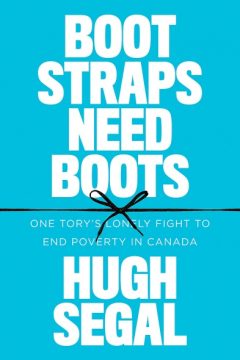
Review: Life By The 40 Watt Bulb
Poverty makes people work hard just as being chased by a bear makes people run fast, but only a sadist would recommend either as a character-building exercise. A million Canadians work two jobs and sixty-hour weeks, by official estimate. The late Senator Hugh Segal recounted this drudgery in his own childhood memories of Mother and Father pulling night shifts to pay the rent in a cramped world lit by 40-watt bulbs.
“Being on the cheery edge of poverty is not, as some bootstraps proponents assert, about building character and ambition,” wrote Segal. “It is about understanding that the financial insecurity at the centre of your existence, once installed in your memory bank, never leaves.”
The Segals were working poor, cabbies and garment salesmen and drugstore clerks. They ate meat and Hugh had his own bedroom in their Montréal walk-up. Segal recalled a prized bottle of Crown Royal saved for extraordinary occasions. No one took a vacation. The bailiff repossessed their car.
Young Hugh remembered the time his older brother caught hell for taking the two of them to a carnival for the day. Working poor never ask, “What would you like to do today?” Every day is like the last.
“I realized poor people had far fewer choices than everyone else,” he wrote. “That money pressures took their toll: on relationships, on outlook, on day-to-day life, on parental harmony, on future prospects.”
Boot Straps Need Boots is a great Canadian memoir of a poignant Canadian experience recognizable to millions. And it is more than that. Segal recalled as a 12-year old the day Prime Minister Diefenbaker spoke to his school assembly. Diefenbaker had a way of mesmerizing schoolchildren. “The family table we call Canada is the finest table in the world,” said the Prime Minister. “There is space and food for all.”
Here Segal comes to the point of Boot Straps, a plain argument for a national guaranteed income program. This has been the policy of the Canadian Labour Congress for fifty years. “Not trying something different – not even attempting to see if poverty can be alleviated in a more humane and efficient way – is a very serious mistake,” he wrote. “The only thing worse than a bias shaped by poor expectations about low-income citizens and their prospects is a sense of complacent defeatism about how, as a mature and productive society, we can reduce poverty and its impact.”
Successive governments endorsed direct federal aid to working people who are hard up, albeit in a piecemeal approach. Parliament in 2016 introduced the Canada Child Benefit that paid low-income parents $6,946 per child. Parliament also charges the working poor GST on home heating and parkas, levies corporate income tax on the smallest of small business, and in 2018 passed a carbon tax that pays an identical rebate to all tax-filers whether you are a billionaire who winters in Florida, or a single mother who shuttles 200 kilometres a week to a job at Walmart.
Boot Straps Need Boots appeals for a reasoned approach, a reconsideration of all scattered aid programs into one coherent, universal guaranteed income plan. In this minority Parliament, the proposal has friends.
By Holly Doan
Boot Straps Need Boots, by Hugh Segal; University of British Columbia Press; 216 pages; ISBN 9780-7748-90458; $32.95
Quadrupled Budget For Clark
A new luxury Manhattan penthouse for New York Consul Tom Clark cost taxpayers four times the expense of renovating the apartment used by his predecessors, records show. Clark is testify next week at the Commons government operations committee over the multi-million dollar purchase that outraged MPs: “How did that purchase come to pass?”
23% Up Against It: StatsCan
Almost a quarter of Canadians are so hard up they expect to eat at the food bank this fall, Statistics Canada said yesterday. The rate was higher than reported during the pandemic: ‘This is the first time in 40 years we have seen unemployment so low and food bank usage so high.’
Get Back To Basics: Poilievre
Media under any future Conservative cabinet must forego federal aid and rely on private revenue as they did for centuries, says Opposition Leader Pierre Poilievre. His remarks yesterday were quoted in an interview with a subsidized weekly: “Sell subscriptions and advertising, get sponsorships and do what media have done for, I don’t know, 3,000 years.”
Offices Already 40% Empty
Federal office buildings were 40 percent empty even before the pandemic sent 240,000 employees to work from home, says a briefing note to Public Works Minister Jean-Yves Duclos. Cabinet has proposed selling half its office buildings nationwide but expects it will take decades: “Infrastructure is the second largest expense to the Government of Canada after salary expenses,”



