
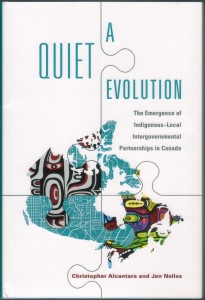
What do municipalities and First Nation reserves have in common? Both are used to being told what to do. It’s natural, then, that any review of Indigenous self-government would examine how these two get along at the most elemental level. A Quiet Evolution is the first research of its kind, and prompts the reader to wonder why nobody thought of this before.
It turns out relationships between cities and reserves can be petty or profound. Human, in other words. If Parliament ever settles outstanding land claims and accepts Indigenous property rights nationwide, it would look something like this.
“It would be easy to conclude that the Indigenous-Crown relationship is almost entirely adversarial and problematic,” authors write. “While this pessimism is certainly pervasive and somewhat justified, given Canada’s history of colonialism, a much different story seems to be unfolding at this local level.”
Co-author Christopher Alcantara is a political scientist at Western University. Jen Nelles is a visiting professor at Hunter College. They examined the fine print in local agreements between cities and First Nations, some 332 of them. “Willingness is key,” they write.
Some contracts are plain and practical. In Kamloops, B.C., the local band paid the city $437,000 a year plus overtime to contract fire protection for its 1,410 property owners. Economic self-interest makes for good neighbours, notes Quiet Evolution: “Indigenous and municipal authorities typically govern with relatively few resources particularly outside of the larger cities and settlements. Where local and Indigenous authorities have discretionary funds to support joint projects, cooperation will likely be easier to establish.”
Other relationships go deeper and are “much more interesting,” authors write. In the Québec municipality of Les Basque on the St. Lawrence River, councilors reached agreement with nearby Algonquians for joint property management specifically to ward off private ownership of prime lands. Each agreed to ante $120,000 and work it out. They did.
In Elliot Lake, Ont., the municipality had an agreement with the Serpent River First Nation on heritage planning and joint lobbying of the legislature. In The Pas, Man., they shared costs of the local hockey team with the Opaskwayak Cree Nation. In Cape Breton, N.S., the regional municipality reached agreement with Membertou First Nation to build a highway and hotel on Indigenous lands.
“While national and provincial media publications are filled with stories of conflict, contention and demands, many Indigenous and local governments are quietly engaging in what seems to be highly productive and beneficial intergovernmental partnerships,” authors conclude.
The formula is not foolproof. “Rightly or wrongly, history has the potential to be a powerful barrier to cooperation,” Quiet Evolution cautions.
In Sault Ste. Marie, Ont., authors identified a grudging relationship between municipal managers and the local Garden River First Nation three kilometres outside of town. Former Buffalo Sabres head coach Ted Nolan is from Garden River. He used to coach the Sault Ste. Marie Greyhounds.
Ratepayers privately grumbled about First Nations residents, and authorities refused to run a municipal bus route through the reserve when nobody could agree on how to pay for it. One Sault planner complained without irony that First Nations are bureaucratic. “The people you’re dealing with are not the people who have the ability to agree or disagree,” he sighed.
Quiet Evolution provides a glimpse of a future in which Indigenous communities are partially self-governing economic units, like a thousand other towns. Some are good, and some are just good enough. It’ll work.
By Holly Doan
A Quiet Evolution: The Emergence Of Indigenous-Local Intergovernmental Partnerships In Canada, by Christopher Alcantara and Jen Nelles; University of Toronto Press; 159 pages; ISBN 9781-44262-6775; $32.95




