
War in the Middle East “is an opportunity for us,” Natural Resources Minister Tim Hodgson said yesterday. Speaking to reporters, Hodgson said while violence was distressing it could be good for exports: “Wow, Canada’s got its act together.”
Monthly Archives: March 2026
Voter Turnout Tells The Story
Women over 65 were the most enthusiastic voters in the 2025 general election with 77.6 percent turnout, new Elections Canada data showed yesterday. Young men under 24 had the lowest turnout, 53 percent, despite a social media campaign targeting campuses nationwide: “Turnout among all voters is a complex phenomenon.”
Lewis Is Odds-On Favourite
Vancouver activist Avi Lewis is the odds-on favourite to win the New Democrat’s March 29 leadership race, according to wagering on the gaming site Polymarket. More than $45,000 in bets were placed to date, a heavy volume by Canadian standards: “The campaign exposed a growing operational, political and cultural distance between the Party and working people.”
Budget Office Is Leaderless
The Parliamentary Budget Office yesterday suspended all new scrutiny of federal spending after cabinet failed to nominate an appointee to lead investigations. The vacancy follows a seven-month standoff with Opposition MPs over the appointment of a “neutral, unbiased and impartial” Budget Officer: “As soon as we publish a report that sets the record straight there are accusations we have not understood the problem or have a bone to pick.”
Feds Polling Recession Fears
Most Canadians questioned in federal focus groups predict the country will fall into recession. The Privy Council had researchers poll the public on fears of rising unemployment and whether Prime Minister Mark Carney’s government was “headed in the right direction.”
10th Lib MP Cited On Ethics
Liberal MP Randeep Sarai (Surrey Centre, B.C.) has been cited for breach of the Conflict Of Interest Act. He is the 10th current and former member of the government caucus to be found in violation: ‘The current regime is naming and shaming.’
Protest Grows Over Railway
Cabinet’s proposed regional high speed rail venture faces its first organized opposition since Transport Minister Steven MacKinnon announced a construction date. Thousands of opponents signed a Commons petition asking that Parliament “cease further advancement of the Alto high speed rail project.”
Needed Help Tracking D.E.I.
Diversity and equity criteria for federal appointees became so onerous the Privy Council required customized software for “applicant tracking,” according to Access To Information documents. Federal executives withheld the fact for 11 months: “Information collected in a tracking system database is used for screening applicants.”
Dep’t Hires Writing Coaches
The Department of Employment yesterday said it is hiring a consultant to teach employees how to write. Federal employees typically email each other up to 100 times a day, by official estimate: “They send and receive too many emails.”
Won’t Register Sovereigntists
Chief Electoral Officer Stéphane Perrault declined to register an Alberta sovereignty party after staff carefully scrutinized membership rolls for technical disqualification, Access To Information records show. Elections Canada admitted registering other parties that failed to meet the letter of the Elections Act: “I definitely feel they were giving us a hard time.”
Dep’t Skipped NATO Target
Defence Minister David McGuinty fell billions short of promised spending on military preparedness equivalent to 2 percent of GDP in 2025, new figures confirm. Cabinet has promised to try again this year: ‘We are making reliable contributions to our allies.’
Feds Profile Student Debtors
The Department of Employment in Access To Information research compiled a first-ever demographic profile of debtors under the Canada Student Loan Program. Tradespeople and engineers were most likely to meet their payments, said a report: “Borrowers who studied humanities or social sciences were generally most likely to report using repayment assistance.”
Wage Gap’s About 10 Percent
Wage disparity between union and non-union workers in Canada is down to about 10 percent, says a Commons committee report. MPs credited a “union threat effect” that prompted private sector employers to pay competitive rates: “The mere threat of unionization will drive employers to improve working conditions.”
Petitioner Hails Home Bakers
Parliament would honour home bakers and “promote national pride” every April 19 under a Commons petition sponsored by Conservative MP Adam Chambers (Simcoe North, Ont.). The date marks the passing of an Ontario homemaker credited with inventing the butter tart: ‘Support our domestic bakers and promote national pride.’
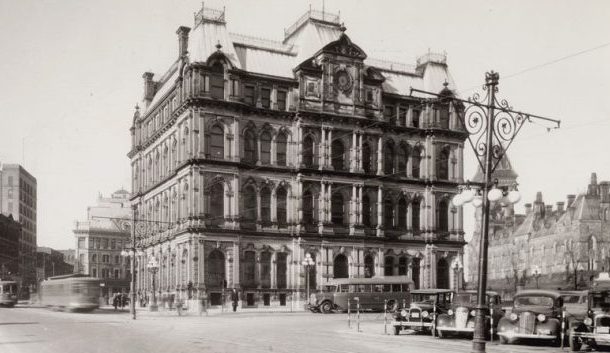
Ottawa Lost: Patronage Place
It was one of Ottawa’s greatest architectural losses, the original Customs House. It stood 62 years and even launched the career of a national leader, Mackenzie Bowell, whose primary achievement was growing the finest beard of any prime minister.
Customs revenue ran the country in the Confederation era. Taxes collected on liquor and goods were the main source of cash for the colony til the introduction of federal income tax in 1917.
The Customs building was constructed in the iconic heart of Ottawa at Elgin and Wellington Streets overlooking the Rideau Canal. It rose four storeys with a clock tower, designed in the grand Empire style by architect Walter Chesterton. The landmark took three years to build and opened in 1877.
Running the Customs House as the nation’s chief tax collector was Mackenzie Bowell, an editor and Orange Lodge Grandmaster from Belleville, Ont. He served 50 years in Ottawa without ever having to commute. Bowell kept a room at the fabulous Russell Hotel, simply walked across the street to the Customs building and another block up to the House of Commons.
Bowell was a master of patronage, stacking the Customs department with Conservative cronies. He made it a rule to fire any employee who attended Liberal meetings. In 1880 he wrote John A. Macdonald: “Everything in the whole system of government in connection with patronage is carried out on this principle: You consult your friends.”
Bowell operated the Customs house with unremarkable diligence. In 1894 he became prime minister on seniority following the sudden death of Conservative leader John Thompson.
Bowell spent 16 unhappy months in office. Today he is universally rated the country’s worst prime minister. He was “decidedly commonplace,” said Lady Aberdeen, a governor general’s wife. One historian remembered Bowell as a “bigoted, conceited and slightly paranoiac little man.”
Bowell was ousted in a cabinet revolt in 1896. A caucus colleague rated him “pompous and ponderous.” Seven cabinet members resigned after branding Bowell a dithering fool. The Ottawa Evening Journal called him “a leader who cannot lead.” He died in such obscurity in 1917 that Prime Minister Robert Borden did not attend the funeral.
And the old Customs House? It survived a fire in 1903, was restored with walls of nearly indestructible concrete, and lasted till 1938 when it was deemed to be in the way of plans for a National War Memorial. Bowell’s office was so well-built it took two months to dismantle the reinforced walls.
“The old building always held a warm place in the hearts of Ottawans,” a newspaperman wrote as the Customs House was demolished. “Even today citizens are noted looking up to where the well-known clock used to be in order to check their timepieces.”
By Andrew Elliott