
Canadians remain sharply divided over cabinet’s promotion of oil pipeline expansion, according to in-house research by the Department of Natural Resources. Authorities spent nearly $300,000 on polling and focus group research on the topic in the past six months: “The main concerns about pipelines tended to be oil spills”.
RCMP Spied On Holidayers, Journalists, Friends Of Cuba
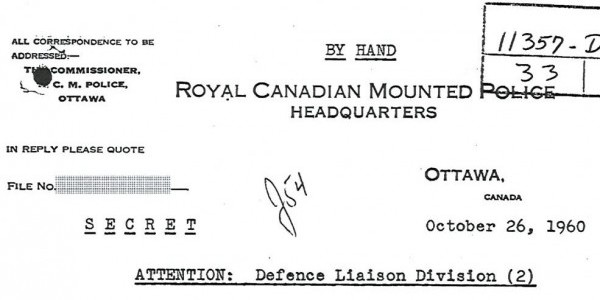
RCMP kept secret Cold War surveillance on Canadians who visited Cuba, Germany and other destinations deemed suspicious in the 1950s and ‘60s, according to newly-released Ottawa archives. The files detail a spy network of informants and police operatives who kept tabs on travellers and vacationers suspected of left-wing sympathies.
“I’m not surprised,” said Howard Pawley, former New Democrat premier of Manitoba. “There was a climate of intense fear and anger.”
Pawley was president of the Winnipeg Fair Play for Cuba committee in 1961, a group monitored by the Mounties. A 1961 RCMP memo described the committee as “mainly controlled by Trotskyite organizations”; “The aim of these committees is to spread the ‘truth’ about Cuba.”
Pawley, 79, said he did not visit Cuba at the time but believed the group was on a watch list. “I was always a bit leery,” he said in an interview. “We weren’t plotting anything. The surveillance was a useless expenditure. What was the purpose of it?”
Documents released by Library & Archives Canada detail surveillance files dating from 1959 to 1963. The memos run to 669 pages detailing reports from police informants and staff with the Department of External Affairs.
“They didn’t like dissent, especially if the dissent came from groups they saw as pro-Russian,” said Pawley. “At the time I didn’t think we were being watched but shortly thereafter I began to think we had been under surveillance. I think it was a product of the Cold War; they were worried about espionage and Cuba was of great concern.”
Confidential files show RCMP kept tabs on innocent holidayers who travelled to Cuba, including a school principal from Fife Lake, Sask.; a Provincial Health Officer from Trail, British Columbia; and a technician from the National Research Council in Ottawa, Dr. John Booth, who visited the Canadian Embassy while in Havana in 1961. “We are bringing this case to your special attention because we noted, to our surprise, that Mr. Booth was wearing on his lapel a cloth badge which was in the form of two flags: the upper flag was that of Cuba and the lower one that of the Soviet Union,” an official reported. “These and other similar emblems are often worn by Cubans and by visitors and ‘special guests’ who wish to demonstrate their sympathy for the Cuban revolution.”
None of the Canadians named in the files were identified as security risks or suspected spies.
“This Was Quite An Industry”
“The Cold War was really at its worst in the early 1960s,” said Dr. Reg Whitaker of the University of Victoria’s political science faculty. “The fact they carried on in this way is not surprising. It was part of the Mounties’ world view.”
“There was no accountability to Parliament; this was all done behind closed doors; this is the kind of craziness that grows when there is no accountability,” said Whitaker, co-author of a 1994 analysis of the RCMP security service Cold War Canada: The Making Of A National Insecurity State 1945-1957 (University of Toronto Press). “This was quite an industry.”
Agents kept watch on the travel plans of numerous journalists, often compiling itineraries from airlines and shipping companies. Among those kept under surveillance was Herbert Steinhouse, a senior CBC producer in Montréal who was watched for more than a decade: “Height 5’11”; weight 190 lbs.,” noted one declassified memo: “Although neither Steinhouse nor his wife have come to notice as being members of a Communist organization, we are maintaining an interest in them because of their continued association during the past four years with known and suspected Communists.”
RCMP tracked Steinhouse as he traveled from Montréal to Paris with his wife and son aboard the liner S.S. Homeric: “Steinhouse has been depressed by events in France but that his morale was boosted by the Communist street demonstrations in Paris which he hoped would increase in scope.” Steinhouse died in 1996.
Jean-Louise Gagnon, editor of La Presse who later co-chaired the 1968 Royal Commission on Bilingualism, was watched mainly on account of the activities of his wife Helene suspected of belonging to a “communist institution” the Organisation Internationale des Journalistes.
“She is most easily influence,” one diplomat wrote. Mrs. Gagnon travelled to China, producing a manuscript “crammed with all the banalities of Communist propaganda”; “I warned her that the publication might have unpleasant repercussions for her husband as editor-in-chief of La Presse.” Authorities tracked Gagnon’s travels to France, Germany, Czechoslovakia and Italy, including flight numbers and itineraries. Gagnon died in 2004.
“Dupes, Fellow Travellers”
“The fact these people weren’t members of the Communist Party was not the point,” said Prof. Whitaker. “They were seen as dupes, fellow travellers who bent the line between them and us.”
“It was going on in the shadows and there was no sense till later on how out of control it was,” Whitaker said. “Even within the RCMP there was an uneasy sense they were compiling more information than they could even process. It built its own momentum. The RCMP security service employed a lot of people. It began to feed on itself.”
Secret files were kept on innocuous Canadians even the Mounties did not consider a threat to national security including:
- •Kathryn Burns of Ottawa, a director of the Canadian Welfare Council who took an overseas post with the U.N. International Children’s Fund in 1961; RCMP believed Burns attended Communist meetings in 1937: “She was 22 and presumably just out of college. She has since then risen pretty close to the top of the tree in her chosen profession without attracting attention”;
- •Gordon Lindsay of Gabriola Island, B.C.: “5’6”, 145 lbs., slight build”; “Lindsay is planning to travel to Spain in the near future”; “It is reported he might have joined the Edmonton branch of the Socialist Youth League”; “He attended two Bible Schools and was employed by various firms including the Sun Publishing Company and Radio CFRN, Edmonton”;
- •Vivian Jacobson of Calgary, a schoolteacher who was monitored as she flew from Montréal to Paris in 1961: “Miss Jacobson attended a Labour-Progressive Provincial School held at Sylvan Lake, Alberta in 1951”; “She is described as being 5’4” tall, weighing 150 lbs., of medium build with blonde hair.”
RCMP also kept files on a B.C. pacifists who attended peace protests in Germany in 1962. “The trio left Vancouver on September 30, 1962 driving an old model car painted with ‘Ban the Bomb’ slogans,” noted one police memo. “During their trek across Canada they stopped in numerous towns and cities and spoke to various ‘Peace’ group gatherings, handing out the usual ‘Peace and Disarmament’ pamphlets.”
“We have no information indicating membership in any Communist organization,” the Mounties acknowledged; “They are responsible for organizing or participating in several ‘Peace’ marches.”
Hans Sinn, 85, now retired in Perth, Ont., was one of the protestors named in the RCMP file. “It was assumed the RCMP were watching,” Sinn said. “I would have been surprised if they didn’t. It was consistent at the time; the RCMP would keep track of peace activists who were in conflict with Canada’s official policy.”
“We were pacifists,” Sinn said. “Still are.”
The RCMP security service was formally disbanded in 1984 following disclosure of illegal activities. Domestic surveillance is now conducted by the Canadian Security & Intelligence Service.
By Tom Korski 
Need Standard On Toxins In Drinking Water: Researchers
Canada should introduce more rigorous standards on drinking water to monitor chemicals and industrial releases, says an environmental group. Ecojustice reported Canada fails to regulate scores of contaminants deemed a health risk in other countries: “It’s the municipalities that will have to fork over the money”.
Naturopaths Lose Court Bid
Naturopaths have lost a Federal Court bid to strike down Health Canada regulations on natural food products that make medicinal claims. Advocates asked a judge to find that federal rules on vitamins and dietary food supplements are unconstitutional: “You’re going to need a prescription to buy vitamin C — that’s where we’re headed”.
Courts OK Border Powers
A B.C. importer has lost a bid for compensation from the Canada Border Services Agency for seizing a shipping container carrying Asian bug larvae. The Supreme Court declined to hear the case that saw the agency fumigate the shipment and order it out of the country: “It reinforces the necessarily Draconian nature of the Customs Act”.
“Wow! This could get ugly”
The National Research Council has bristled after being faulted by engineers including an ex-cabinet minister for a costly mishap. It followed an incident in which a $300,000 telescopic dish likened to a giant Frisbee was damaged in a wind gust while being airlifted over a mountain range: “Surely the NRC has the brain power to figure this out”.
E.I. Lawsuit ‘Waste Of Time’
The Supreme Court in a 7-0 decision has rejected an attempt by two Québec unions to challenge cabinet’s use of funds earmarked for Employment Insurance. The lawsuit followed a 2010 budget provision that saw cabinet transfer a $57 billion balance from an EI account into general government revenues: “It should be pretty damn well sure”.
E-Navigation For Oil Rush
The Canadian Coast Guard plans tests this year on shippers’ internet alerts on marine hazards. The initiative comes as regulators forecast a four-fold increase in West Coast oil tanker traffic. The Pacific coast has not seen a major marine oil spill since 1988: “The data will be all that industry needs”.
School Aid Complex: Study
Student aid programs nationwide are now so complicated borrowers are unlikely to understand their terms and obligations, says new research. A study by the Canadian Centre for Policy Alternatives concludes aid programs are “inherently complex” with “appalling inequities” depending on where students live: ‘Is this the best we can come up with?’
Meat Plants See New Fines
Federal inspectors are gaining new powers to levy fines on meat processors amid industry complaints of ad hoc policy and “pretty shallow” consultations. The regulations follow a pledge by Health Minister Rona Ambrose to penalize processors that withhold information from the Canadian Food Inspection Agency: “We have nothing to hide”.
Lead A Risk Years After Ban
Decades after it was banned in household paint and gasoline, lead continues to pose a “modest” risk to Canadians prone to hypertension, new Statistics Canada research shows. Authorities said sampling of thousands of Canadians found all individuals tested, 100 percent, had blood lead levels: “It’s still there”.
Employee Leave ‘Marginal’
The Government of Canada sees only “marginal” costs in backfilling absentee employees, according to the Parliamentary Budget Office. The latest study follows 2013 research that public servants did not take significantly more sick days than private sector employees – a finding that contradicted cabinet claims of widespread absenteeism: “I hope they’re going to change their tune now”.
Lookin’ Good For The ’70s
Minimum wage rates remain a burden for small business despite new data indicating the average entry-level pay is unchanged since 1975 after inflation, says an advocacy group. Statistics Canada calculated rates mirror those paid in 1975: “There is a trend”.
MPs Fault Trade Negotiators
The Commons trade committee is faulting negotiators for failing to press Canadian trademark claims in confidential negotiations on a European pact. MPs in a majority report said the treaty must not be ratified without “geographical indicators” to protect Canadian products like Atlantic salmon, Saskatoon berries and Winnipeg goldeye: “Europe’s got a whole bunch and Canada didn’t have one”.
Spend $425K To Ask Jobless
Employment Canada will spend $425,000 to interview jobless people. Authorities said the intensive study will provide “detailed micro-level data” on why Canadians are out of work: “Would you be willing to move to seek employment?”