
Health Minister Marjorie Michel’s department has sealed internal reports on vaccine and drug injuries for 15 years, records show. The documents run to “several million pages,” it said.
Feds Confirm Pro-Castro Talk
Farm Credit Canada confirms its $458,000-a year CEO in a speech to staff praised Fidel Castro as an impressive and visionary leader. The Crown bank had no comment on remarks by Justine Hendricks, who also praised Communist Party management of Cuba: “It’s Fidel Castro. There’s all sorts of aspects of Fidel Castro.”
10% Of Small Operators Gone
A tenth of small businesses in Canada have vanished since the pandemic, new Department of Industry figures show. Data confirmed Canadian Federation of Independent Business research showing nationally, closures now outnumber start-ups: “We are bleeding businesses.”
McGuinty Defends Rent Hike
Defence Minister David McGuinty has vetoed a recommendation by MPs that he freeze rents on military housing. Money was required to upgrade accommodation on military bases that failed a 2025 audit, he said: “The Government of Canada disagrees with this.”
Toxic Plastic Order’s Upheld
A cabinet order blacklisting all plastic goods as toxic was “simply an enabling provision,” says the Federal Court of Appeal. Judges upheld the 2021 order by then-Environment Minister Steven Guilbeault but acknowledged more legal challenges are possible: “There was overwhelming scientific evidence.”
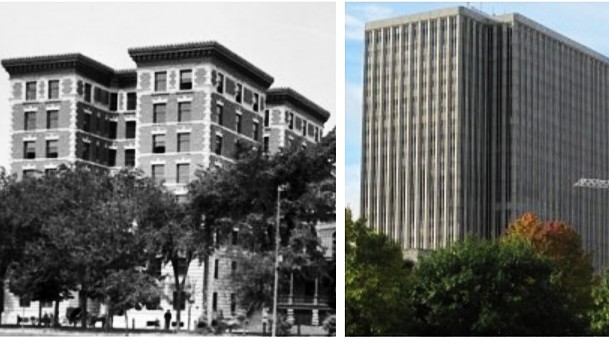
Ottawa Lost: The Roxy Apt’s
It was a sumptuous apartment building, home to a famed leader, then lost to the wreckers. How many Occupy Movement protesters who gathered in Ottawa’s Confederation Park in 2011 realized they’d camped at what was once among the most prestigious addresses in the capital?
The elegant Roxborough Apartments on the northeast corner of Laurier and Elgin Street was a stroll from Parliament Hill with a prime view of the Rideau Canal. Here William Lyon Mackenzie King, Canada’s longest-serving prime minister, lived in a suite for 13 years, “rooms filled with very sacred and memorable associations,” King confided to his diary. “The notes of beauty and refinement are all a part of what is dear to me.”
The Roxborough, crafted by Montreal architect Howard Colton Stone, was an eight-story, 82-suite landmark built of red and yellow brick and embellished with oak and marble. Rents of $40 a week included full maid service and a lavish dining lounge featuring an ancient cockatoo as mascot. It was the place of choice for Ottawa dignitaries.
King made the Roxborough his Ottawa home from his appointment as labour minister in 1909 through his triumph in the 1919 Liberal leadership campaign and first election as prime minister in 1921.
“I am spending my last night in the rooms at the Roxborough,” King wrote January 10, 1923 as he prepared a move to the late Wilfrid Laurier’s Sandy Hill mansion. Laurier House “can scarcely ever be to me what these apartments are,” King wrote. “I feel as if I were parting with something akin to a very dear friend. I love this quiet and comfortable atmosphere.”
Today the Roxborough is gone and forgotten. No other 20th century prime minister did more than King to reshape the urban landscape of Ottawa. He initiated beautification schemes from the 1920s through the ‘40s. His ideas held sway over local planners.
King gave the Ottawa Improvement Commission greater powers over construction of parks and parkways and renamed it the Federal District Commission. He was responsible for widening Elgin Street into a boulevard trod by dignitaries and royalty. He inspired creation of the National War Memorial and Confederation Square and Gatineau Park and its parkways. As prime minister he invited Paris-born planner Jacques Gréber to devise a master urban plan, unveiled in 1949, that inspired the capital’s Greenbelt but destroyed much else.
The prime minister’s beloved Roxborough Apartments became a casualty. After King’s death in 1950 it succumbed to the Gréber Plan.
The landmark was expropriated by the National Capital Commission in May 1965 and all tenants including MPs and a Supreme Court justice were evicted six months later. The building was demolished. “A disgrace,” one 89-year old tenant said of the Roxborough’s destruction. “They are pulling down the only decent apartment building in the city.”
The site was marked for construction of a national science museum but instead languished as a parking lot. In 1969 it was turned into Confederation Park in belated observance of the nation’s centennial two years before. Today, adding further insult to King’s memory, there is no plaque commemorating the site.
By Andrew Elliott

Book Review: Petty — And Profound
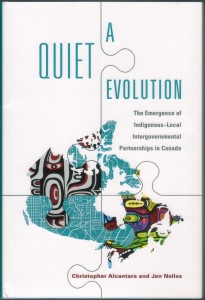
What do municipalities and First Nation reserves have in common? Both are used to being told what to do. It’s natural, then, that any review of Indigenous self-government would examine how these two get along at the most elemental level. A Quiet Evolution is the first research of its kind, and prompts the reader to wonder why nobody thought of this before.
It turns out relationships between cities and reserves can be petty or profound. Human, in other words. If Parliament ever settles outstanding land claims and accepts Indigenous property rights nationwide, it would look something like this.
“It would be easy to conclude that the Indigenous-Crown relationship is almost entirely adversarial and problematic,” authors write. “While this pessimism is certainly pervasive and somewhat justified, given Canada’s history of colonialism, a much different story seems to be unfolding at this local level.”
Co-author Christopher Alcantara is a political scientist at Western University. Jen Nelles is a visiting professor at Hunter College. They examined the fine print in local agreements between cities and First Nations, some 332 of them. “Willingness is key,” they write.
Some contracts are plain and practical. In Kamloops, B.C., the local band paid the city $437,000 a year plus overtime to contract fire protection for its 1,410 property owners. Economic self-interest makes for good neighbours, notes Quiet Evolution: “Indigenous and municipal authorities typically govern with relatively few resources particularly outside of the larger cities and settlements. Where local and Indigenous authorities have discretionary funds to support joint projects, cooperation will likely be easier to establish.”
Other relationships go deeper and are “much more interesting,” authors write. In the Québec municipality of Les Basque on the St. Lawrence River, councilors reached agreement with nearby Algonquians for joint property management specifically to ward off private ownership of prime lands. Each agreed to ante $120,000 and work it out. They did.
In Elliot Lake, Ont., the municipality had an agreement with the Serpent River First Nation on heritage planning and joint lobbying of the legislature. In The Pas, Man., they shared costs of the local hockey team with the Opaskwayak Cree Nation. In Cape Breton, N.S., the regional municipality reached agreement with Membertou First Nation to build a highway and hotel on Indigenous lands.
“While national and provincial media publications are filled with stories of conflict, contention and demands, many Indigenous and local governments are quietly engaging in what seems to be highly productive and beneficial intergovernmental partnerships,” authors conclude.
The formula is not foolproof. “Rightly or wrongly, history has the potential to be a powerful barrier to cooperation,” Quiet Evolution cautions.
In Sault Ste. Marie, Ont., authors identified a grudging relationship between municipal managers and the local Garden River First Nation three kilometres outside of town. Former Buffalo Sabres head coach Ted Nolan is from Garden River. He used to coach the Sault Ste. Marie Greyhounds.
Ratepayers privately grumbled about First Nations residents, and authorities refused to run a municipal bus route through the reserve when nobody could agree on how to pay for it. One Sault planner complained without irony that First Nations are bureaucratic. “The people you’re dealing with are not the people who have the ability to agree or disagree,” he sighed.
Quiet Evolution provides a glimpse of a future in which Indigenous communities are partially self-governing economic units, like a thousand other towns. Some are good, and some are just good enough. It’ll work.
By Holly Doan
A Quiet Evolution: The Emergence Of Indigenous-Local Intergovernmental Partnerships In Canada, by Christopher Alcantara and Jen Nelles; University of Toronto Press; 159 pages; ISBN 9781-44262-6775; $32.95
Feds Blame ‘Political Actors’
Heritage Minister Marc Miller in a letter to MPs says political organizers are using the internet to undermine Canadians’ trust in public institutions. He did not identify any by name: “The needs of protecting public interest journalism are urgent.”
Gov’t Hired Foreign Students
Records show federal managers hire more than 800 foreign students a year while lamenting high jobless rates for Canadian students. The Treasury Board noted federal employers were supposed to hire Canadians first: “The Public Service Employment Act gives preference to eligible veterans first, then Canadian citizens.”
Gridlock Frustrating Cabinet
A senior Liberal MP yesterday complained cabinet is unable to pass most of its bills despite winning the 2025 general election. MP Kevin Lamoureux (Winnipeg North), parliamentary secretary to the Government House Leader, blamed Conservatives: “We have a Prime Minister who was just elected.”
Promise ID Plan Is Voluntary
Digital identification is a convenience that will never be mandatory in Canada, says cabinet. The Department of Employment overseeing digital ID development at a cost of billions said it had “no plans” to force Canadians to use the technology: “Using this online will be completely voluntary.”
Cineplex Loses $1.50 Appeal
Cineplex Corporation, the nation’s largest theatre chain, has been ordered to pay $38,987,000 plus costs for breach of the Competition Act. The Federal Court of Appeal upheld the penalty over a $1.50 online booking fee: “We are shocked.”
Bank Cuts 2026 GDP Outlook
The Bank of Canada yesterday cut its 2026 growth forecast. Governor Tiff Macklem released a report warning of stubborn unemployment and weak investment: “Between October and now, what has changed?”
$263K For Committee Coach
Federal managers in the past two years billed taxpayers more than a quarter million for coaching on how to answer questions at parliamentary committees. Disclosure of coaching fees followed complaints from one deputy minister that questioning by MPs was too rough: “One source of harassment stems from short, decontextualized clips of committee appearances by public servants being posted on social media.”
Gov’t Bank Plans For Layoffs
A Crown bank, Farm Credit Canada, yesterday said it is hiring counselors to provide “emotional support” for staff facing layoffs. The notice came as the Treasury Board said it will cut 1,000 executive positions government-wide: “Career transition can be a stressful time.”



