
We are grateful this holiday to friends and subscribers as Blacklock’s embarks on a 12th great year of independent, all-original Canadian journalism. On behalf of all our contributors, please accept our thanks. We’re back tomorrow — The Editor.
Poem: ‘A Place In November’
A gun-metal sky hangs over
The lake, which is oil-black
And loud as it folds into itself
Again and again until it reaches
The shore and my boots.
Behind, town lights blink on
As eyes ready to shut.
Maple leaves, dead and grey,
Are picked up and scattered
As a child mindlessly throws stones.
I have been standing here for decades
But I have never seen it like this.
This place has never lived through a fall.
What season comes next?
By S.M.G. Dupel

Book Review — Age Of Empires
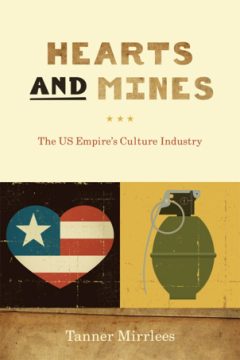
For Canadians who recall when the U.S. won its wars and paid its bills, it’s now popular to consider America as a wheezing empire in decline, to which Professor Tanner Mirrlees replies, ha! Mirrlees’ Hearts and Mines is a bird’s-eye view of a U.S. cultural industrial complex so vast its reach is taken for granted. It is a very sad Third World village that has never heard of Mickey Mouse or Marlboro cigarettes.
“The United States’ cultural reach is unparalleled,” writes Mirrlees, an assistant professor of media studies at the University of Ontario Institute of Technology. “The U.S. culture industry’s global economic power and the near omnipresence of American cultural commodities – news programs, motion pictures, TV shows, video games and interactive digital content – are facts.”
Pundits once marveled at the ascendancy of China though its cultural exports are unwatchable “opera” and Cantonese boy bands. Canadians of a certain generation still recall when schoolchildren celebrated Empire Day and everything English was deemed the epitome of culture, elegance and superiority. The mystique vanished with the British empire. Today the works of Rudyard Kipling are unread.
Not America. Those people know how to sell, Mirrlees writes. “Just because it does not now fit the profile of empires of old does not mean that it is not an empire.”
Its agents are McDonald’s and Microsoft, Pepsi and Coca-Cola, Google, Ford and George Clooney. “The U.S. government on behalf of powerful corporate lobbyists has largely established and enforced through law, policy and regulation a capitalistic mode of media and cultural control that extols markets, private ownership, the profit motive, advertising and hyper-commercial values.”
The reach is spectacular. Consumers from Irkutsk to Bangkok to Cardston, Alta. equate American products with primacy. Nike shoes are not merely footwear, they are a celebration of can-do sportsmanship and individual athletic achievement. No Canadian shoe manufacturer stands a chance.
“At its core the ideology of American exceptionalism represents the United States as a unique liberal capitalist country in a world system of liberal and illiberal capitalist states,” Hearts and Mines explains.
It’s a claim that grates on the nerves, U.S. exceptionalism, though here Professor Mirrlees points to evidence hidden in plain view. America remains the world’s largest national economy, still home to the only world currency, still a “choice of destination for highly skilled workers.” Nobody wins more Nobel Prizes. Nobody files more patents. Nobody sells more pizza.
“The U.S. culture industry creates, coopts and commoditizes universal and particular stories, transnational and national symbols, and global and local motifs to strengthen its grip in markets everywhere,” Mirrlees writes. “It floods markets with goods that do not always appear to be agents of Americanization. Yet, in an era of endless market segmentation into smaller and smaller niches, and the resulting marketization of cultural difference, diversity sells.”
An empire in the decline? Not yet – not by a long stretch.
By Holly Doan
Hearts and Mines: The U.S. Empire’s Culture Industry, by Tanner Mirrlees; University of British Columbia Press; 336 pages; ISBN 9780-7748-30157; $34.95
Uproar Over Secret Nazi List
Cries of “fascists” yesterday rang out in the Commons as MPs pressed for release of a secret federal blacklist of 20 Nazi fugitives in Canada. Demands for disclosure of the 1985 list came as the Liberal chair of Parliament’s Canada-Ukraine Friendship Group expressed unease with disclosure: “I prefer not to speak to that.”
Budget Officer Defends Data
Budget Officer Yves Giroux yesterday defended research indicating cabinet misled taxpayers on the recovery of green technology subsidies. “I don’t have a vested interest,” Giroux told the Commons industry committee: “As soon as we publish a report that sets the record straight there are accusations we have not understood the problem or have a bone to pick.”
Says Hotel Loan’s Grotesque
Federal financing for energy refits of a luxury Toronto hotel is “grotesque,” says Conservative MP Leslyn Lewis (Haldimand-Norfolk, Ont.). The MP challenged the Minister of Housing to justify the funding when “Canadians are sleeping in garages.”
Sees Budget Going To Pieces
Parliament must curb deficit spending now or “pick up the pieces” later, former Bank of Canada governor David Dodge yesterday told the Senate banking committee. Canadians had no choice but to confront an “unpleasant” future, he said: “I mean, Canadians are pretty realistic.”
Protest ‘Cruel Farm Practices’
Animal rights advocates yesterday opposed a bill threatening jail and six-figure fines for trespassing on farms. Camille Labchuk, executive director of Animal Justice, called it an “ag gag law” to conceal cruel farm practices: “This includes things like keeping pregnant pigs in gestation crates which are metal cages so small the mothers can’t even turn around.”
No Excuse To Keep Nazi List Secret: Immigration Minister
There is no excuse to delay release of a decades-old blacklist of 20 suspected Nazi fugitives in Canada, Immigration Minister Marc Miller said yesterday. Miller said he had not seen the confidential list but questioned if any suspects were still alive: “There’s no excuse for delay.”
More Than 800 “De-Banked”
More than 800 depositors have been “de-banked” nationwide in the past five years at bankers’ discretion, say Access To Information Records. Federal law does not allow banks to cancel accounts except in cases of suspected criminality: ‘How many depositors have been de-banked in Canada for reasons other than substantiated terrorism or money laundering?’
Warn GG: Stop The Spending
Governor General Mary Simon must economize in her $24.7 million annual budget, the Commons government operations committee said yesterday. MPs protested spending was so lavish that Rideau Hall did not tell the whole truth when questioned about the cost of overseas junkets: “You got caught red-handed.”

Censor Cellphone Data Scoop
The Public Health Agency has censored thousands of pages of data on cellphone users it collected in the name of pandemic lockdown enforcement. The Agency invoked commercial confidentiality in refusing to disclose weekly reports drawn from cell tower tracking data on millions of mobile customers: “We have developed internal policies to limit access to these data.”
MPs Seek Green-Wash Probe
The Commons ethics committee last evening targeted an investigation of alleged “green-washing” by a federal foundation suspected of sweetheart subsidies for environmental technology firms. Industry Minister François-Philippe Champagne suspended funding for Sustainable Development Technology Canada over “allegations of mismanagement.”
Be Ashamed, Says Senator
Canadians should be ashamed over mistreatment of Indigenous people, says Senator David Arnot (Sask.). The former Saskatchewan human rights commissioner said “ritualized boilerplate statements” of contrition are insufficient: “Be shocked, appalled and ashamed.”
Won’t Disclose Debt Charges
Finance Minister Chrystia Freeland’s department yesterday said it does not know how many billions it is currently spending on debt interest charges. One senator expressed disbelief: “All the smart people are in the Department of Finance.”



