
Canadians want “stronger legislation” to regulate legal internet content, says a report by Heritage Minister Pablo Rodriguez’s department. Findings were based on comments from groups handpicked to attend Department of Heritage meetings on censorship: “There was support among participants for creating an online safety regulator.”
More Cash For Baylis Medical
Cabinet has awarded millions more to Baylis Medical Technologies Incorporated on a sole sourced service contract, records show. The firm previously run by ex-Liberal MP Frank Baylis (Pierrefonds-Dollard, Que.) in 2020 was a subcontractor on a $237 million deal for Covid ventilators: “When the crisis hit my partner and I, we took a decision.”
Put Landlords’ Margin At 8%
Profit margins for landlords in Canada average eight percent, the Commons human resources committee was told yesterday. Witnesses disagreed over means to increase the national housing supply: “We have a large task in front of us.”
Wanted ‘Winning Messages’ On Vax Injury: Secret Memo
The Privy Council Office in a secret memo said Covid vaccine injuries and deaths “have the potential to shake public confidence” and must be carefully managed with “winning communication strategies.” A federal compensation fund to date has paid out millions on injury and death claims: “Government messaging following an adverse event will be important.”
I Will Testify, Says Johnston
Former governor general David Johnston yesterday agreed to take MPs’ questions over his role at the Trudeau Foundation. Johnston for weeks ignored requests that he appear before the Commons public accounts committee and narrowly avoided a summons last Thursday: “It’s not easy.”

Gov’t Faked Security Bulletin
The Department of Public Safety issued a false security bulletin claiming it had “confirmation” Freedom Convoy protesters ransacked federal office buildings, Access To Information records show. Public Safety Minister Marco Mendicino’s office yesterday said it had nothing to do with the disinformation: “There’s a danger.”
Amending Budget 904 Times
Conservative MPs yesterday introduced 904 amendments to the budget as a filibuster entered its second month. Opposition Leader Pierre Poilievre said MPs would use all means possible to block the budget bill until cabinet caps the carbon tax and commits to eliminating the deficit: “If the government does not meet these demands we will use all procedural tools at our disposal to block the budget.”
ArriveCan Use Down To 11%
Only a tenth of air travelers are using the costly ArriveCan app since it was made voluntary, records show. Use of the app had been mandatory until last October 1: “Canadians have been able to cross the border without it for decades and even centuries.”

Mandate CBC As Mouthpiece
The Privy Council in an Access To Information memo proposed a legal requirement that the CBC broadcast government messaging in a “national crisis.” Cabinet aides complained they had to buy advertising during the pandemic: “There could be new possibilities to create partnerships to respond to future crises.”
Gov’t Polled On Vax Tactics
The Privy Council secretly polled Canadians on pandemic vaccination tactics, Access To Information records show. Researchers tested options from paying Canadians to take a Covid shot to punishing the unvaccinated by denying them access to “certain activities.”
Filibuster Reaches Into House
A month-long Conservative committee filibuster of cabinet’s budget bill has spilled into the House of Commons. MPs on Friday voided a whole day’s worth of debate on Bill C-47 as cabinet fumed: “It was actually a point of order on the process for raising points of order during points of order.”

Military Ads ‘A Bit Desperate’
Jobseekers polled by the Department of National Defence rate a new recruitment campaign as too technical and “a bit desperate.” Researchers said the air force, navy and army face a “highly competitive job market.”
Find ‘Problematic Behaviour’
A bill for independent oversight of the Canada Border Services Agency will not address “problematic behaviour” by management, employees have told the Commons public safety committee. The Agency is the only police force of its size in Canada without a civilian oversight board: “Make real change.”
Sunday Poem: “Wait Staff”
My friend
who works as a server
at a banquet hall
tells me
about their training.
We are expected to work
in the background, she says,
allow patrons
to focus on their business.
We respond politely
to requests, questions,
but do not encourage
further discussions.
Friendly
but not familiar.
Patrons are not here for us.
Downtown Toronto
I look for a place
for lunch.
Across the street, Hooters.
By Shai Ben-Shalom

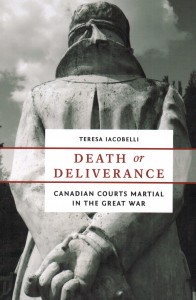
Book Review: Not Like In The Movies
In 2001 Veterans Affairs Canada added 23 names to the nation’s First World War Book Of Remembrance preserved in the Peace Tower. The 23 were shot for cowardice and desertion. Ron Duhamel, then-veterans affairs minister, told the Commons: “People may lose control of their emotions, have a breakdown for reasons over which they have little control,” he said. “I wish to express my deep sorrow at their loss of life”.
But what if this is all wrong? What if the image of the frail and cowering soldier executed by sadistic military brass is a First War set piece that owes more to filmography than fact?
Historian Teresa Iacobelli challenges readers to review the evidence in Death or Deliverance, as fascinating a case as ever went to the jury. Iacobelli asserts that not only were military executions extremely rare, but that Canadians’ view of the incidents – including Veterans Affairs’ 2001 observance – is skewed by a Hollywood film.
Stanley Kubrick’s 1957 production Paths of Glory depicts the execution of three innocent French soldiers convicted on trumped-up charges of cowardice. One reviewer called the story “grotesque,” “appalling” and “nauseating”. Adolphe Menjou is particularly good as the sociopathic General Broulard. Paths of Glory was filmed in Germany and not screened in France for many years.
Iacobelli has seen the film, too. “Those soldiers of the First World War who stood before firing squads have been portrayed as shell-shocked boys who had run out of the courage to withstand the trying circumstances,” she writes. “But was this really the case? Was military justice unnecessarily severe, and can we typify those soldiers who deserted?”
It turns out, no. Iacobelli meticulously reviews all instances of execution in the Canadian Expeditionary Force and comes to a striking conclusion. Execution was rare, the overwhelming majority of deserters were briefly jailed and commanders were sensitive to the “reputation” of deserters.
Canadians were subject to military law under the 1881 Army Act. Espionage was punishable by death as well as drinking on duty, cowardice, desertion and throwing away your rifle in combat. If the penalty appears brutal to modern readers, Death or Deliverance notes Canadians at the time found execution an acceptable punishment. Forty-eight hangings took place in Canadian jails during the war years, more than twice the number who were shot by the army.
“It was common for shell shock to be viewed by military authorities as a threat akin to malingering or the more serious crime of desertion and cowardice,” Iacobelli writes. Yet 90 percent of death sentences were commuted. And even a 1918 federal report acknowledged that “men who had committed serious military offences because of exhaustion or their loss of courage or for other reasons” deserved a “chance to save their reputation”.
Canada was not alone. No Australian was executed. The U.S. had 23 by official count, including soldiers convicted of felonies like rape and murder. Germany had 48.
Death or Deliverance has no drum roll, no Adolphe Menjou character. It is much better. “Enduring myths of the war easily fed into myths of the courts martial themselves,” Iacobelli writes. “Is it not true that the historian’s role is to explain rather than to judge?”
By Holly Doan
Death or Deliverance: Canadian Courts Martial in the Great War, by Teresa Iacobelli; University of British Columbia Press; 192 pages; ISBN 9780-7748-25689; $32.95