
Employment Minister Carla Qualtrough yesterday disclosed she was never told dozens of department employees were under investigation for fraud. Qualtrough said she only learned after the fact that 49 were fired for cheating the Canada Emergency Response Benefit program: “No one brought to your attention specifically that there were employees being investigated within your department?”
Freeland Friends Get Audited
The Commons yesterday by a unanimous 320 to 0 vote ordered a special audit of federal contracts to McKinsey & Company, a global consulting firm formerly led by a friend of Finance Minister Chrystia Freeland. Liberal MPs endorsed the Conservative motion amid complaints the Opposition was looking for evidence of corruption: “We have a right to know what is going on.”
Says China Cost MP His Seat
Communist Party agents cost a Conservative MP his seat in Parliament, the House affairs committee was told yesterday. MP Kenny Chiu (Steveston-Richmond East, B.C.) was targeted by a “massive campaign of disinformation,” testified an investigator who looked at the case: “If had not been for that disinformation Mr. Chiu would still be in Parliament.”
Spy Hunt Must Be “Sensitive”
Any federal attempt to unmask Chinese foreign agents must be “culturally sensitive,” Public Safety Minister Marco Mendicino said last night. Legislators have sought passage of a Foreign Agents Registration Act similar to a law enacted by the United States in 1938: “It would help to bring people out of the shadows.”
Claim They Saved 800K Lives
The Public Health Agency yesterday claimed it saved 800,000 lives in Canada under its vaccination program. The claim was made as MPs questioned auditors’ findings that the Agency wasted $1 billion of the $5 billion it spent on Covid shots: “Shame on you.”
Committee Erased Testimony
Several minutes of a public hearing have been censored by a Commons committee. MPs erased a 26-minute portion of video recordings in which a witness divulged details of a sex crime: “This testimony has been deleted.”
Marijuana Versus Road Safety
There has been a “significant increase in the prevalence of drug use” by drivers since Parliament legalized marijuana, says a Department of Public Safety report. Findings were drawn from self-reporting by cannabis users and blood testing of those hospitalized with traffic injuries: “There are some concerning indicators.”
Election Year Ads Hit $141M
Cabinet boosted election-year government advertising to $140.8 million, the highest figure disclosed to date. Only half the spending was related to pandemic safety measures: “This is very difficult to justify.”
Secret Contract Talks Are OK
The Lobbying Act permits corporations to secretly negotiate sole-sourced federal contracts without disclosing the fact, the Commons ethics committee has learned. MPs questioned the practice in cases like Baylis Medical Co., a firm run by former Liberal MP Frank Baylis that subcontracted a $237.3 million order for pandemic ventilators: “There was a lot of money.”

$15.7M To Investigate Staffers
Federal departments and agencies spent almost $16 million investigating their own employees, records show. Expenses for private investigators followed introduction of a new law curbing workplace harassment: “What are the details?”
Pits Holland Versus Hunters
Cabinet regrets its latest gun bill, says Government House Leader Mark Holland. Amendments to restrict hunting rifles were abruptly withdrawn Friday in the face of stiff opposition in the Commons public safety committee: “I get it, deeply, profoundly.”
Unsure Of Ratepayers’ Impact
Mandating use of electric cars will result in a 23 percent increase in overall demand for electricity, says a Department of Natural Resources report. Estimates of resulting impacts on power rates are “still being developed,” it said.
Taxpayers Out $173 Million
Recovery of millions in subsidies sunk into a failed vaccine factory is not an immediate priority, says Industry Minister François-Philippe Champagne. Cabinet had approved $173 million for construction of a Medicago Inc. plant in the health minister’s Québec City riding: “We need to move on.”
Sunday Poem: “Million Jobs”
My toilet got clogged.
Again.
Plumber says
he’ll replace the drainage,
install a new bowl.
I consult an engineer.
He says
a 4-foot pipe
cannot substitute
a 7-foot,
and the new bowl
is far too small
for the task;
the fix will only aggravate the problem.
I sign the work order,
hand it to the plumber.
His math may be flawed,
but he’s the only one in town
who came up with a plan.
By Shai Ben-Shalom

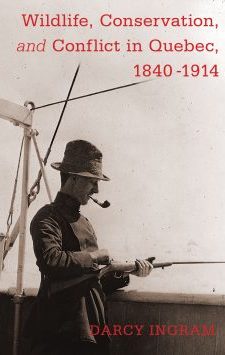
Review: A Legacy Of Landed Gentry
Who invented our conservation movement: Hippies? First Nations. Settlers? The answer is none of the above. Conservation was created by 19th century corporations and wealthy urban sportsmen. The first national park in Banff was intended as a resort for the rich. Critics cursed it.
“There is no reason for the government to go into the business of entertaining,” Liberal MP John Kirk of Nova Scotia told the House in 1887. “This is a benefit to the wealthy while the poor people are compelled to foot the bill.”
If the motives of corporations like Banff’s Canadian Pacific Railway resort builders were selfish and narrow, the result was good and beyond debate. There is a park. Wildlife and waterways were preserved.
Wildlife, Conservation and Conflict in Quebec 1840-1914 is the first book we know of that tells the odd story of the birth of ecology in Canada. In anecdote and fascinating detail, author Darcy Ingram confirms conservation was created by millionaires eager to ape the habits of Old Country gentry, “the twinned ideas of ‘improvement’ and ‘patrician culture,’” writes Ingram.
In 1858 the first organization of its kind was created, the Fish & Game Protection Club of Lower Canada. Excluded from membership were Indigenous people and homesteaders who were reduced to prosecution for poaching or paid work as guides. “Conservation amounted to a process of dispossession that saw commercial and subsistence hunters and fishers pushed off the province’s better hunting and fishing territories, stripped of former claims to fish and game resources and left to cope with seasonal and other restrictions,” writes Ingram.
Nor were clubs intended to raise hell with industry. Ingram notes there is no instance in which any timber leases were upset for fear of harming the fish, mainly since club members were timber barons. “It was the tremendous wealth generated by the timber industry that led these men to mimic the cultural and material practices of landed society, including the desire to devote their wealth and their leisure time to elite sporting activities such as salmon angling,” writes Ingram.
The elitism was beyond dispute. Prime Minister John Abbott, a Montreal railway attorney who led the country in 1891, owned his own salmon stream. When Quebec auctioned river leases to the very wealthy, buyers at one club included Governor General Lord Dufferin, Finance Minister Alexander Galt, the chair of the Senate banking committee and George Stephen, president of the CPR. In one three-week binge on the Matapedia River in June 1877 Stephen and his guests landed 2,800 pounds of salmon. They donated most of the catch to local villagers.
If their enjoyment was purely private, their legacy is profound: a nation of pristine lakes, streams and forests.
By Tom Korski
Wildlife, Conservation and Conflict in Quebec 1840-1914 by Darcy Ingram; UBC Press; 304 pages; ISBN 9780-7748-21414; $34.95



