
Senior management at the Department of Immigration is so racist that cabinet should appoint an ombudsman to investigate employees’ complaints, says an internal report. “Some people do need to be fired,” the report quoted one staffer in describing office bigotry: “We need to weed these people out.”
Rule Bending For Pow-Wows
The Department of Canadian Heritage bent rules on federal grants to subsidize pow-wows, according to auditors. Existing rules had banned funding for contests: “I believe all parts of Canada’s heritage are important to Canada.”
Embassy Says It’s The Victim
Beijing envoys accuse Canada of interfering in China’s business. Cabinet was “malicious,” “farfetched” and “extremely ridiculous,” the Chinese Embassy said in a statement: “Stop spreading China-related lies and false information.”

Spent $158K & Still Forgotten
A federal agency paid pollsters $157,646 to find out most Canadians never heard of it. The Canada Energy Regulator said it wanted to “create awareness” of its work after learning it is “not a household name.”
Convoy Panel In 18th Month
Parliament’s Special Joint Committee on the Declaration of Emergency yesterday entered its 18th month of deliberations with no deadline in sight for a final report into cabinet powers used against the Freedom Convoy. MPs complained they are still waiting to see all records in both official languages: “It became obvious the Liberal members of the committee were not prepared to permit the release of any government documents.”
MPs Worry Over Mortgages
The Commons finance committee has voted down a motion to question the finance minister over looming impacts of interest rates on mortgage renewals. “I am very concerned about what is going to happen in the fall,” said Conservative MP Adam Chambers (Simcoe North, Ont.), sponsor of the motion: “We are not paying close enough attention to what is happening in the mortgage market.”
Target Small Realty Investors
Parliament must investigate the role of “smaller investors” in housing including Airbnb listers, says New Democrat MP Daniel Blaikie (Elmwood-Transcona, Man.). Liberal members of the Commons finance committee expressed interest, noting another Commons committee is already acting on an NDP motion to review “financialization of the housing market.”
Tips To Handle Controversies
Federal managers need “tips, tools and techniques” to deal with media on sensitive First Nations controversies, says the Department of Indigenous Services. It proposed to hire media coaches at undisclosed hourly rates: “Figure out who is taking the training and why.”
Overpayment Was “Lottery”
A federal agency that overpaid employees thousands of dollars by direct deposit waited too long to recover the money, a labour board has ruled. Federal lawyers likened the mistake to a “lottery” for lucky winners.
Radio Pioneer Broke License
Canada’s oldest public broadcaster has repeatedly breached terms of its license, says the CRTC. Regulators imposed no sanction on Alberta’s CKUA Radio network: “It must comply at all times.”
A Sunday Poem: “Zombies”
Dead organisms
buried,
decomposed,
turned into crude oil,
waiting.
Until they are brought to the surface,
eager to make contact
with today’s living organisms,
drag them across the boundary
that separates life
from death.
The list is long –
Exxon Valdez;
the Persian Gulf;
BP Deepwater Horizon –
but revenge-seeking zombies
are looking for more
than just fish,
ducks,
otters.
In the late night hour,
a tanker train
starts its way
to Lac-Mégantic.
By Shai Ben-Shalom

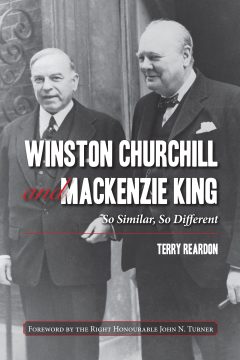
Review: Ditches Of Expediency
“It is sometimes very hard to tell the difference between history and the smell of skunk,” wrote English author Rebecca West. This is enough to make you wary of history that smells like violets.
Winston Churchill & Mackenzie King casts these “two elderly statesmen” as wartime peers out to save democracy. Author Terry Reardon is struck by parallels. Both were Sagittarians born in 1874, both had blue eyes and “large egos,” both stood 5’6”.
In chronicling their fifty-year acquaintance Reardon sees two dynamos of the Second World War. Well, not exactly. Churchill’s own Foreign Office in 1940 described King as “lukewarm about any war measure which he cannot show to redound to Canada’s own advantage.”
King took no part in battlefield strategy. No Allied leader took his advice too seriously. Even fellow Liberals considered King a partisan, cheese-paring functionary who was forever “traveling in the ditches of expediency,” as Air Minister Chubby Power put it in 1948.
Angus Macdonald, Canadian navy minister, considered King “weak at all points where pressure has been exerted – on conscription, on labour matters, on financial concessions to this or that group,” he wrote in 1944.
In his wartime diaries King emerges as a lonesome bachelor and scheming administrator devoid of any heroic impulse. To read King’s daily scribbling is to search pointlessly for any broad insight into WWII as compared to, say, a byelection in Cartier.
An example: On July 12, 1941, with Nazis approaching Leningrad and the RAF executing daylight raids over France, King confided the highlight of his day was singing to his little dog Pat: “I sang over to myself and to him the little hymn Safe In The Arms Of Jesus, as beautiful a hymn as I knew from those childhood days.”
“King’s reputation did not survive the day of his resignation,” Max Aitken, Churchill’s wartime supply minister, wrote in 1959. No historian has yet made a persuasive case that King was any more than what he was, though many have tried including Reardon.
“During the lifetime of these two products of the Victorian age the world evolved into a global village,” he writes. “On the world stage, Winston Churchill still towers as the great leader in the cause of freedom. In Canada the orchestrator of the successful development of the country during the turbulent first half of the twentieth century has been recognized as Mackenzie King.”
There is no evidence Churchill thought much about King. His most candid reflections are sadly lost to history. We will never know Churchill’s reaction in 1947 when King privately told him of his fascination with séances and Ouija boards.
In pairing Churchill and King as wartime giants, “so similar, so different,” the author unfortunately omits evidence to the contrary including juicy bits. In 1940, at the height of the Battle of Britain, as Churchill galvanized his people with a pledge to fight to the death, the Luftwaffe bombed Westminster Hall. On hearing the news, King secretly cabled the Canadian mission in London to retrieve stones from the rubble for his private rock collection. The British declined.
By Tom Korski
Winston Churchill & Mackenzie King: So Similar, So Different by Terry Reardon; Dundurn Press; 432 pages; ISBN 97814-5970-5890; $35
“Did Pretty Well”: Freeland
Finance Minister Chrystia Freeland yesterday boasted “Canada did pretty well” on Covid though death rates here were higher than in Australia, South Korea, Norway and other industrialized countries. A proposal to conduct an inquiry into cabinet’s pandemic management is currently stalled in the Commons health committee: “Of course we could learn lessons about how to do better.”
800 Artifacts Vanished: Audit
Hundreds of artifacts have vanished from two federal museums, auditors disclosed yesterday. Missing items included museum pieces “of great historical significance.” They were not identified: “We were particularly concerned.”
Will Pay More For Electricity
Ratepayers in four provinces face steeper hydro bills, as much as 15 percent more, under draft Clean Electricity Regulations released yesterday. “It’s time to roll up our sleeves,” said Environment Minister Steven Guilbeault: “Higher incremental rate increases are expected.”



