A longtime Liberal Party donor “won the lottery” with federal contracts near a Québec border crossing, the Commons ethics committee was told yesterday. Federal agencies spent $136.6 million accommodating illegal immigrants including millions paid for contracts and leases to Party donor Pierre Guay, a local businessman: “He names his price and the government pays it.”
Convoy Agreed To Withdraw
Freedom Convoy organizers were complying with a city agreement to move trucks the very day cabinet declared a national emergency, a public inquiry was told yesterday. Ottawa City Manager Steve Kanellakos testified he had no warning cabinet would invoke the Emergencies Act: “Were there incidents? There always are. Was there any extreme violence or anybody seriously injured? No.”
New Gun Reg Rated Pointless
Most Canadians consider a federal freeze on handgun sales to be pointless and ineffective, says in-house Privy Council Office research. People questioned how the freeze would counter contraband guns: “Several felt such a law would have little to no effect on the prevalence of firearms-related crimes.”
Black Market Pot Flourishing
Black market drug dealers are flourishing despite Parliament’s legalization of cannabis on a promise of market regulation, says a federal report. It warned banks to be on the lookout for suspicious cash transfers involving proceeds of cannabis crime: “There still exists a flourishing and illegal cannabis market in Canada.”
Election Claims Contradicted
A federal report contradicts Chief Electoral Officer Stéphane Perrault’s claim of major threats at 2021 Covid election polls. Only a tiny fraction of poll workers reported trouble with voters who declined to follow public health orders: “The level of satisfaction with the way the federal election went was unchanged from 2019.”
Feds Seal Kabul Flight Record
Internal records on the flight of Canada’s last ambassador to Afghanistan will not be disclosed to the public, says the Department of Foreign Affairs. Staff cited the “sensitive nature” of evidence detailing why Ambassador Reid Sirrs fled Kabul aboard a half empty plane, leaving behind thousands of Canadian citizens and Afghan allies: “We were the first embassy to depart.”
Convoy “Scared” Police Chief
A witness at the Freedom Convoy inquiry testified she heard Ottawa Police Chief Peter Sloly tell a business group he was scared of the truckers. Sloly later compared the protest outside Parliament to the violent 2021 storming of the U.S. Capitol that injured 138 police: “There was a sense that maybe our leaders were a little shaken.”
Convoy “Terror” Was Unseen
An Ottawa New Democrat councillor who petitioned cabinet to take steps against the Freedom Convoy testified she was terrified of truckers but acknowledged seeing no acts of violence. “I wrote to the Prime Minister begging for resources,” said Catherine McKenney, a mayoralty candidate: “I didn’t personally witness any acts of violence. I was told about them.’
Bootleg Market Share Is 32%
Bootleg tobacco now accounts for a third of the Canadian market, says one of the nation’s largest cigarette makers. Imperial Tobacco Canada Inc. in a submission to the Senate legal and constitutional affairs committee put tax losses in the billions: ‘It’s arguably the most lucrative criminal enterprise in Canada today.’
Sanitary Mandate Costs $12M
A new labour department mandate requiring federally regulated private employers to provide workers with free sanitary napkins would cost about $11.6 million a year, by official estimate. Cabinet called it a basic right for Canadian women: “Government intervention is necessary.”
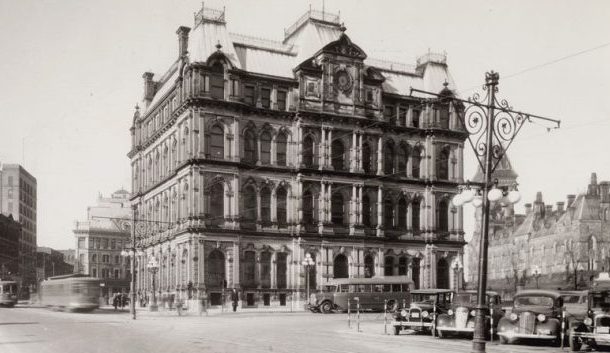
Ottawa Lost: Patronage Place
It was one of Ottawa’s greatest architectural losses, the original Customs House. It stood 62 years and even launched the career of a national leader, Mackenzie Bowell, whose primary achievement was growing the finest beard of any prime minister.
Customs revenue ran the country in the Confederation era. Taxes collected on liquor and goods were the main source of cash for the colony til the introduction of federal income tax in 1917.
The Customs building was constructed in the iconic heart of Ottawa at Elgin and Wellington Streets overlooking the Rideau Canal. It rose four storeys with a clock tower, designed in the grand Empire style by architect Walter Chesterton. The landmark took three years to build and opened in 1877.
Running the Customs House as the nation’s chief tax collector was Mackenzie Bowell, an editor and Orange Lodge Grandmaster from Belleville, Ont. He served 50 years in Ottawa without ever having to commute. Bowell kept a room at the fabulous Russell Hotel, simply walked across the street to the Customs building and another block up to the House of Commons.
Bowell was a master of patronage, stacking the Customs department with Conservative cronies. He made it a rule to fire any employee who attended Liberal meetings. In 1880 he wrote John A. Macdonald: “Everything in the whole system of government in connection with patronage is carried out on this principle: You consult your friends.”
Bowell operated the Customs house with unremarkable diligence. In 1894 he became prime minister on seniority following the sudden death of Conservative leader John Thompson.
Bowell spent 16 unhappy months in office. Today he is universally rated the country’s worst prime minister. He was “decidedly commonplace,” said Lady Aberdeen, a governor general’s wife. One historian remembered Bowell as a “bigoted, conceited and slightly paranoiac little man.”
Bowell was ousted in a cabinet revolt in 1896. A caucus colleague rated him “pompous and ponderous.” Seven cabinet members resigned after branding Bowell a dithering fool. The Ottawa Evening Journal called him “a leader who cannot lead.” He died in such obscurity in 1917 that Prime Minister Robert Borden did not attend the funeral.
And the old Customs House? It survived a fire in 1903, was restored with walls of nearly indestructible concrete, and lasted till 1938 when it was deemed to be in the way of plans for a National War Memorial. Bowell’s office was so well-built it took two months to dismantle the reinforced walls.
“The old building always held a warm place in the hearts of Ottawans,” a newspaperman wrote as the Customs House was demolished. “Even today citizens are noted looking up to where the well-known clock used to be in order to check their timepieces.”
By Andrew Elliott

Review: Another Kind Of Inflation
When political fixer Jean Pelletier was fired as chair of VIA Rail in 2004 the National Post reported with a straight face he was denied “due process.” Pelletier was cast not as a target of Liberal score-settling but a victim denied his fundamental right to a porkbarrel appointment.
Sociologist Dominique Clément would call this a case of “rights inflation.” Like real inflation, it cheapens the currency. Pat references to human rights now run the gamut from Tibetan genocide to accessible washrooms. Forgotten are the nuances of the English language that draw proportional distinction between atrocities and grievances.
“There is a danger in framing any and all grievances as rights violations,” writes Professor Clément of the University of Alberta’s Department of Sociology. “This raises questions about the widespread use of rights talk. These days, almost every grievance is framed as a human right.”
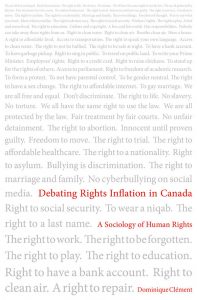
Debating Rights Inflation In Canada is a box of fireworks that would liven any book club. Clément notes that compared to 1867, when Canadians’ understanding of common rights was limited to ownership of land and Catholic schooling, postwar years have seen an explosion of rights dialogue. Canadians claim a right to privacy, housing and immigration, a right to work or die or obtain a safe supply of heroin or make free photocopies under the Copyright Act.
In 2013 the Supreme Court in what Clément calls a “stunning decision” ruled prostitution laws breached the Charter Of Rights. “It is hard to imagine a more striking example of rights inflation than a court overturning criminal laws that have existed since before Confederation,” writes Clément.
Debating Rights Inflation In Canada is scholarly, never snide and always provocative. “Rights inflation challenges the boundaries of our rights culture through rights claims that offer a new understanding of rights,” says Clément. “Is text messaging, for instance, free speech?”
Clément also questions the application of enforcement. If rights dialogue draws no distinction between grievance and atrocity then it draws no distinction between Mao and, say, Ted’s Tap & Grill of Burlington, Ont., fined $10,000 for kicking out a cannabis-smoking customer. “The Ontario Human Rights Commission determined he was guilty of discrimination on the basis of disability because the marijuana was medicinal,” writes Clément.
The book is fair-minded with opposing views. Rights lawyer Pearl Eliadis of Montréal complains Clément’s analysis is “troubling”: “Is it true that human rights no longer deal with real rights at all, but rather with watered-down or trivial versions of ‘real’ rights? The most striking examples of these critiques have been directed at human rights commissions, whose officials are sometimes cast as officious bureaucrats trolling for fringe claims from ‘surgery-seeking transsexuals’, say, or ‘unhygienic foreigners’ who won’t wash their hands, thus creating what critics see as a self-perpetuating cottage industry of dubious claims,” writes Eliadis.
“But this argument depends on a fallacy,” Eliadis continues. “Confusing where the right is being claimed with the right itself can indeed make cases bizarre. For example, the sit-ins and protests at lunch counters by African Canadians in southern Ontario in the 1960s could be reframed as fighting for the ‘right to have lunch.’ The famous case of Viola Desmond, a black woman who was thrown out of a Nova Scotia theatre in the 1940s, could be recast as a struggle for ‘the right to go to the movies.’”
Maybe. But Jean Pelletier was no Viola Desmond. And whatever is preventing Canada from achieving the workers’ paradise of equality, fraternity and liberty, it’s not Ted’s Tap & Grill.
By Holly Doan
Debating Rights Inflation in Canada: A Sociology of Human Rights, by Dominique Clément; Wilfrid Laurier University Press; 200 pages; ISBN 9781-77112-2443; $24.99
Freeland Inflated Losses: Data
Finance Minister Chrystia Freeland grossly inflated estimates of the Freedom Convoy impact on the economy, internal documents show. Freeland cited figures described in one Department of Transport memo as an “extreme case” that did not reflect actual data: “I have many figures in my head.”
A Genuine ‘Mass Movement’
The Freedom Convoy was the culmination of a “mass protest movement” against pandemic mandates and lockdowns, a convoy inquiry lawyer said yesterday. Counsel at the Public Order Emergency Commission counted more than 140 major demonstrations and legal challenges nationwide leading to the truckers’ blockade outside Parliament: “Just stick to the facts, the raw facts.”
Judge Promises Fair Dealing
Paul Rouleau, the Liberal-appointed judge heading the Freedom Convoy inquiry, yesterday promised Canadians a “fair and meaningful” investigation stripped of any partisanship. “Be prepared to work hard,” he told lawyers at the Public Order Emergency Commission: “The public has a right to know what happened.”