A Christmas recession is likely, the Department of Finance yesterday confirmed in a Fall Economic Statement. “Times feel tough,” said Finance Minister Chrystia Freeland: “We cannot support every single Canadian in the way we did.”
OK ArriveCan Audit 173-149
The Commons yesterday by a vote of 173 to 149 ordered a detailed audit of the ArriveCan app. The $54 million program intended to check cross-border travelers’ vaccine status was suspiciously expensive, MPs were told: “There is obviously something fishy going on.”
Note From Our Shareholders
Blacklock’s shareholders yesterday issued the following statement regarding threats of punitive sanctions by subsidized competitors on the Parliamentary Press Gallery executive: “We will fight these people. We are retaining counsel. We will vigorously enforce our lawful rights and the Gallery’s obligations under the Canada Corporations Act. We will seek costs and damages. We will hold directors personally liable for their misconduct. We will compel disclosure of confidential Gallery correspondence and cross-examine executive members under oath. We will name names.”

Bought Genocide-Made Pins
The Department of Canadian Heritage bought maple leaf flag pins from China even as the Commons voted to condemn the People’s Republic for crimes against humanity, records show. Federal contracts for patriotic paraphernalia were worth hundreds of thousands: “This is our national symbol. This is our country.”
Spent $1.3M On Dubai Junket
A junket to Dubai by Governor General Mary Simon and 45 invitees cost taxpayers $1.3 million, according to accounts disclosed yesterday by the Commons government operations committee. Federal agencies have yet to surrender actual menus from the trip that were equivalent to $218 per plate for breakfast, lunch and supper: “Oh my God, this is an astronomically high price.”
Spaghetti Up 26%: StatsCan
The price of spaghetti is up 26 percent nationwide on average, Statistics Canada reported yesterday. New grocery inflation figures came ahead of a Fall Economic Statement that will provide some inflation relief, said Prime Minister Justin Trudeau: “Yes there continue to be pressures.”
Subsidized Media “Terrible”
The state of Canadian journalism is terrible, a former CBC executive has testified at the Commons heritage committee. Legacy media are “memories of what they used to be” despite federal subsidies, MPs were told: “You need to give me money forever because nobody is buying my buggy whips.”
Bank Expects Mild Recession
A winter recession will not be severe, Bank of Canada Governor Tiff Macklem last night told the Senate banking committee. Macklem acknowledged his earlier forecasts were wrong: ““It’s not like we got everything right.”
‘We’ll Terminate Blacklock’s’
Parliamentary Press Gallery president Guillaume St-Pierre is threatening to “terminate” Blacklock’s ten-year membership on complaints of disrespectful treatment of subsidized competitors. St-Pierre of the Journal de Montréal yesterday would not release a mediator’s report in the case.
“The Gallery will consider taking appropriate measures,” St-Pierre wrote in a formal letter of reprimand. Blacklock’s contravened “the quiet and civil environment that members expect,” he wrote.
“The executive may determine it is appropriate to remove privileges from a member at any time for due cause,” wrote St-Pierre. “Membership in the Gallery could also be suspended or terminated.”
The Gallery has no bylaws on quietness or civility. Its constitution also restricts the Gallery from directing how members cover news or adjudicating grievances between competitors.
Threats of expulsion follow a 2021 motion in which Blacklock’s sought full disclosure of subsidies paid to members including the Journal de Montréal. Records show the Gallery executive from last May 2 began compiling vexatious grievances including a complaint Blacklock’s managing editor Tom Korski listened to English-only audio feeds from the House of Commons.
“It is important to listen to the French,” Catherine Levesque of the National Post, a former Gallery president, told a May 2 executive meeting. The Gallery refused to release the text of the noise complaints or grant Korski a chance to respond.
On June 7 and 8 President St-Pierre and the National Post’s Levesque attended the National Press Building to personally monitor Korski’s work habits. On July 11 the Gallery hurriedly drafted a Code Of Conduct. The code written by the National Post’s Levesque, Althia Raj of the Toronto Star and Dylan Robertson of The Canadian Press stated members must “avoid loud conversations” in the newsroom.
Opposed Disclosure 18 To 1
The Gallery also compiled pages of frivolous complaints from Gallery director Emilie Bergeron of The Canadian Press, freelancer Hélène Buzzetti, a former Gallery president, and Michel Saba, a Canadian Press reporter.
Complaints included allegations Korski created a “toxic environment” in the National Press Building by using a speaker phone, leaving the “House of Commons feed running all day” when the House was in session, referring to freelancer Buzzetti as “that idiot,” speaking to a competitor “in a vaguely threatening tone,” tearing a piece of paper “in a theatrical gesture,” propping open a newsroom door and posting a tweet critical of Canadian Press committee coverage.
The Gallery refused to allow Korski to address the board. It also refused to canvass 19 other newsroom reporters and clerks assigned desks in the National Press Building on the “toxic environment” claim.
Journalists the Gallery refused to question included freelancer Gerhard Braune, Andrea Gunn of the Halifax Chronicle-Herald, Adam Huras of Brunswick News, Kathryn May of Policy Options magazine, David McKie of the National Observer, freelancer James Munson, Tim Naumetz of iPolitics, Greg Quinn of Market News International, Cristin Schmitz of The Lawyers Daily, Antoine Trépanier of Le Droit, Pascal Vachon of TFO, Paul Vieira of the Wall Street Journal, Limin Zhou of New Tang Dynasty TV and Alex Binkley, dean of the Press Gallery, a member since 1975.
Threats of censure follow an April 7, 2021 Gallery meeting in which Blacklock’s sponsored a motion asking “that all Gallery members disclose all applications for grants, rebates or subsidies to any branch of the Government of Canada and that disclosures be published on a Press Gallery website.” The motion was defeated by a vote of 18 to 1.
Blacklock’s in 2020 also reported Canadian Press petitioned the Commons finance committee for 100 percent subsidies “to fully offset subscription fees paid by CP media clients,” and on August 25, 2021 reported Canadian Press launched a fact-checker service “that examines the accuracy of statements made by politicians” after pocketing $1.6 million in sole-sourced federal contracts.
By Staff
China Targets MPs, Senators
Chinese Communist agents are targeting MPs, senators and political aides, the Canadian Security Intelligence Service yesterday told the House affairs committee. “We are very concerned about targeting,” testified Michelle Tessier, deputy director: “Did the Chinese Communist regime interfere in the last federal election?”
Convoy Was “Calm, Festive”
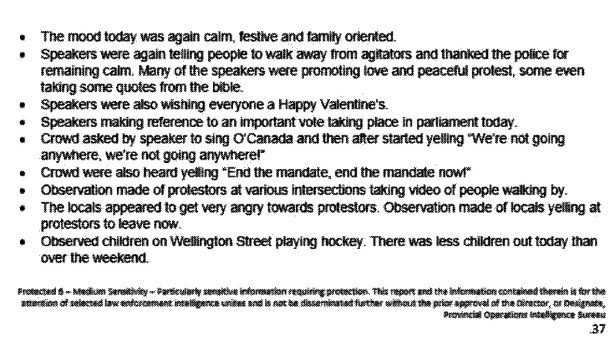
The Freedom Convoy was “calm, festive and family oriented” the day cabinet invoked emergency powers, according to an internal memo by Ontario Provincial Police. Protesters and their children were playing hockey, quoting the Bible and “wishing everyone a happy Valentine’s” at the moment cabinet claimed the streets were lawless, said the memo: “Speakers were again telling people to walk away from agitators and thanked the police.”
Most Still Working At Home
Most federal employees continue to work at home, Treasury Board President Mona Fortier said yesterday. The Canadian Chamber of Commerce petitioned cabinet to suspend the practice introduced in 2020 as a pandemic precaution: “Some public servants are back in the workplace at least two days a week.”
No Recession In Immigration
Immigration Minister Sean Fraser yesterday proposed to let nearly 1.5 million immigrants into Canada within three years despite fears of a recession. Cabinet’s latest immigration plan follows in-house research showing Canadians are skeptical of federal claims immigrants create jobs: “Go to a machine shop and see if they get talent on the shop floor to fill the orders.”
Convoy ‘Not Extremist’: OPP
Media and political leaders falsely characterized the Freedom Convoy as an extremist movement, according to confidential emails between Ontario Provincial Police commanders. There was no evidence convoy members were anything but political protesters, said one commander: “It is not an ‘extremist’ movement.”
Gov’t Worked Media Angle
Cabinet and political aides schemed on ways to perpetuate media coverage depicting Freedom Convoy members as “crazies,” the Public Order Emergency Commission was told yesterday. A lawyer for the truckers read out text messages in which Liberal aides contemplated a media campaign to depict protesters as violent, adding: “We need something to back this up.”