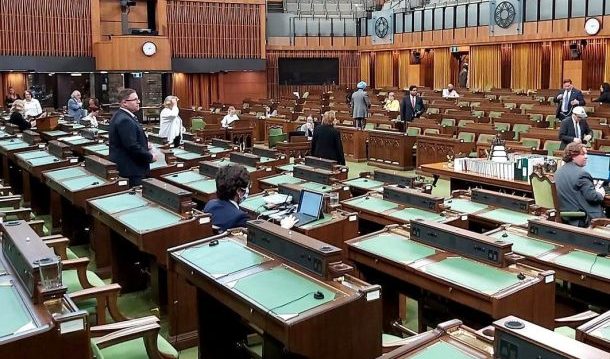
Beware Full Communism: MP

Covid mandates were “full Communism,” Conservative MP Dr. Matt Strauss (Kitchener South-Hespeler, Ont.), yesterday told the Commons in his maiden speech. Strauss, an emergency care doctor, was an outspoken critic of pandemic controls: “I refuse to be a cog in their broken machine.”

This content is for Blacklock’s Reporter members only. Please login to view this content. (Register here.)

Says Gaza Like WWII Murder

The New Democrats’ foreign affairs critic in a podcast Friday compared Jews’ military action in Gaza to the murder of innocent civilians in World War II. MP Heather McPherson (Edmonton Strathcona) was silent as her interviewer likened the killing of Palestinians to the Holocaust: “We are 19 months into this genocide.”

This content is for Blacklock’s Reporter members only. Please login to view this content. (Register here.)

Big Shift In Vax Views: Study

The pandemic prompted a “large shift” in parents’ views on vaccination, says a Public Health Agency report. Fears of unknown side effects are now common, wrote researchers: “The Covid-19 pandemic yielded a large shift in Canadians’ knowledge, attitudes and beliefs towards vaccinations.”

This content is for Blacklock’s Reporter members only. Please login to view this content. (Register here.)

Calls UFOs A Security Threat

UFOs are a national security issue though federal agencies decades ago deemed they were no threat, says the office of cabinet’s Chief Science Advisor. Dr. Mona Nemer’s office in an Access To Information memo said Canadians should guard against “undetected intrusions” from space: “Motivation: national security.”

This content is for Blacklock’s Reporter members only. Please login to view this content. (Register here.)

Most TV Viewers Are Over 65

Typical television viewers are senior citizens, says new CRTC research. The demographic profile of the TV audience follows repeated warnings that television is in steep decline: “In fact the likelihood of subscribing to a TV service increases with age.”

This content is for Blacklock’s Reporter members only. Please login to view this content. (Register here.)

Silence On Fire Preparedness

Cabinet won’t say what if any new steps on fire prevention have been taken by Parks Canada following a disastrous 2024 blaze in Jasper, Alta. One Alberta MP told the Commons the consequences of poor forest management were obvious: “We learned.”

This content is for Blacklock’s Reporter members only. Please login to view this content. (Register here.)

Recalling The House Tavern

Parliament ran its own tavern for 49 years. Sober and sadder are today’s holidays on Parliament Hill. Old-timers recalled the tavern fondly. Here the Fathers of Confederation took a bracer or entertained visitors. It was a “very natural” place, John A. Macdonald enthused.

The bar “accounted for the fine, free flow of language in the press and the House,” one senator wrote in his memoirs. “When the cold hand of prohibition closed the bar, something went out of the House.”

Another Parliamentarian recalled, “It was quite an ordinary thing for at least 50 percent of the members to be more or less under the influence of liquor when the House adjourned around midnight.”

Specialties of the House are today lost to history. Sessional Papers are silent on the question of what parliamentarians drank, though the tavern was so convivial reformers twice tried to shut it down, in 1874 and 1881.

Modern mythology depicts 19th century drinking as crude and violent. This is untrue. An 1844 creditors’ notice for a bankrupt Toronto grocer details all the ingredients of a first-rate holiday party: claret, Madeira, brandy and Muscovado sugar with ginger root, cloves and nutmeg.

One 1824 diarist wrote that Canadians seemed “very partial to Jamaica spirits, brandy, shrub and peppermint.” Shrub was a cocktail of berries boiled in vinegar and sugar. “Peppermint” was a mix of peppermint oil, whiskey and burnt sugar. The Ontario Historical Society detailed such early recipes in a 1989 booklet Consuming Passions: Eating and Drinking Traditions in Ontario.

What did the Fathers of Confederation drink? Not water, surely. Ottawa suffered periodic epidemics of cholera. An 1832 outbreak killed 1,421 people. And the city suffered occasional plagues of typhoid as late as 1912. To drink unboiled municipal water was to risk sickness or death.

Nor were pioneers partial to beer. The 1852 census showed Upper Canada had nearly twice as many distilleries as breweries. An 1859 visitor reported that ale was “rather a novel thing” in Canada compared to England.

The House tavern would have featured “fancy sugars, bitters, limes, lemons – quality citrus,” says historian Dr. Julia Roberts of the University of Waterloo. “I think they would have had a staggering array of incredibly good liquor: port, champagne, whiskey, rum. Rum was very, very popular.”

Dr. Roberts in her 2009 account In Mixed Company: Taverns and Public Life in Upper Canada calculated early Canadians downed nearly five ounces of liquor a day, more than eight times today’s rate of consumption. “They didn’t drink for relaxation,” she said.

“These were hard-labouring people who needed calories,” said Roberts. She calculated in the 1840s Upper Canada had nearly 1,500 taverns, the equivalent of one roadhouse for every 300 settlers.

Rum was so popular the Royal Canadian Navy maintained the tradition of serving sailors a noon-time tot until 1972. “Today only in very rare and exceptional circumstances,” a Navy spokesperson said as late as 2012, “commanding officers in the Royal Canadian Navy can still permit a celebratory issue of spirits to sailors of legal age.”

The House tavern did a roaring trade until it burned in 1916. Its location today is unmarked.

By Tom Korski

Book Review: Art And Catastrophe

Catastrophes inspire art. Many an 18th century painter documented the Great Fire of London and eruption of Mount Vesuvius. Artists similarly tried to chronicle Canada’s one true catastrophe as described by the Truth and Reconciliation Commission. The results have been jarring. Arts of Engagement spreads the canvas.

From 1867 some 150,000 Indigenous children were forced through the Indian Residential School system. The Commission appointed to examine the historical record was the product of a class action lawsuit, designed by liability lawyers. The outcome satisfied almost no one.

“Truth-telling was not to include the naming of individuals and institutions associated with wrongdoing ‘unless such findings or information has already been established through legal proceedings,’” writes Professor David Garneau of the University of Regina. “Truths were to be accounts of subjective experience, feelings and perceptions rather than the relating of facts.”

The result: Victims of child abuse were angered by public indifference, churches were baffled they as a group were classed as sadists and the public was resentful all Canadians were to be shamed for historical crimes sanctioned by officialdom. When the Commission declined to name names, when everyone is to blame, nobody is to blame.

Professor Garneau writes that the confines of Commission hearings discouraged the most telling testimony: “Rage, the refusal to forgive, the naming of names, the details of intergenerational effects, the use of Indigenous people in these schools to oppress their own, the deformation of masculinity there, discussion of what happened to the payout money and how it distorts individuals, families and communities, the Metis who were also subjects of these places, and so on.”

Yet the Commission’s work was poignant enough to provoke artistic expression. This is the core of Arts of Engagement. It is plaintive and absorbing.

Co-editor Dylan Robinson, Canada Research Chair in Indigenous Arts at Queen’s University, recounts one startling incident. At a 2012 hearing in Victoria where commissioners heard hours of tearful testimony on incidents of pedophilia and child cruelty, a local choir wrapped up the session with a song, Susan Aglukark’s O Siem. “I sat listening in disbelief,” Robinson writes.

“Fifty singers repeated the chorus, ‘O Siem, we are all family; O Siem, we’re all the same,’” Robinson recalls. It was supposed to make people feel better.

“To sing this song after three days where a history of inhumanity was overwhelmingly present felt both inappropriate and offensive,” says Robinson. “The irony in this song is, of course, that the history of abuse and cultural oppression in Residential Schools is anything but ‘the same’ as the education received by settler Canadians, nor are the present realities of Aboriginal communities and the settler Canadian public ‘the same.’”

Arts of Engagement cites another awkward incident at the National Gallery of Canada in 2011, where a visiting U.S. anthropologist delivered an oration on the meaning of the Residential School experience as expressed in art. The lecturer was white, his audience was Indigenous. “The crowd was sensitive to his lack of sensitivity,” Arts of Engagement notes. “The talk peaked with a comparison of the effects of Indian Residential Schools to flesh-eating disease compete with photographs. It was offensive, particularly to the survivors present. Oblivious and confused, the man was ushered from the building.”

Interestingly, the failed lecturer inspired an oil painting Aboriginal Curatorial Collective Meeting. It depicts a series of colourful panels with empty speech bubbles. It fits.

By Holly Doan

Arts of Engagement: Taking Aesthetic Action In and Beyond the Truth and Reconciliation Commission of Canada, edited by Dylan Robinson & Keavy Martin; Wilfrid Laurier University Press; 382 pages; ISBN 9781-7711-21699; $29.99

Carney Likes Protectionist Bill

Prime Minister Mark Carney yesterday endorsed a Bloc Québécois dairy bill opposed by free trade farmers as protectionist. An identical bill was gutted by Liberal appointees at the Senate foreign affairs committee last November 7: “I am going to give a direct answer to you.”

This content is for Blacklock’s Reporter members only. Please login to view this content. (Register here.)

Dep’t Links Pot To Psychosis

The Department of Health seven years after legalizing marijuana will mandate warning labels stating cannabis is an addictive drug linked to psychosis, schizophrenia and brain damage especially for users under 25. The department in earlier research referred to marijuana as less risky than teenage drinking: “Using cannabis before age 25 increases your risk of mental disorders like psychosis and schizophrenia.”

This content is for Blacklock’s Reporter members only. Please login to view this content. (Register here.)

“Rip This Place Down”: MP

An Alberta MP in his maiden speech to the Commons yesterday said Westerners would like to “rip this place down” and rebuild Canada. “Alberta separatism is no longer a fringe idea,” said Conservative MP David Bexte (Bow River): “The future of this country is not a guarantee.”

This content is for Blacklock’s Reporter members only. Please login to view this content. (Register here.)

Claim A Say-So In Secession

No province may secede without Parliament’s say-so, the Government Representative in the Senate said yesterday. Senator Marc Gold (Que.), a former law professor, called it “a matter of law” but did not explain how it would be enforced: “Could you state then what hurdles a province would have to clear before it could separate?”

This content is for Blacklock’s Reporter members only. Please login to view this content. (Register here.)

‘Shameful’ To Question Ethics

Opposition critics should be ashamed for questioning Prime Minister Mark Carney’s personal tax planning, the Commons was told yesterday. Conservative MPs sought assurances Carney had not taken advantage of offshore corporations to avoid paying his share of federal taxes: “They dig dirt on day one. Shame on them.”

This content is for Blacklock’s Reporter members only. Please login to view this content. (Register here.)