
The federal prison system has compiled recidivism rates based on inmates’ race. Data on Asian, Black, Caucasian and Indigenous parolees are intended to fill gaps in corrections, wrote staff: “The designation of ethnic groups is problematic.”
Court Upholds Credit Checks
The Federal Court of Appeal has upheld mandatory credit checks on government employees as a reasonable security measure. Unions opposed the program that’s spent millions on Equifax checks for federal staff: “Is it truly a threat, that they’re going to sell secrets?”
Judge Reopens Bias Probe
The Canadian Human Rights Commission has been ordered to reopen an investigation of claims “white French Canadians” are given preference in government hiring. The Federal Court order follows a 2015 complaint by a Black employee who uncovered data that few African-Canadians are hired: “Let’s dig a little deeper.”

Cannot Verify 1% Tax Claim
The Department of Finance says it has no idea how much it raised with a new tax rate on Canada’s top one percent. The department had claimed it was worth $2 billion a year, though the Canada Revenue Agency in Access To Information records described figures as puzzling: “Turns out we do not track tax amounts by tax brackets.”
March Madness Confirmed
A federal audit confirms “March Madness” overspending that sees government agencies burn through unused budgets before the fiscal year expires at midnight on March 31. An internal audit at the National Research Council found employees’ use of government charge cards jumped 231 percent in March: “We noted the increased pressure to spend budgets at fiscal year-end.”
Bus Ads Beat Twitter: Study
Military research confirms Canadians are more likely to read transit bus ads than use Twitter. The Department of National Defence polled the public on media habits to rate the impact of recruitment campaigns: “What is your main source of information?”
Wary Of Privacy Breaches
Nearly half of Canadians surveyed, 45 percent, say businesses do not respect their privacy rights, says newly-released research by the Office of the Privacy Commissioner. The report follows a data leak on 2.7 million customers by one of the nation’s largest credit unions: “Canadians feel they lack control”
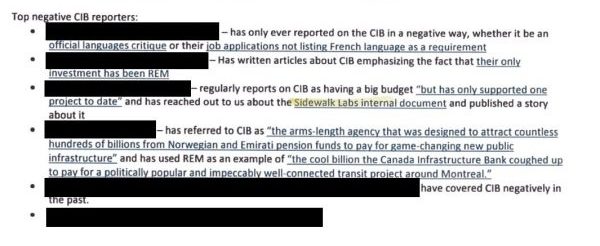
Agency Runs Media Blacklist
A Crown agency compiled a blacklist of ‘negative reporters’ faulted for unflattering coverage of its work. Access To Information records show the Canada Infrastructure Bank listed journalists who criticized the corporation, and named others whose work was so positive the Bank should “reach out to them again”.
Would Test For Pot At Work
A labour arbitrator has halted one employer’s attempt to begin random workplace drug tests to spot marijuana users. Cougar Helicopters Inc. of St. John’s blamed legalization of cannabis for proposing new safety standards on the job: “There is a serious issue.”
“Paralyzed” By Jury Duty
A juror who was mentally “paralyzed” by a gruesome murder trial has been cleared of alleged workplace fraud. The Toronto man was guilty only of failing to tell employers of his mental state, a labour arbitrator ruled: “The experience was horrific.”
Count 21 BBQ Brush Injuries
The Public Health Agency of Canada is calling barbecue cleaning brushes a health risk though reported injuries are rare. “Brush injuries don’t just happen in the summer,” wrote staff. “They happen throughout the year.”
Remove ‘White Race’ Plaque
A federal advisory panel yesterday recommended permanent removal of a plaque celebrating the “white race”. The tribute to Samuel de Champlain was unveiled in Orillia, Ont. in 1925 before a crowd of 10,000: “Originally the monument was about reconciliation between the French and the English.”
Spent $12M On Old Battles
The Department of Veterans Affairs in 2017 spent more than $12.3 million commemorating old battles, according to a newly-released internal audit. The spending topped annual funding for the Veterans Ombudsman or Veterans Review and Appeal Board: “Consider the price they paid, the burden they bore, the country they made.”
Drug Driving Still Acceptable
Marijuana-impaired driving remains more “socially acceptable” than drunkenness, according to focus group research by the Department of Public Safety. Federal regulators recommend cannabis users wait up to 24 hours before driving: “The stigma of driving high is definitely not like drunk driving.”
Plan Targets Prison Mistakes
The federal prison service has completed an Action Plan to prevent the mistaken release of inmates, according to an internal audit. The initiative follows the accidental 2017 release of a convicted British Columbia cocaine dealer with sixteen months left in his sentence: “The scheduled release date was incorrectly calculated.”