
Defence Minister David McGuinty included costs of tree-planting in attempting to meet a minimum 2 percent NATO target on military spending, Access To Information records show. The defence department still fell billions short: ‘It’s for the ongoing planting of approximately 14,450 trees at strategic locations.’
Vow No Hi-Speed Overrun
The Department of Transport promises its $90 billion regional high speed rail venture Alto will never go over budget. The department in a report to senators said “challenges are expected,” but did not elaborate: “How will Transport Canada make sure?”
Only Favoured Press Allowed
Immigration Minister Lena Diab’s office yesterday declined comment over its refusal to speak to independent media. Only newsrooms that meet criteria for government approval will be granted questions, according to a Department of Immigration notice: “The department must be satisfied.”
U.S. Upsets ‘Moral Compass’
Trade with the United States is compromising Canada’s “moral compass,” a Commons committee chair said yesterday. Liberal MP Salma Zahid (Scarborough Centre-Don Valley East, Ont.) said internal American immigration enforcement raised “serious human rights questions.”
Too Many Old, Male Anglos
Order of Canada recipients are too old, male and English-speaking, says a Privy Council memo. Cabinet aides in an Access To Information memo said work was underway to “modernize” civil honours: “Nominators are mostly older, male and English speaking and are extremely likely to nominate older male candidates.”
Want Deer Cull At Sacred Site
Parks Canada would license a deer cull at a “sacred site” under a proposal disclosed Saturday. Parks managers complained deer were a nuisance at Grosse Ile, Que., a historic quarantine station home to mass graves of thousands who fled the Irish famine of 1847: “That island is a sacred site.”
Reconciliation Rated Unclear
After 11 years of reconciliation fewer than half of employees in one major federal department say they have a clear understanding of what it means or how it applies to their work. It follows a 2024 Privy Council survey of Indigenous people that found reconciliation had not resulted in “any tangible improvements in the qualify of life for Indigenous people.”
MPs Question Green Windfall
MPs seek documents regarding millions in subsidies awarded to friends of the Liberal Party for a green energy project in Nova Scotia. One MP likened the windfall to the “green slush fund,” the scandal-ridden Sustainable Development Technology Canada agency disbanded in 2024 over conflicts of interest: “Canadians deserve transparency.”
Judge Orders Rail Disclosure
A federal judge has ordered public disclosure of locomotive data recorders. The ruling came in the case of electronic data that captured the final, terrifying moments of a fatal derailment in a mountain pass: “Railway companies are statutorily obliged to record this information.”
Want More Quake Protection
The Department of Natural Resources proposes a fully-automated earthquake warning system that would not only alert the public of impending disaster but slow trains, divert landing aircraft and shut off natural gas mains. No budget was disclosed: “Why have you not taken any steps to protect your property from earthquakes?”
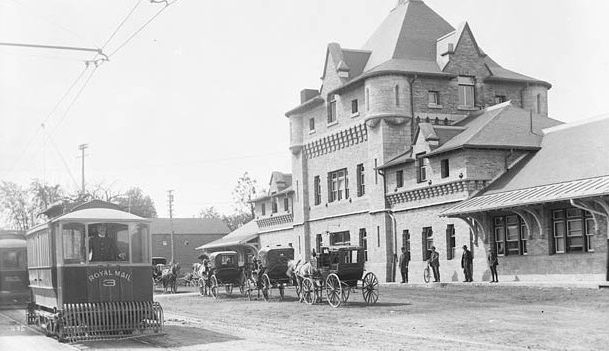
Ottawa Lost: Bagman Station
It was a monument to scandal. For 19th century visitors and VIPs, the last stop in Ottawa was Canadian Pacific Railway’s Broad Street station. It had no more frequent visitor than Prime Minister John Abbott, millionaire lawyer and CPR fixer. The station is gone now, the scandal forgotten. And Abbott is recalled only as the great-grandfather of actor Christopher Plummer.
The Broad Street station was designed by architect Edward Maxwell in the trademark chateau style the CPR made famous nationwide. It rang to the hiss and clang of steam locomotives on the Ottawa-to-Montreal run morning, noon and night.
Abbott traveled by free CPR pass between Montreal and Parliament Hill, but not always on public business. As counsel he incorporated the CPR and served as director. He also toted the cash used to buy votes in the House and Senate. Abbott was a key figure in the 1874 Pacific Scandal, “the most stupendous contract ever made under a responsible government,” as one newspaperman put it.
The CPR was granted $25,000,000 in subsidies, a land grant of 25 million acres, a 20-year monopoly on freight rates, free right-of-way through Crown lands and exemption from all local taxes in the West. In exchange the railway paid kickbacks to John A. Macdonald and his cabinet totaling $440,000.
“Even to railway promoters of the United States, accustomed as they were to the lobbying and corruption in the legislatures of their country, the lavish terms of this agreement caused astonishment,” wrote an MP.
Abbott kept a tally of all the payoffs but on the witness stand at a subsequent inquiry suffered a memory lapse. Asked if he acted as a CPR bagman, Abbott replied: “No, I don’t think I was –”
Public life made Abbott rich. He owned a fabulous mansion in Montreal and a 300-acre country estate on the west end of the island. Here he built a baronial house with a library and conservatories surrounded by farms, orchards and gardens. No wonder he didn’t have a residence in Ottawa. He could escape Parliament Hill, arriving at the Broad Street station at dinnertime and be in Montreal by 9 pm.
Despite the Pacific Scandal Abbott survived politically in the Senate. Named a caretaker prime minister in 1891, he served eighteen joyless months as leader. “I hate politics,” Abbott wrote. “Why should I go where the doing of public work will only make me hated?”
He remains the only prime minister who never made a public speech. When he died of cancer in 1893 Saturday Night magazine marveled the news “occasioned surprisingly little comment.”
The Broad Street train station burned in a 1900 fire. The old CPR tracks on what is now LeBreton Flats were removed by 1970.
By Andrew Elliott

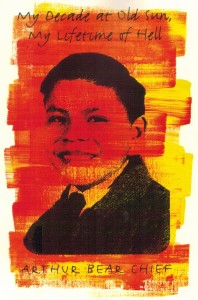
Review: For Nelson
First-hand accounts of horrific childhoods are rare in literature, and compelling: Charlie Chaplin’s My Autobiography, or A Memoir of Robert Blincoe, the recollections of an English workhouse boy that was so stark one U.K. reviewer said it made Oliver Twist look like a holiday camp.
From Athabasca University Press is My Decade at Old Sun, My Lifetime of Hell, the memoirs of an Indian Residential schoolboy. Arthur Bear Chief’s story is so raw it would have gone unpublished 30 years ago. Bear Chief notes with irony the Anglican Church didn’t give him much of an education at the Old Sun Residential School in Gleichen, Alta. His English skills were so poor that later, as a public servant, he had an ex-wife ghostwrite his government reports. The result in My Decade at Old Sun is a plain and riveting narrative stripped of adjectives and ornamental prose. It is vivid and powerful.
Bear Chief writes in memory of his best friend, Nelson Wolf Leg. He recalls the two little boys cowering in the dark awaiting a summons from the staff pedophile. “We made a promise to each other to never say anything about what happened to anyone, not even our parents. We also made a pact that if one of us died, the other would come forward and talk about our abuse. I can still vividly remember Nelson, both of us lying in my bed crying and holding onto each other for protection, and scared out of our wits,” writes Bear Chief; “I was younger than Nelson, and I can remember him wiping the tears from my face and saying, ‘Keep quiet.’”
Bear Chief went to Residential School at age 7 in 1949. Eight brothers and sisters were taken, too. He remembers when they came for his older brother: “Francis came running into the house, jumped up into the attic opening and crawled inside,” he writes. “Not long after that, three white men and an RCMP officer came running in. They dragged my brother down as he was screaming and kicking. They dragged him out, and my parents could not do anything. That was a preview of what was in store for me.”
My Decade at Old Sun recounts a boy’s aching loneliness, occasional joy – chocolate pudding was served once a week – and the reign of sadism. One gym teacher liked to rifle a soccer ball at the children’s heads. Another supervisor enjoyed terrifying students by waving his service revolver in class. The faculty kept a directory and checked off the name of any student heard to speak the Blackfoot dialect. A check meant weekly beatings. “We used to call Sundays ‘payday’,” writes Bear Chief.
“There were times when I would go out to the field by myself and sit there calling for my mother,” he writes; “My life is like a cocoon that never really hatched.”
Bear Chief recalls failed marriages and a battle with alcoholism, his letter of apology from the Anglican Church and a $105,000 out-of-court settlement. “My lawyers took 30 percent,” he said. The government charged GST.
Unlike other crime victims, Bear Chief and thousands of fellow Residential School students never had the chance to face their tormentors in court. Nobody named names, nobody went to jail. “Even now I cannot begin to comprehend a system that was so completely out of whack and so full of individuals who were just there to satisfy their cruelty and lust, or understand why they will never be asked to answer for what they did,” he says.
My Decade at Old Sun is an unforgettable memoir.
By Holly Doan
My Decade at Old Sun, My Lifetime of Hell, by Arthur Bear Chief; Athabasca University Press; ISBN 9781-7719-91759; $19.95
Agonized Over Gay Marriage
Newly-declassified 2004 cabinet minutes show then-Prime Minister Paul Martin agonized over legalization of same-sex marriage. Martin privately complained provincial courts had forced the government’s hand, according to Access To Information records disclosed yesterday: “Many Canadians are struggling with the idea.”
Alleged Graves ‘Confidential’
The Department of Crown-Indigenous Relations has censored as “confidential” its files on what a Kamloops, B.C. First Nation did with $12.1 million paid to recover alleged graves of Indian Residential School children. The Tk’emlups te Secwepemc First Nation acknowledged February 18 it never exhumed any remains: “The heartbreaking truth about Residential Schools’ unmarked burials continues to be unveiled.”
A.I. Layoffs Are Here: Union
Layoffs due to artificial intelligence are already underway, says one of the country’s largest unions. The Canadian Union of Public Employees in a report to senators itemized jobs that have vanished: “CUPE is already seeing job loss.”