
Foreign Affairs is the only federal department to buy a Huawei internet plan, accounts show. Staff did not explain the purchase dating from 2016, prior to the Vancouver arrest of a Huawei executive that led to Canadians’ detention in China and a billion-dollar trade dispute: “The Chinese government arrests people to use as bargaining chips.”
A Sunday Poem: “Spectrum”
Changes are coming
to Ontario’s autism program.
Families will get $20,000 a year
for children 5 and under,
$5,000 for youth 6-18.
But parents say
intensive therapy could reach $80,000.
The Social Services Minister,
and the Premier,
appear detached.
As though in their own world.
(Editor’s note: poet Shai Ben-Shalom, an Israeli-born biologist, examines current events in the Blacklock’s tradition each and every Sunday)

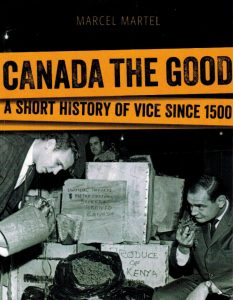
Review: 300 Yrs Of Fornication
Canadians don’t think of themselves as some of the most liberal people on earth, but we’re pretty close: gay marriage, nude theatre, cuss words in Parliament, no social aristocracy of any kind, and every liquor store has an ample parking lot.
When former Attorney General Vic Toews left his wife to take up with a younger woman he not only escaped shunning – Toews was appointed a judge – his friends said they were shocked, shocked anyone dare read Toews’ divorce papers, though they are public documents. This does not happen in America.
Our uniquely Canadian concept of liberty and vice is documented by Professor Marcel Martel of York University’s Department of History. Canada The Good is a sweep through three centuries of gambling, drinking and fornication. There emerges a kind of consensus that Canadians should be let alone to do what they want in the privacy of their homes.
When Parliament held an 1898 plebiscite on prohibition a majority voted to ban booze, and MPs promptly ignored the result. In Catholic Québec and New Brunswick, liquor was never much restricted. In Protestant Ontario and Alberta, dry laws were so successfully enforced the crime rate fell. It seemed everybody was happy.
“How should society prevent or reverse the disintegration of morality?” writes Martel. “Moral reformers considered various means for slowing down and hopefully reversing the degeneration process. Through their churches, they encouraged people to change their behaviour. According to Protestant morality, everyone should practice self-restraint.”
Martel’s research is delightful. Who is not wiser on knowing Canada’s first lottery was licensed in 1732, or that Confederation-era Halifax had 600 working prostitutes, or that Parliament’s 1869 Act Respecting Vagrants targeted any “night walker wandering in the fields…not giving a satisfactory account of themselves.” They just don’t write Acts like that anymore.
Canada The Good delves into the roots of much of the anti-vice law that persisted until cannabis was legalized in 2018. If the country maintained a “repressive anti-drug agenda”, as Martel puts it, the source dated from a 1908 debate in the House of Commons that resulted in Canada becoming one of the first countries to criminalize the sale of opium under threat of hard labour.
Also striking is how much of our historic campaign against wickedness reflects the character of one man, John Thompson, the justice minister who wrote the first Criminal Code in 1892. Professor Martel does not profile Thompson, though his story is documented elsewhere.
A rum-drinking Catholic with nine children and a hearty laugh, Thompson wrote the Code to reflect a world that long lingered in our criminal law. Alcohol was nobody’s business, homosexuality and birth control were outlawed, the public humiliation of stocks and pillories was abolished, and spanking children was okay if done in the home.
“The regulation of vice has changed over time,” notes Martel. “This should give us pause for reflection.”
By Holly Doan
Canada The Good: A Short History Of Vice Since 1500 by Marcel Martel; Wilfrid Laurier University Press; 210 pages; ISBN 9781-5545-89470; $29.99
Eye Mandatory Rights Panels
Parliament should mandate human rights committees in federally-regulated workplaces, the Canadian Labour Congress said yesterday. The Congress in a report said panels would combat “group hatred” against Muslims: ‘They are not asking for special treatment.’
Enviro Review List Is Secret
Federal regulators have drafted a secret list of projects subject to new environmental reviews, the Senate energy committee was told yesterday. The list is so secret even the Manitoba cabinet can’t see it, said the province’s Trade Minister Blaine Pedersen: “Surely to goodness between governments we can share this.”
Not Fair, Say Broadcasters
The Canadian Association of Broadcasters yesterday protested federal payroll subsidies for local newspapers are unfair to private TV and radio newsrooms. Cabinet proposes to spend up to $95 million a year on direct grants to dailies deemed reliable by a government-appointed panel: “Who is to say that print is more important?”
Star Contract Questioned
Conservative MPs on the Commons government operations committee seek a hearing on a 2018 federal contract to pay the Toronto Star to cover parliamentary committees. The contract was cancelled after the Procurement Ombudsman intervened.
“Much like the National Post is supportive of the Conservative Party, the Toronto Star is a known mouthpiece for the Liberal Party,” said Conservative MP Kelly McCauley (Edmonton West): “It plays into the controversy of the government putting aside $595 million of taxpayers’ money towards a media bailout.”
A federal agency, the Office of the Superintendent of Financial Institutions, last October 25 approved a sole-sourced contract to pay a Torstar Corporation subsidiary iPolitics INTEL to attend public meetings of the Senate banking and Commons finance committees. Staff said only the Star was “capable of performing the work” though 43 other news organizations are accredited to cover Parliament Hill committees. Hearings are open to the public.
“Government should not be sole-sourcing contracts without a specific reason, and there are legit reasons – something like Microsoft,” said MP McCauley. “The product’s not available from anyone else, there’s only one company to do the business, etcetera.”
The contract was cancelled December 5 following Blacklock’s complaint to the Procurement Ombudsman. Cabinet in an Inquiry Of Ministry tabled in the Commons said the contract was worth $71,190 and not $355,950 as originally reported, and acknowledged a total 80 employees already monitor parliamentary committees on behalf of 21 federal departments and agencies.
“What was the original purpose of the contract?” said MP McCauley. “Which minister initially approved the contract? Does the government have enough employees to monitor parliamentary committees without hiring the Toronto Star?”; “I have to wonder why we would sole-source the Toronto Star to do this work when there are private media people out there who could have easily done that,” said McCauley.
Notice of the contract was issued fifteen days after Torstar Corporation chair John Honderich published a commentary appealing for federal subsidies. “I think we’d prefer some real action on these files,” wrote Honderich. Torstar Corporation lost $31.5 million last year, according to public filings.
The Commons committee adjourned without voting on McCauley’s motion to investigate circumstances surrounding the contract. Liberal MPs indicated they would not support it.
Cabinet in its March 19 budget proposed a $595 million, five-year newspaper bailout including payroll subsidies for dailies deemed to meet unspecified journalistic standards. Criteria were not detailed.
By Staff
Senate Likes Disability Bill
The Senate yesterday gave Second Reading to a cabinet bill on accessibility, and referred it to hearings of its social affairs committee. The Commons passed the bill unanimously last November 27 though MPs noted it will not take effect for years even if it becomes law: “No one group should have to fight to enjoy the full rights of citizenship.”
37% Say Too Many Foreigners
A growing minority of Canadians complain the country is letting in too many immigrants, says in-house research by the Department of Immigration. More than a third of Canadians surveyed, 37 percent, said too many immigrants are coming to Canada. The rate was 26 percent in a 2014 department poll: ‘Attitudes are very important.’
House Passes Holiday Bill
The Commons last night by a vote of 211 to 87 passed a bill to proclaim a new legal federal holiday called First Nations, Inuit and Métis Peoples Day. The bill now proceeds to the Senate: “We got this done.”
Rollback On Drug Safety Act
Health Canada yesterday rolled back provisions of its own drug safety law following years of lobbying by the pharmaceutical industry. Parliament passed the Act in 2014, prompted by the death of a former MP’s daughter: “It is shameful.”
Vegas Junket Cost $158,533
Federal agencies spent nearly $160,000 to send employees on a January weekend junket to Las Vegas, according to accounts. Vegas temperatures averaged 18° at the time compared to -17 in Ottawa: ‘It is the most cost-effective method to gather technical information.’
Access Bill Crashes In Senate
The Senate legal and constitutional affairs committee yesterday vetoed numerous curbs on disclosure of public records sought by cabinet. Senators rewrote key amendments to the Access To Information Act after complaining the system is dysfunctional: ‘It is so broken in Canada.’
Unsure If $24M Plan Worked
RCMP in an internal audit say they are not sure whether a $23.8 million border crime-fighting program actually reduced crime. The so-called Shiprider program introduced in 2012 allowed U.S. agents to operate in Canadian waters: ‘A key limitation was lack of data.’
Didn’t Call Seven Witnesses
The Commons justice committee yesterday voted to end hearings on the SNC-Lavalin Group Inc. political scandal without calling seven witnesses accused of attempting to quash a prosecution of the company on fraud and bribery charges. Prime Minister Justin Trudeau questioned whether voters cared: “A lot of people will raise an eyebrow on that.”