
The Department of Employment is delaying release of a year-long investigation of migrant farm labour practices. Authorities earlier acknowledged “some criticism” of a federal program in place since 1966: ‘It will be made available at a later date.’
Vaccination Rate Still Poor
Flu vaccination rates are so low Canada will not meet an 80 percent target set 17 years ago, says the federal Public Health Agency. Influenza is blamed for 12,000 hospital visits a year and an average 5,000 deaths: “There is room for improvement.”
Copyright Act Fails: Memo
The Department of Canadian Heritage in an Access To Information memo says current copyright policy has let down creators. Witnesses at the Commons industry committee have complained of steep losses due to free photocopying by institutions.
“Copyright is not necessarily supporting them well,” said the 2017 memo Parliamentary Review And Creator Focus; “Cultural stakeholders have expressed the need to ensure Canadian creators share in the financial rewards resulting from increased dissemination of digital cultural content.”
More than a quarter of Canadians, 26 percent, admit to online theft of music, e-books, movies, software, TV shows and video games, according to a May 29 Industry Canada report Study Of Online Consumption Of Copyrighted Content: Attitudes Toward And Prevalence Of Copyright Infringement In Canada. Respondents told federal researchers they stole material because it was “easy to do” (39 percent) and “it’s what everyone does” (24 percent).
“How will the Minister ensure the upcoming parliamentary review of copyright will focus on creators?” staff wrote in the heritage department memo. “Part of a parliamentary committee’s task is to hear from Canadians on their challenges and priorities for action.”
“Throughout consultations on Canadian content in a digital world, we heard from Canadians and Canadian creators in particular,” the memo continued. “We heard that, while copyright remains a vital part of our creative economy moving forward, many creators are struggling to make a return on their creative investments.”
The current Copyright Act includes a “fair dealing” provision that permits free photocopying of works for private study or personal research. The Supreme Court in a 2012 decision Alberta v. Access Copyright expanded private study to include wholesale photocopying of textbooks and literature for classroom use. A federal judge in 2017 faulted York University for using free photocopies in millions of student course packs.
Authors earlier testified at committee hearings they’d suffered serious loss of income due to free photocopying. “My income is down 90 percent to $12,000,” said novelist Sylvia McNicoll of Burlington, Ont. McNicoll published two novels last year.
“I’m trying to make a living. It’s impossible,” said McNicoll; “I am drawing my pension and cashing in my registered retirement funds. After that, I will sell my house. What does that mean for future writers and cultural workers? Your job must become your hobby. You do it on your lunch break.”
Winnipeg novelist Patricia Robertson told the Commons industry committee her 2017 income of $10,353 was comprised mainly of a $10,000 Manitoba arts grant. “Large corporations including universities take all possible steps to protect their own intellectual property, yet apparently Canadian writers – who provide the imaginative and creative work that Canadian students read – are expected to underwrite the educational sector essentially for free.
Copyright hearings will resume after Parliament returns from its summer recess September 17.
By Staff 
17 Cities Studied For Radon
Few homeowners test for radon poisoning even in 17 cities targeted by Health Canada as high-risk, says federal research. The odourless gas is the leading cause of lung cancer in non-smokers: ‘An important objective is to understand attitudes of residents of radon-prone areas.’
Privacy Breach In Fed Court
A proposed class action lawsuit is challenging insurers’ collection of credit scores from policyholders. Lawyers alleged customers were pressured into agreeing to credit checks when filing auto claims: “It will be interesting to see how this plays out.”
Pot Waste Survey Underway
Statistics Canada has begun a three-year analysis of sewage to gauge the nation’s cannabis consumption before and after legalization. The monthly analysis of wastewater samples from cities nationwide should have been undertaken long ago, said one legislator: “It’s been performed in various countries for over a decade.”
A Poem: “Progressive”
We no longer masturbate
in Ontario.
That part of our sex-ed
flew out the window.
Let them touch themselves
in Halifax, Montreal, Winnipeg.
Even in Whitehorse
– what else is there to do
on long wintry nights?
Just not in Toronto,
Kingston,
Sudbury.
Here we fast-track our boys
to real manhood.
“Me Tarzan, you Jane”
more proper
than seeking consent.
And we teach healthy relationships,
ones that exclude
man to man,
woman to woman,
or anything LGBTQ.
That part crossed out too.
In Ontario
we remember our past.
In fact, we’re bringing it back
to the days before Google, Twitter, Snapchat,
with a 20-year old curriculum and a rotary phone,
trusting our new Leader
to take us down the path
where not knowing is knowledge,
division is unity,
news is fake,
and darkness and ignorance
trump.
(Editor’s note: poet Shai Ben-Shalom, an Israeli-born biologist, examines current events in the Blacklock’s tradition each and every Sunday)
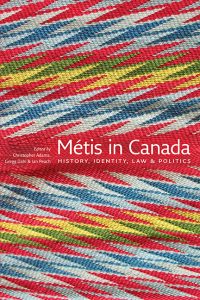
Review: “If They Are Half-Breed They Are White”
In a national census 409,065 Canadians identify themselves as Métis. They represent the 18th largest “ethnic” group in the country after Portuguese, Norwegians and Filipinos. Of course the Métis are unique, with centuries-old roots that define much of the nation’s history.
And yet –
Métis are iconic figures of Canadiana famed as self-reliant hunters, but they have spent the past forty years in court determining their aboriginal rights. Métis are a nation, but for centuries had no constitution or identifiable self-government.
As people of aboriginal and European descent, Métis rely on self-identification to count their numbers. Yet “a person can identify as Métis and not be legally entitled to exercise the Métis Aboriginal right to hunt for food,” note editors of Métis in Canada; “Furthermore, being legally entitled to exercise the Métis right to hunt for food does not necessarily indicate that such a person is also a member of a Métis political organization.”
Still, there is a uniquely Canadian logic to it. Everyone knows what is meant by the term Métis, and the people themselves are defined exactly by what they are not. The editors put it succinctly: “About the only elements that tie this diversity together are the facts of the Métis peoples’ distinctiveness – from other Indigenous peoples and from the settlers – and their constitutional recognition as rights-bearing, indigenous peoples in Canada.”
This University of Alberta press selection chronicles the unique Métis contribution to the Canadian story. The late Helen Bradley, former senator of the Georgian Bay Métis Council, recalled her childhood in the 1930s as the daughter of an Ojibwe-speaking father from Drummond Island and a French-speaking mother from Québec: “Mom would always say she didn’t have any native blood. Remember the Indian List? They couldn’t go into hotels. The Indians were getting bad names because of that; that’s why, I think, they didn’t want us to let on that we had native blood in us.”
Underscoring the story of the Métis is the vulgar term “half-breed”, still popular till recent times. As late as 1958 the parliamentary bureau of The Canadian Press referred to “half-breeds” in everyday coverage of federal bills affecting aboriginal land rights; as late as 1972 history schoolbooks approved for use by Ontario’s Ministry of Education approved history texts that cited “half-breeds” as a fixture of pioneer life.
In 1885 John A. Macdonald said, “If they are half-breed they are white.” Well, not exactly; Métis in Canada recounts an 1869 traveller’s telling observance that “half-breeds are a sort of half-and-half specimen of humanity, hardly entitled to the privilege of being called rational beings”; “The word ‘half-breed’ merely signifies where there is a tinge more or less of Indian blood – but whoever started the term ‘breed’ ought to have been choked before he had time to apply it to human beings.”
By Holly Doan
Metis in Canada: History, Identity, Law & Politics edited by Christopher Adams, Gregg Dahl & Ian Peach; University of Alberta Press; ISBN 9780-8886-48112; $52
Bank Made 307,000 Mistakes
A federal agency has cited an unnamed bank for misleading more than 300,000 customers over mortgage payments. The breach of Cost Of Borrowing Regulations occurred over a seven-year period before it was reported: ‘The bank argues its customers did not suffer harm; I do not agree.’
No Right To Know All Fees
Taxpayers have only a limited right to know how much government lawyers spend on contentious cases, says the British Columbia Information & Privacy Commission. The ruling contradicted federal decisions allowing disclosure of fees in ongoing or high-profile litigation including the Omar Khadr case: “There is no doubt a significant public interest.”
Want Tax Sweep At Airbnb
Hoteliers yesterday appealed to the Canada Revenue Agency for a tax sweep of Airbnb vendors. The Agency since 2004 has targeted similar audits against eBay sellers and PayPal account holders in Canada: “Home-sharing is one thing; it’s the commercial operations we’re looking at.”
Revenue Agency v. Charities
A charity that won a landmark July 17 court ruling on free expression yesterday accused the Canada Revenue Agency of duplicity in appealing the judgment while promising reforms. The Ontario Superior Court struck down a 1985 policy that limits charities’ participation in policy debates; “I don’t see any silver lining here.”
Migrant Layoff Ruled Illegal
An employer breached human rights law in laying off migrant workers ahead of Canadians, an Alberta Department of Labour adjudicator has ruled. ATCO Electric Co. said it feared it would violate federal regulations by keeping Jamaicans on staff while cutting its Canadian workforce: “There is no issue about ATCO’s good faith.”
Feds Claim Migrants Outdo Canadians In Small Business
The Department of Citizenship says immigrants are more entrepreneurial than Canadians. “This helps create jobs,” staff wrote. The department yesterday did not comment on the claim based on a 2016 analysis that included business-class immigrants.
Army “Botched” The Case
The Federal Court of Appeal has faulted the military over a routine workplace grievance that stretched into a nine-year legal battle. Judges ordered reconsideration of a claim that a medically-released veteran be allowed to sue the army for $400,000 in damages: “He did not have the opportunity to be heard.”



