
The Department of the Environment is granting a mining company approval to turn a freshwater lake into a tailings pond. The order requires that mine operators spend $2.2 million to create a new lake stocked with pickerel: ‘It would destroy fish habitat.’
Happy May Long Weekend
Blacklock’s pauses for the Victoria Day holiday with best wishes to subscribers and friends. We’re back tomorrow — The Editor.


Review: Us & The Solomon Islands
Dundurn Press marks the twilight of an era with an intriguing project. They compiled commentaries from the nation’s most distinguished monarchists in what may be the last book of its kind in the era of Queen Elizabeth, 92. It’s a souvenir that documents deep public ambivalence. Canada in 2018 is one of only fifteen nations to retain the Queen as head of state. Others include Papua New Guinea and the Solomon Islands.
“The concept of the Queen of Canada or the Queen of New Zealand is an important legal and political reality,” writes contributor Sean Palmer. “However, beyond these constructions the public understanding of the Crown in each realm is not necessarily robust.”
Essays in The Canadian Kingdom are refreshingly candid. Steven Point, former lieutenant governor of British Columbia, recalls riding to his swearing-in ceremony in a big white Lincoln past a group of protestors that included his own brother. They exchanged friendly waves. “The Crown is not so much misunderstood as ignored by Canadians,” writes Point.
“In my role as lieutenant governor I learned that government representatives have ears and listen to people of influence inside their respective ridings or electoral districts,” says Point. “I recall one instance when members of the royal family were coming for a visit. The lieutenant governor, who is second in precedence to the Queen, had not been invited to events surrounding the visit. It took a phone call from a wealthy citizen to change this oversight.”
The monarchy once embodied all the mythology of English superiority that was important to Canadians of the pre-war era. Anything English was therefore better: English tea, English fabric, English monarch. Today we think of a constitutional monarchy like alternating current: Sure it’s important, but if we didn’t have it, we’d have something else, and the lights would come on either way.
Contributor Christopher McCreery, private secretary to the lieutenant governor of Nova Scotia, notes 3 of 10 provinces – Alberta, Saskatchewan and Québec – do not even maintain an official residence for vice-regal appointees. Alberta was the first to evict its lieutenant governor, in 1938, amid popular support. “This erodes the dignity of the office in a tangible manner,” writes McCreery. “No longer are citizens summoned to attend events at Government House. Instead, they trundle off to some rented venue, usually entirely devoid of history or dignity of the state.”
Canadians as members of the Commonwealth do not feel part of something important or even relevant. We neither praise nor scorn the monarchy, but are simply indifferent. If MPs and federal judges still swear an oath of true allegiance to Her Majesty, Senator Serge Joyal (Liberal-Que.) notes the ritual has been the subject of nine court challenges since 1992.
“The interpretation given by the courts to the meaning of the oath of allegiance confirms that the loyalty and allegiance sworn is to our form of democratic constitutional monarchy,” writes Joyal. “However, it will tend to make the person of the sovereign appear more remote from the operation of our system of government. The bond between the monarch and her subjects will seem looser over time. The emotional, affectionate element of the oath between the Queen as a person and the one who pledges his or her allegiance will tend to fade away, making the sovereign an abstract concept, devoid of any humanity.”
By Holly Doan
The Canadian Kingdom: 150 Years of Constitutional Monarchy; edited by D. Michael Jackson; Dundurn Press; 248 pages; ISBN 9781-4597-41188; $25
Public Wary Of China Pact
Federal in-house research shows Canadians are wary of any free trade agreement with China. Cabinet has been attempting to negotiate a pact with the People’s Republic since 2016: “I distrust China.”
Passenger Complaints Rising
The Canadian Transportation Agency has denied general compensation to unhappy Air Canada travelers including an 89-year old woman left without a wheelchair, and a young family denied boarding amid confusion over travel visas. Cabinet has promised enactment of a passenger rights’ bill with statutory damages by year’s end: “It’s frustrating.”
Ash Trees Endangered: Study
Invasive insects may spell an end to ash trees in whole regions of Canada, caution University of Waterloo researchers. Damage from the emerald ash borer first detected in Windsor, Ont. in 2002 is estimated in the billions: “It’s sort of like a slow-moving catastrophe.”
Won’t Comment On Blacklist
The Department of Public Works will not say if Canada’s largest engineering firm will be struck from its bidders’ lists after a former executive yesterday was charged with arranging illegal political contributions. Under a 2015 policy, federal contractors convicted of wrongdoing can be blacklisted.
Bank Enforcer Rated Weak
A federal consumer watchdog says it has lesser powers than provincial regulators to protect Canadians from unfair treatment by banks. The review by the Financial Consumer Agency of Canada was prompted by 2016 Senate protests that the Agency is weak: ‘They essentially admit it’s something of a toothless tiger.’
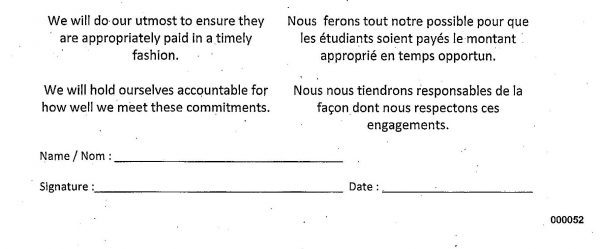
Take Pledge To Pay Students
The Privy Council has asked federal managers to sign an oath that they will pay students hired for government work. The pledge obtained through Access To Information followed complaints from two-thirds of students hired last year: “We will hold ourselves accountable.”
Rules Target Chinese Steel
Cabinet yesterday introduced long-promised regulations to counter dumped goods like China-made steel. Amendments to the Special Import Measures Regulations followed two years of review: “We’d like to see them go further.”
First Job Was ‘Re-Branding’
Canada’s newly-appointed ethics commissioner in one of his first acts in office hired an artistic director to devise a new look for the agency, according to records. Commissioner Mario Dion said he is also experimenting with video production: “It’s fashionable.”
Pot Grower Jailed 45 Days
In what may be the last sentence of its kind in Canada, a bookkeeper has been jailed 45 days for selling marijuana. Senators are to vote on whether to legalize cannabis in two weeks’ time. “Courts should not condone defiance of the law even if a change in that law seems imminent,” wrote a judge in Kitchener, Ont.: “He got burned.”
Press Gag Purely Canadian
Canada’s consul general in Los Angeles yesterday declined to speak to Canadian media after contacting a U.S. newspaper to complain about a YouTube video. The consulate explained all contact with Canadian journalists must be screened by the Department of Foreign Affairs.
“The policy is rather strict,” said Dan Pasquini, spokesperson for the California diplomatic mission. “The marching orders are really strict. I’m not going to get into the reasons why we do it this way.”
Consul General James Villeneuve earlier contacted a Los Angeles Times columnist to complain of unfair treatment of Canada in a pharmaceutical lobbyists’ YouTube video. The ad questioned Canadian regulation of imported medicines.
“Being Canadian, he was too polite to openly criticize the United States,” wrote Times consumer columnist David Lazarus in a May 11 item Canadian Officials Decry Jagged Little Pill Of Attacks By U.S. Drug Industry. “But Villeneuve allowed that the ads from the Partnership for Safe Medicines are ‘very deceptive’ and ‘kind of mean’.”
The Consul General was unavailable for comment when contacted by Blacklock’s. Spokesperson Pasquini explained rules for dealing with Canadian and American media are different.
“This may sound bureaucratic, but that’s us,” said Pasquini. “Any press requests from Canadian media have to go through the media people at the department. Our Consul General can engage with media in their regions.”
“We actually reached out to the Los Angeles Times reporter – that we can do – but Canadian media calls have to be referred to media relations in Ottawa,” said Pasquini. The department did not comment.
“I’m not sure he’d get in trouble,” added Pasquini. “He’s empowered to speak to the press in the consular region.”
Villeneuve’s comments to Canadian media are rare but not unprecedented. He previously granted a 2017 interview to Toronto’s Get Leashed Magazine to discuss his dog Poppy. “If you ask me, Poppy is a great diplo-mutt,” Villeneuve told the periodical.
The foreign ministry in a 2015 Ministerial Mandate letter wrote, “Members of the Parliamentary Press Gallery, indeed all journalists in Canada and abroad, are professionals who, by asking necessary questions, contribute in an important way to the democratic process. Your professionalism and engagement with them is essential.” Foreign Affairs Minister Chrystia Freeland in a May 3 statement observing World Press Freedom Day said, “We remind ourselves that without a free and independent press, we all lose.”
Villeneuve was appointed to the Los Angeles post in 2014. He was formerly vice-president of corporate affairs for Labatt Brewing Co. and campaign manager for ex-Toronto mayor Mel Lastman. Villeneuve’s budgeting as Consul General earlier prompted a departmental review after a 2015 Inquiry Of Ministry tabled in the Commons indicated he spent $12,460 on two buffets.
By Staff
Copyright Revenue Fell 80%
One of Canada’s most acclaimed independent publishing houses has told MPs its copyright royalties dropped 80 percent with free photocopying under federal law. Publishers and authors appealed to the Commons industry committee to tighten regulations that allow mass copying of works in the name of research: “For every cent we get, the author gets a cent.”
Blame High Prices On Zoning
Regulations are costing Canadian homebuyers an average of more than $100,000 over the actual cost of construction, say analysts. The C.D. Howe Institute yesterday said costs of restrictive zoning and development charges artificially raised prices in eight cities surveyed nationwide: “There is clearly some market dysfunction.”



