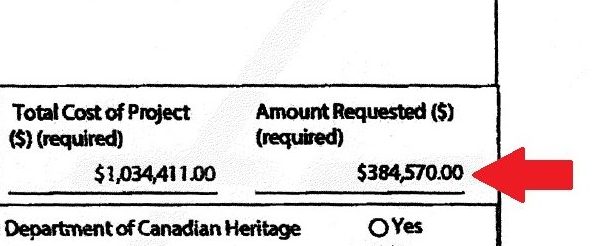
A newspaper lobby group, the Canadian News Media Association, has received nearly $385,000 in federal grants – the equivalent of more than half its annual budget – to encourage people to buy newspapers, according to Access To Information records. The funding was never announced. Costs include having $160-an hour publicists encourage celebrities to pose for Instagram photos reading a newspaper.
“We simply don’t have the resources to plan and execute campaigns of this scope and scale on our own,” wrote Bob Cox, publisher of the Winnipeg Free Press, in a letter to the Department of Canadian Heritage: “Even well-informed people often do not realize what is at stake.”
“The Winnipeg Free Press might also be in trouble,” wrote Cox, chair of the News Media Association. The daily has been in print since 1872. “This is the most serious crisis we have faced in our history,” wrote Cox.
The department approved the funding but yesterday did not comment. The Association’s grant application Call To Action proposed to seek endorsements from unidentified “high-profile Canadians, from traditional media ‘influencers’ to authors to politicians to business leaders, to showcase their passion for newspapers on their social media channels by asking them to share a photo of themselves on Instagram reading their favourite newspaper.”
“We will undertake a proactive national awareness campaign,” said Call To Action. “This campaign will be designed to drive consumers to take action, showing their support for the Canadian newspaper industry by signing an online petition. The success of this campaign will subsequently be leveraged with advertisers to encourage them to advertise in newspapers.”
The lobby group also suggested local papers sponsor screenings of “a high-profile film that promotes the essential role of newspapers in society, i.e. the 2015 film Spotlight.” The Academy Award-winning movie is about an American newspaper, the Boston Globe.
“I Couldn’t Agree More”
Heritage Canada approved a grant totalling $384,870. The subsidy is more than all federal grants of $284,532 paid to the News Media Association in the period from 2013 to 2018, and worth 52 percent of the Association’s annual budget of $729,174.
Subsidies include payments to News Media staff billed at $75 an hour, according to accounts, and $160 an hour for the Association’s publicist, Craft Public Relations of Toronto. The Association also proposed to spend $75,000 on Facebook ads, though publishers in their grant submission complained American social media like Facebook get too much advertising.
“As local advertising dollars move to international digital giants like Facebook and Google, we need to take every opportunity to tell our story and reaffirm the critical role our newspaper, and newspapers like us all across the country, play in Canadian democracy,” wrote Peter Kvarnstrom, president of community media for Glacier Media Group Inc., a Vancouver-based chain of 71 weeklies.
“Canadians have said they believe democracy would be threatened if established news organizations were no longer able to fulfill their civic news function and I couldn’t agree more,” Kvarnstrom wrote the department. “In an era of clickbait reporting, #fakenews and filter bubbles, strong, independent local news has never been more important.”
Cabinet proposes in 2019 to detail a $595 million, five-year subsidy for news media deemed reliable. The Department of Canadian Heritage as recently as September 29, 2017 vetoed any newspaper bailout.
“Our approach will not be to bail out industry models that are no longer viable,” said then-Heritage Minister Mélanie Joly. “Rather, we will focus our efforts in supporting innovation.”
Joly’s department has estimated any bankruptcy of the nation’s largest newspaper chain, Postmedia Networks Inc., would leave 28 cities without a daily newspaper. Postmedia is a member of the board of the News Media Association.
Postmedia this year paid its CEO $5.04 million in salary and bonuses, according to a Management Circular obtained November 28 by the online Halifax Examiner. Other executive pay included $2.2 million to Postmedia’s chief operation officer, and $1.2 million to its chief financial officer.
By Staff