New Carbon Tax Cost $600M

The Department of Finance in a confidential Access To Information memo says energy consumers in provinces without a legislated carbon tax will pay at least $600 million in higher fuel costs this year. Federal legislation mandating the tax nationwide is due this spring: “The impact on consumers and businesses will depend.”

This content is for Blacklock’s Reporter members only. Please login to view this content. (Register here.)

Bleak Outlook Puzzles Feds

Research for the Privy Council Office has uncovered a deep gloom among Canadians over wellbeing of the next generation. Staff in Access To Information memos expressed puzzlement over the data: “Why do Canadians say the previous generation had a better quality of life than they have?”

This content is for Blacklock’s Reporter members only. Please login to view this content. (Register here.)

Brace For Oil Spill Audit

The Canadian Coast Guard is bracing for another federal audit on the state of oil spill preparedness. The Commissioner of the Environment is to publish a report this fall, the third performance audit of its kind in eight years: “We are in charge.”

This content is for Blacklock’s Reporter members only. Please login to view this content. (Register here.)

Santa Refugee Gag Unfunny

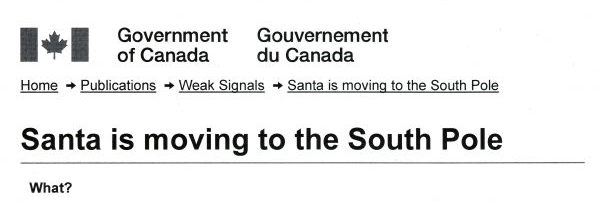
A Privy Council think tank in a sardonic notice says Santa has fled the North Pole as a climate change refugee. One MP described the mocking write-up as unfunny.

“It’s more like an April Fool’s joke,” said MP John Brassard (Barrie-Innisfil, Ont.), Deputy Conservative Whip. “It’s not even funny. To be frank, it is a bizarre statement to put out there.”

The Policy Horizons think tank in a notice Santa Is Moving To The South Pole wrote, “Thanks to rising global temperatures, rapidly melting Arctic ice and growing human operations in the North, Santa Claus has signed an agreement with the international community to relocate his village next year to operate in an exclusive zone in the South Pole.”

“Santa’s relocation agreement marks the first time the international community agrees on a common legal definition of climate change that includes refugees as corporations, as well as individuals,” the notice continued. “This deal is expected to lead to the deployment of a global climate change refugee visa system that in the near future could help to more easily relocate individuals and corporations facing the impacts of climate change.”

Policy Horizons staff yesterday did not comment. The notice was unsigned.

“If people who work there have nothing better to do than this, maybe they could be seconded to help fix the Phoenix pay system,” said MP Brassard. “That way their fellow employees can at least have gifts from Santa for their kids under the tree.”

The same federal agency in a 2016 paper Canada 2030: Scan Of Emerging Issues – Sustainability predicted the nation could become a preferred destination for climate change refugees fleeing catastrophic weather events. “Canada has the opportunity to become a preferred destination for climate refugees as well as companies trying to reduce their supply chain exposure to the risks of climate change,” said the report. “Canada may also have an opportunity to become an important producer of water intensive goods in the future.”

“Extreme drought, rising food insecurity and water scarcity in some regions of the world may have important impacts over the next 10 to 15 years including regional conflicts, spread of disease and viruses, and rising commodity prices” said Emerging Issues; “Even companies are evaluating their exposure to the rise in extreme weather events and are searching for climate-proof regions for their production facilities.”

Isabelle Perrault, spokesperson for Policy Horizons Canada, earlier said the paper was intended as “exploratory”. “We have not explored the types of economic opportunities that could be harnessed from climate refugees that come to Canada, so unfortunately cannot comment on that at this stage,” said Perrault.

“Our purpose is not to predict the future but to identify emerging issues,” said Perrault, adding the document “does not necessarily represent the views of the Government of Canada.”

By Jason Unrau

Gov’t Plans Trudeau Tribute

The Department of Canadian Heritage will observe the 100th anniversary of Pierre Trudeau’s birth but stopped short of reviving plans for a Parliament Hill statue, according to Access To Information records. One unsigned department document described the elder Trudeau as a polarizing figure: “Anniversaries must be nationally significant.”

This content is for Blacklock’s Reporter members only. Please login to view this content. (Register here.)

Court Rejects Wi-Fi Worry

A federal judge has rejected a bid by a former government researcher for access to Department of Health records on the impact of wireless devices. Regulators have repeatedly dismissed claims that Canadians are unknowingly exposed to risks from cellphone towers, Wi-Fi and other devices: “Where are the studies?”

This content is for Blacklock’s Reporter members only. Please login to view this content. (Register here.)

Feds Ran Propaganda Blitz

Health Canada in response to industry lobbying orchestrated a “detect and correct” media campaign to promote a regulatory change, say Access To Information memos. The propaganda blitz included confidential emails to unnamed friends who were to pose as “trusted experts” in providing reporters with helpful statements.

“If the gun isn’t smoking, it’s pretty hot,” said Cathy Holtslander, director of research and policy for the National Farmers Union of Saskatoon. “This is not the role of a regulator. The regulator should not be supporting a specific agenda.”

The Department of Health last February 21 approved the sale of irradiated ground beef. The Canadian Cattleman’s Association had lobbied since 1998 for amendments to Food And Drug Regulations to sell hamburger irradiated to kill bacteria and parasites.

In memos, Health Canada staff wrote they felt pressured by industry to amend regulations, and orchestrated a media campaign to bolster public support for the initiative. “Beef industry stakeholders have voiced concerns to the department over the lack of progress,” staff wrote in a 2015 memo Strengthening Food Safety In Canada: Authorizing The Use Of Irradiation For Treatment Of Fresh And Frozen Raw Ground Beef.

“Recognizing the potential for public and stakeholder reaction, Health Canada developed a proactive and reactive outreach and communications approach in support of advancement towards permitting the sale of irradiated fresh and frozen raw ground beef,” said the memo. The campaign included “proactive media outreach with both traditional and social media (to) ‘detect and correct’ as needed.”

Michael Masotti, senior advisor to the department’s director general of issues management, in a series of confidential emails said staff lined up “trusted experts” to parrot phrases promoting the benefits of irradiated beef. “In the past, media interest on food irradiation triggered by department initiatives was largely focused on safety concerns,” wrote Masotti; “This proposal should be expected to generate media attention.”

“Trusted experts from academia, industry and consumer or public health groups have been identified and will be called upon to issue public statements of support,” wrote Masotti. The department worked up a “preliminary list of high-profile supporters we could bring in” to contact reporters “should the announcement lead to some information disseminated by media, or voicing of concerns on the safety of irradiation.”

Won’t Name Names 

Health Canada yesterday would not release the names of unofficial spokespeople who were to pose as trusted experts. Masotti did not reply to an interview request.

“There is supposed to be a regulatory process,” said the Farmers Union’s Holtslander. “Going beyond that to get spokespeople to take a position – that just seems to be interference.”

The Department of Agriculture in a 2014 in-house survey found little public support for treating hamburger with radiation to kill bacteria from cattle feces. Just over a third of Canadians surveyed, 39 percent, said they would purchase irradiated beef if it was properly labeled, according to the Ipsos Reid research Consumer Protection Of Foods.

“We have not heard anyone, any farmer or consumer, ask for irradiated beef,” said Holtslander. “The department should be protecting the public, not protecting private interests.”

Amendments under the Food And Drugs Act were supported by the Canadian Cattlemen’s Association, Saskatchewan Stock Growers Association, Beef Farmers of Ontario and the Canadian Meat Council. A total 17,000 people signed an online petition against beef irradiation.

The Farmers Union in its submission noted the practice is not allowed in the European Union or Japan, and appeared to be a “mop up operation to compensate for unsanitary conditions and inadequate procedures” at packing houses that allow ground beef to be contaminated with fecal matter. “It was the meat industry, not consumers or retailers, who asked for it,” the Union wrote in an August 15, 2016 submission to the health department.

Memos showed Health Canada gave early notice of the regulatory change to individuals it considered friendly – a “confidential heads-up”, wrote staff — to help “proactive communication by you in support of the irradiation proposal.”

By Tom Korski

Caution On Spam Rewrite

A Commons committee report urging sweeping changes to Canada’s anti-spam law is flawed and should be reconsidered, says the committee’s New Democrat vice chair. Members of the industry committee said the 2014 law is overly broad and should be rewritten: “This means opening up the legislation.”

This content is for Blacklock’s Reporter members only. Please login to view this content. (Register here.)

English-Only Hiring OK’d

The Federal Court of Appeal in a rare split decision has ended a three-year legal battle over preferential hiring in the public service. An agency was faulted for skewing a bilingual job search to hire a single candidate who didn’t speak French: “The language of work is no trifling thing.”

This content is for Blacklock’s Reporter members only. Please login to view this content. (Register here.)

Memos Question Nt’l Ad Ban

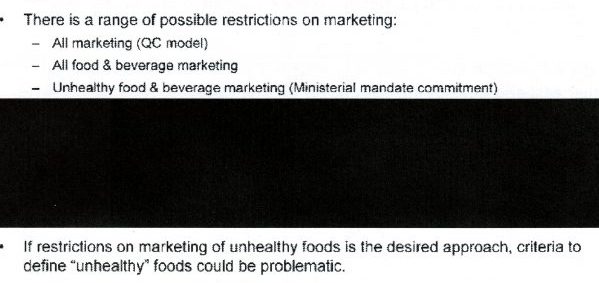
The Department of Health in Access To Information files says a proposed national ban on food ads targeting children is problematic and possibly unenforceable. The department concealed 512 pages of redacted memos for two years: “It is incumbent on Parliament to make sure they get this right.”

This content is for Blacklock’s Reporter members only. Please login to view this content. (Register here.)