
A dispute over “pollution” exemptions in commercial insurance policies will not be heard by the Supreme Court. Justices declined to hear an appeal by a British Columbia company denied coverage following a disastrous fire: “This is a super important issue”.
Review: Globaliz… — Yeah, Whatever
Globalization, phooey.
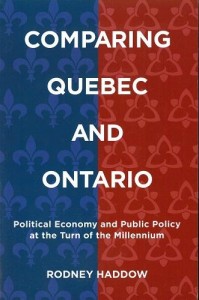
If our century is a march to international corporatism and conformity, why do such vastly different societies thrive on opposite banks of the Ottawa River? In this book of dissent, political scientist Rodney Haddow of the University of Toronto documents the striking absence of anything resembling globalization in our own neighbourhood. It’s a neat proposition.
First, the facts. Ontario and Québec combined have a population of 22 million, only slightly less than Australia and twice the size of Greece.
All provinces now control a majority of government revenues nationwide, about 57 percent. Premiers, not Parliament, pretty much run the country under terms of Confederation that were never appreciated at the time. Haddow explains, “The Constitution Act 1867 grants the federal government almost unlimited fiscal authority while requiring the provinces to rely primarily on direct taxes. The provinces were assigned most social responsibilities, but these were considered to be modest in nineteenth-century Canada.”
In John A. Macdonald’s day most revenues came from tariffs – income tax was considered revolutionary – and the only welfare program per se was the voting of annuities to widows of federal judges. “Social responsibilities became much more important in Canada as it constructed a modern welfare state after 1945,” Haddow writes. “The provinces’ capacity to raise funds from their own resources grew substantially and was complemented by rapid program expansion.”
Here the trail takes a winding course.
Comparing Quebec And Ontario documents widely different postwar societies built by neighbours. You’d struggle to find two states within the European Union that have more diverse governments.
Québec has a higher rate of union membership; less foreign trade; an older population; fewer immigrants; more debt; a similar jobless rate; higher taxes but better benefits for families. The last point is spectacular. In 2011 a single mother received $4,078 in benefits in Québec but only $1,860 in Ontario.
Childcare in 2002 cost $3,600 in Ontario, but only $1,400 in Québec. True, one province received more federal transfers than the other, Haddow notes, but that does not explain the contrasting values in where they spent the money.
In a single year, 1986, more than 10 percent of the entire province of Québec received social assistance. Ontario by comparison in the 1992-93 recession cut operational spending by one-tenth and fired 5,000 public servants.
Why? Haddow attributes the gulf to “dissimilar party systems”; there is comparatively little daylight between most Québec politicians on issues of taxing and spending, while Ontarians can still argue over the minimum wage.
“These results are resilient in the face of controls for globalization and post-industrialism,” Haddow concludes; “Differences between Ontario and Québec do not disappear when we control for the impact of globalization and post-industrialism, separately or together. These forces are not causing our provinces to converge.”
In Geneva and Brussels and Tokyo globalization is all the rage. Yet it dies on the right lane of the Champlain Bridge as you cross the Ottawa River.
By Holly Doan
Comparing Quebec And Ontario: Political Economy and Public Policy at the Turn of the Millennium, by Rodney Haddow; University of Toronto Press; 392 pages; ISBN 9781-4426-27017

CP Rail Loses Landmark Case
One of the country’s largest railways has lost a landmark challenge of federal law restricting a “near-monopoly” of service to commercial shippers. The Supreme Court rejected an appeal by Canadian Pacific Railway Co. of regulations expanding competition for Prairie shippers: “You really need to play hard ball with the railroads”.
Cabinet Pressed On Plan To Privatize 71 Border Crossings
Union executives are pressing cabinet for an explanation of a plan to privatize scores of Canada Border Services Agency crossings with 30-year leases. Public Safety Minister Ralph Goodale, responsible for the Agency, did not comment: “There was no consultation at all”.
Flying Horses Costs $500,000
The RCMP is spending an estimated half-million dollars on a two-week flying tour of Europe for the Musical Ride. The precision drill unit earlier faced budget cuts by a Liberal cabinet facing large deficits: “RCMP horses do not have passports”.
$100K For “Virtual” Combat; No Real Combat In 66 Years
The Royal Canadian Navy is buying $100,000 worth of virtual gaming software to train personnel. The Navy has not seen actual combat since 1950: “There will never be a substitute for hands-on experience”.
Survey Follows Complaints
Federal regulators are issuing a national questionnaire to seek Canadians’ views on internet service. The initiative follows a sharp rise in complaints over billing and service: ‘It’s increasing year over year’.
Privatization Program OK’d; To Lease 71 Border Crossings
Canada Border Services Agency has okayed a mammoth privatization of border crossings after citing “pervasive” maintenance costs. As many as 71 land crossings will be refit and leased to private investors. Contractors were warned not to speak to media: “The supported program of works spans all regions of Canada”.
Enviro Work Injury Claim In Court: ‘Could Impact Many’
The Supreme Court today hears an appeal that tests the scope of workers’ compensation. The lawsuit involves co-workers at a British Columbia lab who reported a suspiciously high incidence of cancer though no “causal” link to the jobsite was proven: ‘Evidence is available even if the science isn’t clear’.
Feds Rewrite Oil Spill Order
Environment Canada is revising oil spill clean-up directives for industry for the first time in 16 years. It follows new research prompted by Enbridge Inc.’s Northern Gateway project: “Science continues to evolve”.
Sea Traffic Down, Tolls Up
The St. Lawrence Seaway is raising tolls for a third year despite a sharp decline in traffic. Managers proposed a 2 percent increase in 2016, following combined 5.5 percent increases in two previous years: “The Seaway is the bellwether of the economy”.
Millions Feared Lost At Mint
The Royal Canadian Mint will not divulge costs after failing to find a U.S. buyer for electronic currency software it once lauded as “the future of money”. The so-called MintChip program was cited for a ten-fold increase in research budgets totaling $34 million: “A great name, mint cookie”.
Fed ‘Engagement’ Tour Cost $300K; Public Wasn’t Invited
The National Energy Board spent nearly $300,000 on a “national engagement tour” that didn’t include any public meetings. The initiative followed 2012 amendments to the National Energy Board Act limiting public testimony at licensing hearings: “We need to be far more attentive”.
Slow Go On Red Tape Reform
The Department of Social Development admits little progress in a red-tape reduction measure passed by Parliament last year. The reform was calculated to save $47 million a year by simplifying the reporting of a taxpayer’s death to numerous federal agencies: “Its implementation will take place incrementally”.
CRTC Ponders Local TV Aid
Federal regulators are reviewing the state of local TV news following dire financial reports pointing to station closures. The CRTC said its “open to any other proposal” after cancelling $100 million-a year grants to smaller stations: “It’s not working”.