
MPs say they are unable to reach a consensus on a report citing the perils of marijuana. Health Canada’s own surveys show many Canadians are ambivalent about cannabis use: “It was no longer seen as a substance that only the ‘druggies’ use”.
Dep’t Sets Gluten Labelling
A minor change in Health Canada label regulations that was 10 years in the making is being hailed by health advocates. The department says it will clarify which oat products can be promoted as gluten-free: “It sounds like a tiny distinction but it is actually significant”.
Bootleg News Claim Settled By Canadian Media Monitor
Friends Of Canadian Broadcasting has settled a copyright claim after republishing media news content without the owners’ permission or licensing agreement. The advocacy group claimed “fair dealing” under the Copyright Act in freely publishing paywalled news on its website.
Blacklock’s Reporter sued in 2014 after the group reprinted a single story on its website and refused to remove the article for some five weeks after being contacted by management. “The Copyright Act saves newsroom jobs,” said Blacklock’s publisher Holly Doan. “Covering the news costs money, and reporters deserve to be paid for their work.”
Blacklock’s sued for economic and punitive damages in a Federal Court application claiming breach of copyright; and asked that Friends identify their source for the article.
“We welcome a settlement in this unhappy matter,” Doan said. “Copyright is not a technicality; it is our livelihood.”
The dispute followed Blacklock’s publication of a February 14, 2014 article “CBC Its ‘Own Worst Enemy’”. The item recounted Senate committee testimony by Konrad von Finckenstein, former CRTC chair. Von Finckenstein had told senators, “The CBC is also its own worst enemy”; “It has not articulated clearly and precisely how it intends to thrive in the new digital environment, given its mandate and the fiscal restraints. Its strategies appear to be a vague repetition of what is set out in the Broadcasting Act.”
Friends Of Canadian Broadcasting published an identical version of Blacklock’s story on its own website within days, claiming it was entitled to do so under the Copyright Act without permission or payment for distribution rights.
“Our lawyers advise us that we can fairly deal with works that are only available by paid subscription,” Ian Morrison, Friends spokesperson, wrote in a February 27, 2014 email; “Friends earns no money from the operation of the database.”
The group claims an estimated 200,000 financial donors. It has spent more than $256,000 on third-party election advertising since 2011, according to Elections Canada.
Documents submitted to court by Blacklock’s included a Friends mail-out to contributors that cited Senate CBC hearings in appealing for funds: “We need your help to keep a very close eye on these folks, to expose their hostility to public broadcasting, and to connect the dots to Stephen Harper,” read the mailout.
Friends maintains a large database of other media’s stories for free use by internet visitors for “scholarship, research, private study and related purposes,” Morrison said; “Friends operates the Media Monitor database which stores reports of news and events pertaining to the broadcasting system, media ownership and cultural policies in Canada.”
Terms of the settlement are confidential. Blacklock’s publisher noted subscription revenues are crucial to all paywalled media to recover costs of news coverage. “We will vigorously defend our rights,” Doan said.
By Staff 
Senators Can Filibuster C-377
The full Senate is taking up Bill C-377 for the first time since a failed bid by the Conservative majority to limit debate on private bills. Current rules permit any filibuster of the contentious bill that would force all unions to disclose confidential data: “Once you force a vote, the majority will win every time”.
Cabinet To Veto A Bank Fee
Cabinet in a financial first will abolish monthly fees charged by banks to issue paper statements to customers. Finance Minister Joe Oliver yesterday promised the consumers’ initiative. Oliver’s department could not say the last time a Canadian cabinet forced repeal of any bank service fee: “Stay tuned”.
No Fingerprinting Of Citizens
The Government of Canada will not collect and store photos and fingerprints of citizens, authorities promise. The pledge comes as lawmakers review amendments sanctioning the largest fingerprint database in Canadian history: “I could care less about the people that aren’t breaking the law”.
Says Cull Birds, Save Salmon
Federal regulators should consider a cull of fish-eating birds to preserve wild stocks of Atlantic salmon, the Commons fisheries committee has been told. A Nova Scotia conservation group said a cull of cormorants should be investigated: “Canada has to do better”.
Feds Appeal Senate Lawsuit
Cabinet is widening a legal battle over whether Senate vacancies must be filled by the Prime Minister. The government is appealing a Federal Court ruling that the case proceed after federal attorneys argued the claim was frivolous.
“It’s difficult to avoid the inference that the respondents are trying to drag this out,” said Aniz Alani, a Vancouver attorney who filed the original lawsuit to appoint more senators. There are currently 20 vacancies in the 105-seat chamber, with another five senators due to leave within a year as they reach the mandatory retirement age of 75.
Prime Minister Stephen Harper halted all new Senate appointments last August 23 after three Conservative senators were suspended in an expense scandal. Two – Patrick Brazeau and Mike Duffy – subsequently faced criminal charges, still unproven in court.
Alani said he’d hoped to have his legal claim settled by this October’s federal election till the government responded with a series of challenges, first arguing the lawsuit should be dismissed as pointless, and then appealing the ruling of a federal judge that it was worthy enough to proceed.
“They have in correspondence vigorously opposed any effort to expedite the hearings,” said Alani; “I suppose I always considered it was a possibility they could do that, but wanted to give them the benefit of the doubt.”
Alani argues that under the 1867 Constitution Act the Prime Minister has no choice but to immediately fill Senate vacancies as they occur. Under section 32 of the Act, “When a vacancy happens in the Senate by resignation, death or otherwise, the Governor General shall by summons to a fit and qualified person fill the vacancy.”
Prof. Adam Dodek of the University of Ottawa law faculty said the lawsuit illustrates a valid constitutional point. “The case raises the important issue of whether there is any legal recourse if the Prime Minister simply refuses to appoint persons to the Senate,” Dodek said. “In other words, is it legally permissible for the Prime Minister to simply let the Senate wither away into nothingness?”
Federal Judge Sean Harrington, who earlier rejected the government’s claim the issue was not a court matter, wrote that new senators will eventually have to be appointed as age and attrition take their toll. “Certainly at some stage senators have to be appointed,” Harrington wrote. “If there were to be no quorum, Parliament could not function as it is composed of both the House of Commons and Senate.”
The Senate requires a quorum of 15 members. It currently has 82.
By Dale Smith
C-377 Is Challenged On Costs
A contentious bill to compel unions to disclose confidential information is being challenged on a legislative technicality. Liberal and Conservative critics said C-377 will cost taxpayers millions of dollars, violating the scope of private bills: “Does Parliament have the right to do this?”
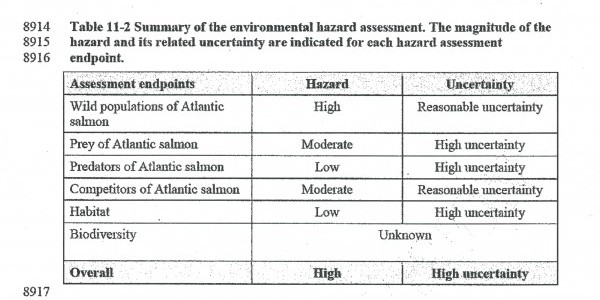
Lab Salmon ‘High’ Risk: Files
The fisheries department privately warned of “high” environmental risks from made-in-the-lab salmon despite public assurances, documents reveal. The disclosures were made in court documents filed in a federal lawsuit by two environmental groups: “It is incredibly frustrating to see this being kept from public view”.
Thanks For Liability Cap, Oil Pipeline Co’s Tell Parliament
Pipeline corporations are praising a cabinet bill that caps the industry’s liability at $1 billion in case of an oil spill. However executives of the Canadian Energy Pipeline Association contradicted each other on whether the coverage would actually cover costs of an eco-disaster: “Call it a worst-case scenario”.
Feds Lose Student Debt Case
The federal Student Loan Program has lost a bid to force repayment of thousands in debts from a jobless graduate. The ruling in a Saskatchewan court allowed a bankrupt student with a Bachelor of Arts degree to avoid $33,870 in federal loans: “I am not satisfied she obtained a benefit from her education”.
Gas “Gift” Beats U.S. Terms
Changes to natural gas export licenses rated a “gift” to industry will see Canadian firms granted double the licensing terms of U.S. corporations, says the Department of Natural Resources. The changes were inserted in a 157-page omnibus budget bill: ‘It provides greater certainty to investors’.
A Poem — “La Dolce Vita”
Nordstrom and Whole Foods are moving in;
David’s Tea is announcing a major expansion;
Parliament undergoes a $3 billion renovation; and
full-page ads by Rocky Mountaineer
offer life-changing trips
for over $1,000 a day.
Oh, and for one senator,
cold Camembert isn’t good enough.
The Liberals have yet to hear about all this;
they still think
the next election
is about the economy.
(Editor’s note: poet Shai Ben-Shalom, an Israeli-born biologist, examines current events in the Blacklock’s tradition each and every Sunday)
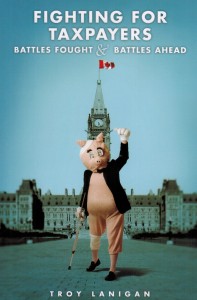
Review — The Pig & The Spendthrifts
Of all populist movements to spring from the Prairies in the Mulroney era – and there were dozens – none achieved a more enduring impact than the Canadian Taxpayers Federation. Disparaged by critics as a Conservative shill, nobody gave spendthrift Conservatives more grief.
The group once rolled up its giant debt clock outside the party’s national convention: “It was detained by the RCMP and searched by bomb-sniffing dogs,” recalls Federation president Troy Lanigan.
Does the language commissioner really need a car and chauffeur? Did cabinet really have to spend $12 million training geologists in Ethiopia? What was the defence department thinking when it wrote 167 pages of specifications to order mukluks? The Federation has an opinion on that.
Fighting For Taxpayers is an affectionate account of the group’s founding and grassroots financing. Born as the Association of Saskatchewan Taxpayers in 1989, it became a kind of national magpie caw-cawing over frugality in a cheeky, abrasive manner guaranteed to irritate officialdom. “Years ago a TV reporter in the Victoria press gallery, Robin Adair, made the point to me that government employee unions had spokespeople in the capitals who built relationships with legislature reporters and were available for quick comment on provincial affairs,” Lanigan writes. “Part of our media success, especially breaking into the daily news cycle, was building similar relationships and offering a counterpoint in an arena where big-government advocates had enjoyed a virtual monopoly for decades.”
In the pre-Federation era media heard no taxpayers’ voice save the annual rumblings of the Auditor General and Question Period needling of opposition MPs. The Federation opted for pitchforks and torch parades. The results delighted ratepayers.
“Few things have provided more laughs than writing the Teddies script each year”, the name given the Federation’s dubious awards for wasteful spending, Lanigan writes: “From snowplows moving nothing but air in Montreal, to an escalator going straight into a wall; the Saskatchewan government losing $36 million trying to grow potatoes; the federal government advertising a non-existent jobs program; Liberal Senator Raymond Lavigne ordering his staff to cut down trees on his neighbour’s property.” This is gold.
Fighting For Taxpayers pulls some punches. The Federation has always been strangely silent on farm subsidies; many farmers are subscribers. And it pays homage to Jason Kenney, a pioneering organizer from 1991 to ’95, without noting Kenney as a member of cabinet voted for the largest single deficit in Canadian history, a whopping $55.6 billion in 2013. “Post-Kenney, the Canadian Taxpayers Federation would become a better organized, more stable place, but it would lose the naïveté, the fearlessness and the rawness that defined those early years,” Fighting reports. Taxpayers are left to wonder what it was that Kenney took from the experience.
Yet the Federation remains essentially true to its mandate. Few employees have taken government jobs – Lanigan counts 10 in 25 years: “If I had my way the number would be zero”. And Federation directors to their credit are rarely seen at Ottawa cocktail parties.
The Federation remains a hell-raiser that delights in ridicule, as shown in their choice of mascot: Porky The Waste Hater, the invention of former research director Adam Taylor: “It cost $50 to rent Porky at Malabar costume rentals in Ottawa, but since it was rarely rented, the owner told Adam in 2005 ‘for an extra $40 you can have it’. And so, for the princely sum of $90, Porky earns hundreds of thousands of dollars’ worth of publicity each year, primarily as the star attraction of the Teddy Waste Awards.”
Fight the man!
By Holly Doan
Fighting For Taxpayers: Battles Fought & Battles Ahead, by Troy Lanigan; Canadian Taxpayers Federation; 163 pages; ISBN 9780-9940-13200; $21.95