
The St. Lawrence Seaway is raising tolls for a third year despite a sharp decline in traffic. Managers proposed a 2 percent increase in 2016, following combined 5.5 percent increases in two previous years: “The Seaway is the bellwether of the economy”.
Millions Feared Lost At Mint
The Royal Canadian Mint will not divulge costs after failing to find a U.S. buyer for electronic currency software it once lauded as “the future of money”. The so-called MintChip program was cited for a ten-fold increase in research budgets totaling $34 million: “A great name, mint cookie”.
Fed ‘Engagement’ Tour Cost $300K; Public Wasn’t Invited
The National Energy Board spent nearly $300,000 on a “national engagement tour” that didn’t include any public meetings. The initiative followed 2012 amendments to the National Energy Board Act limiting public testimony at licensing hearings: “We need to be far more attentive”.
Slow Go On Red Tape Reform
The Department of Social Development admits little progress in a red-tape reduction measure passed by Parliament last year. The reform was calculated to save $47 million a year by simplifying the reporting of a taxpayer’s death to numerous federal agencies: “Its implementation will take place incrementally”.
CRTC Ponders Local TV Aid
Federal regulators are reviewing the state of local TV news following dire financial reports pointing to station closures. The CRTC said its “open to any other proposal” after cancelling $100 million-a year grants to smaller stations: “It’s not working”.
“Promising” Crime Program Fizzles; Cost Taxpayers $574K
A “promising” federal anti-crime program for Canadian youth did not in fact reduce crime, new data show. The Department of Public Safety admitted “mixed findings” in a venture that saw delinquents taken camping and zip-lining at a cost of more than $7,000 for each participant: ‘It’s an unconfirmed crime prevention model’.
A Sign Of Slowing Economy
In a sign of a slowing economy, a federal agency proposes a new user fee on marine shippers to cover a growing deficit. The Pacific Pilotage Authority said its shortfall is due in part to a downturn in coal and forestry: “We burnt up almost all our surplus”.
White Collar PTSD Dismissed
A federal manager who claimed post-traumatic stress disorder from working in the Department of Human Resources has lost a claim for $100,000 in damages. The Federal Court of Appeal upheld a lower ruling that the woman’s tears were “short of proof” of mental suffering: “She became very stressed”.
Claim Fails In Traffic Court
Indigenous rights do not include driving without insurance or auto registration, a Court has ruled. The judgment came in a lawsuit by a member of Ontario’s Mohawks of Grand River fined $6,170 for motoring outside the Highway Traffic Act: ‘It is a fool’s errand’.
Fracking Case In High Court
The Supreme Court tomorrow hears a landmark challenge on fracking. An Alberta rancher claimed Encana Corp. poisoned her well with toxic groundwater chemicals, then refused to answer complaints unless she stopped talking to reporters: “It is incredibly problematic”.
Facebook Creeping Expanded
The defence department is assigning up to 40 employees to monitor social media in a bid to “identify trends” deemed a threat to national security. The program follows expansion of Facebook creeping by domestic media monitors in the Department of Public Works: “Insidious”.
Feds Quiet On Project Delays
The public works department is refusing comment on delays in its multi-billion-dollar renovations to Parliament Hill. Completion of one project ran six months late, and contractors have been told all scaffolding and other work must be off the grounds for 2017 celebrations of Canada’s 150th birthday: ‘It’s just a few weeks’.
Warning On Home Chemicals
Chemical flame retardants cited for possible health risks are more commonly used in Canada than the U.S. or Mexico, says new research. The Commission for Environmental Cooperation also warned of limited data on chemical use in imported products: ‘Should we be using them in the first place?’
Review: Just People
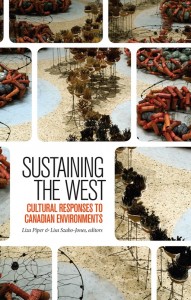
What happens when you put a group of artists and historians in a room and ask them to write about science? The result is Sustaining The West, a fresh and eclectic collection of essays on the environment. “If we are going to be honest about the environmental crises we face, the problems before us lie with people,” note editors Liza Piper and Lisa Szabo-Jones of the University of Alberta.
The people behind Sustaining The West are poets and naturalists, authors and filmmakers. “The role of humans in twenty-first century environmental change is clear,” editors write. “Framed as such, who better to grapple with the cultural issues at the core of our environmental crises than artists, writers and scholars in the humanities?”
Cabinet points to climate change as one of the nation’s foremost worries, though the impact is uneven. If farm production is at historic levels, Regina naturalist Trevor Herriot notes 80 percent of prairie grasslands have been ploughed up as cropland – a loss rate four times greater than the vanishing Amazonian rainforest: “What this means, of course, is that native biodiversity of the prairies is in rapid retreat.”
Sustaining The West is an eloquent collection of vignettes that cite astonishing fact, odd tales and compelling human stories woven together on an environmental theme.
Readers learn the Douglas fir is named for a hapless 19th century English botanist who misidentified the tree as a sugar pine and later perished under peculiar circumstances in 1834: “His body was found, lifeless and trampled, at the bottom of an open pit dug to trap wild bulls near Mauna Kea in Hawaii,” write Zac Robinson and Stephen Slemon of the University of Alberta. The circumstances “fueled speculation of foul play, even suicide.”
Contributor Nancy Holmes, of the University of British Columbia Okanagan, recounts the tale of the 22-acre Woodhaven Nature Conservancy of Kelowna established in 1973 by a couple determined to save groves of red cedar, cottonwood and ponderosa pine from local developers. Disaster struck when city planners diverted a creek to prevent basement flooding in nearby subdivisions: “Rare groves of western red cedar in the park began to die,” Holmes writes. In a surprising epilogue, managers worked out a compromise that sees trees watered a few months a year.
Sustaining The West even honours Ontario’s original fruit baron Ernest D’Israeli Smith, a son of pioneers who kept meticulous weather records documenting the micro-climate of the Niagara Escarpment from 1853. The number of frost-free days varies 10 percent or more depending on the location of orchards within the same county: “Smith recognized that to succeed as a fruit grower he would have to move to a more suitable location,” write the U of A’s Shannon Studen Bower and Sean Gouglas. The peach farmer grew to glory as founder of E.D. Smith Foods Ltd., still in business after 130 years.
Environmental issues at their core are human stories. The challenge of “how to equitably support ever-growing populations is just one part of a much larger canvas of catastrophe with fingerprints strewn across,” editors conclude.
Sustaining The West traces the prints.
By Holly Doan
Sustaining the West: Cultural Responses to Canadian Environments, edited by Liza Piper and Lisa Szabo-Jones; Wilfrid Laurier University Press; 380 pages; ISBN 9781-5545-89234; $32.24

Sport Betting Bill’s In Trouble
Another bill to sanction Vegas-style sports betting appears dead on arrival in Parliament. The measure earlier lapsed in the Senate on protests from the Toronto Blue Jays. One Liberal senator said the new bill preys on problem gamblers: ‘It makes no sense whatsoever’.