
Global Health Imports Corp., an Alberta medical supply firm co-founded by Liberal MP Randy Boissonnault (Edmonton Centre), is blacklisted from bidding on any federal contracts for five years. The Department of Public Works put the firm on its Ineligibility And Suspension List: “Information brought to our attention recently concerning an Edmonton Police Service investigation kind of put us at the right threshold to take action.”
Fears Biggest Crash Since ’92
U.S. tariffs would drive the Canadian economy into the worst recession in a generation, says Bank of Canada Governor Tiff Macklem. Recovery would take at least two years, the steepest decline since 1992: “There won’t be a bounce-back.”
NDP Launches Election Ads
New Democrats in preparation for a snap election have launched a $500,000 video campaign depicting leader Jagmeet Singh as a middleweight boxer. The ads represent a significant expense for the Party that trails other national rivals in fundraising: “I won’t stop fighting.”
Faults Regulator As Slipshod
A federal judge has reprimanded regulators for slipshod scientific review of one of Canada’s bestselling pesticides. The key ruling came on a petition by four environmental groups opposed to the continued sale of glyphosate: “I cannot connect the dots when there are none.”
Suspended For Name-Calling
A federal labour board has upheld a one-day suspension without pay for a Canada Revenue Agency clerk who called her supervisor a “dictator.” Strong language against management is disrespectful, ruled the Public Sector Labour Relations and Employment Board: “Name-calling in the workplace is never appropriate.”
A Poem — “The Best Service”
The clinic is under
renovation.
Paint cans
in the waiting room,
tarp on the floor.
Sign says
“We are improving the facility to serve you better.”
In the magazine rack,
last year’s American Scientist;
a six-year-old Canadian Geographic;
and a thirteen-year-old
Guinness Book of World Records.
By Shai Ben-Shalom

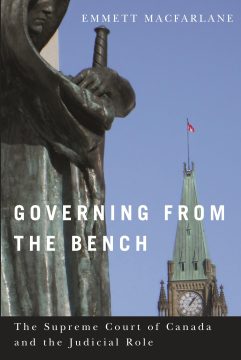
Review: Secrets Of The Chamber
If the Supreme Court is “one of the country’s most important governing bodies,” as author Emmett Macfarlane notes, it’s also true Canadians know little about it. The irony is noted. It’s the only court in the country to televise hearings, the only one with a chief justice who grants interviews, the only one to hold media lock-ups where complex cases are explained to the public.
Yet not one of the justices is recognizable in a Walmart parking lot. And the inner workings of the Supreme Court remain a riddle wrapped in a mystery.
“People wonder, are they completely isolated?” as retired justice Jack Major once put it. “Do they even read the newspaper? Do they know what’s going in the ‘real world’?”
Professor Macfarlane of the University of Waterloo opens the door to the secret chamber. “The Supreme Court is one of Canada’s most important – and least understood – governing institutions,” he writes.
Governing From The Bench is intriguing and oddly reassuring. In candid, anonymous interviews the judges emerge as very human. One justice complains law professors are smart alecks who make “terrible” court appointees. Another admits to asking “devil’s advocate” questions to stir up the courtroom. A third confesses to disliking orders: “I think that chief justices would like to think they could have a court marching to the same tune, but it just doesn’t happen.”
Are judges liberal or reactionary? Humbug, reports Macfarlane: “All the justices I interviewed responded to those attempts to label them in ideological terms in dismissive or amused tones.”
Do arguments ever change a judge’s mind? Yes, “10 to 25 percent of the time.”
Does the Court agonize over decisions and their impact on Canadians’ lives? Not really: “Give it your best…and you’re on to something else,” shrugged one justice.
Do they have long conferences on a case? Never. The only meetings attended by all justices can last as little as five minutes, and rarely more than 20.
Does the Court ever bicker? Sometimes, like the judge who described an irritating colleague assigned to draft an opinion: “One in particular said he was going to write for a unanimous Court, and he changed his mind writing. He didn’t tell anybody, and I’m reading the judgment, and I’m thinking ‘this doesn’t make sense, I thought we were going the other way.’ And I called him and he said, ‘Oh, well, I changed my mind as I was writing it.’ And I said, ‘Well, you might have told me, it would have saved me a lot of guessing.’ And he said, ‘Yes, I suppose I should have.’”
Governing From The Bench in rare instances even dissects why justices do what they do. When the Court ruled in 2004 that autistic children in British Columbia had no legal claim to mandatory medicare funding, it was mainly because “the Court’s pretty reluctant to tell the government how they should be spending their money,” one explained.
Professor Macfarlane reveals the Supreme Court as workmanlike, fallible and modest, where most try their best and some get on each other’s nerves. It is comforting to know it.
By Holly Doan
Governing From The Bench: The Supreme Court Of Canada And The Judicial Role by Emmett Macfarlane; UBC Press; 264 pages; ISBN 9780-7748-23500l; $34.95
Complain Internet’s Too Free
Heritage Minister Pascale St-Onge yesterday complained cabinet has “no control” over free expression on the internet. Her remarks came six weeks after cabinet’s latest bill to censor legal content lapsed in Parliament: “Freedom of expression is currently being exploited.”
Banks ‘Weak’ On Compliance
Haphazard reporting of suspicious bank transactions is a concern, says a federal regulator mandated to combat money laundering and terrorist financing. Canadian banks had “foundational weaknesses,” said the Financial Transactions and Reports Analysis Centre: “Is there a non-compliance issue with Canadian banks?”

Prayers Yes, Handshakes No
A guide for federal managers asks that executives avoid shaking hands with Muslim employees but set aside prayer rooms in government offices. Amira Elghawaby, cabinet’s Special Representative on Combating Islamophobia, endorsed concessions for Muslims as “one of the largest” employee networks in the federal public service: “There is only one god.”
Feds Feared Marriage Outcry
Newly-declassified records show Prime Minister Jean Chretien’s cabinet feared a political backlash over 2003 court rulings on same-sex civil marriage. Chretien in one secret meeting warned his cabinet “it would not be helpful to act hastily.”
Little Disasters Boost Growth
Natural disasters are good for economic growth but not to excess, Bank of Canada researchers said yesterday. Analysts studied 40 years’ worth of data in concluding earthquakes, droughts, floods and fires boost gross domestic product but only in the short term: “We find a small positive effect on GDP after a disaster.”
Want More Immigration Cuts
A 16 percent cut in this year’s immigration quota was not deep enough, Canadians have told the Department of Immigration. In-house research found widespread support for deeper cuts to record-high quotas: “Why do you say that?”
No Gold Watch For Chretien
Liberal cabinet ministers worked up a modest retirement gift for Prime Minister Jean Chretien after 10 years in office, according to newly-disclosed cabinet minutes. Chretien was awarded a flag flown that day from the Peace Tower, the same token given to Toronto Mayor Rob Ford’s widow and a community league in Bognor, Ont.: “The Prime Minister assured ministers that he had no regrets.”
Foreign Voter Caught, Fined
The Commissioner of Elections yesterday confirmed another case of an ineligible foreigner casting a federal ballot. It follows in-house data that found a third of returning officers encountered attempts at balloting by people whose names were not on the National Register Of Electors: “Clean up the list.”