A court test of Canada Revenue’s “duty of care” to investors in dubious tax shelters is headed for the Court of Appeal. A federal judge agreed taxpayers are entitled to ask whether they’re owed some warning when auditors consider a shelter questionable. Government attorneys are appealing the ruling: ‘Canada Revenue knew what was going on and sat back’.
Oil Liability Caps Below Cost
A cabinet bill capping pipeline operator’s liability would cover only part of actual costs to clean up a 2010 Enbridge Inc. oil spill in Michigan. U.S. law carries no limit on expenses for environmental damage from a pipeline breach: “If it’s $1.2 billion, companies should be paying $1.2 billion”.
Trademark Cites ‘Weird’ Law
One of Canada’s largest public insurance corporations has a lost a bid to claim perpetual trademark rights to four letters of the alphabet. The decision follows introduction of a Commons bill to restrict the “weird” practice: ‘Canada is the only jurisdiction in the world that does this’.
MPs Will Intro E-Petitioning
MPs will mark the passing of a parliamentary era with a committee proposal to sanction electronic petitioning of legislators after the next election. The Conservative chair of the Commons House Affairs committee said a report, now being drafted, will see change: “I’m assuming it will be in place going forward”.
Senate To Okay Liability Cap
Legislation capping companies’ liability in case of oil spills or nuclear contamination has cleared the Senate energy committee. One official said the bill “clarifies responsibilities” though critics caution taxpayers will bear the cost of any disaster: “It is providing a very inappropriate subsidy”.
MPs Cautioned On Pesticides
Parliament should mandate greater transparency on the use of pesticides, say environmental lawyers. The appeal follows data that use of farm chemicals has grown 17 percent in two years, including pesticides licensed for decades without studies on their long-term toxicity: ‘How do they justify this?’
Data Lost Forever, Gov’t Told
Canada is falling behind other countries in compiling a permanent, digital database of archival material, says the Council of Canadian Academies. Researchers noted Canadians rate among the heaviest internet users in the world, and that loss of data could impact historical accounts: “There is a real issue”.
Court Hears Deadline Appeal
The Supreme Court today is hearing appeals on whether shareholders are subject to deadlines in pressing class action claims against three corporations, including the Canadian Imperial Bank Of Commerce. All three cases allege misrepresentations to shareholders: “It came as a real shock”.
Census Bill Defeated By MPs
MPs have defeated a bill to change the appointment of a chief statistician, and restore the method of collecting census data. The Commons voted 147 to 126 to reject the private Liberal bill amid claims that cabinet has compromised statistics gathering: “Science does matter”.

Review — Jihadists And Televangelists
It’s the most pernicious religious conflict of our lifetime. I refer of course to the Irish troubles. Violence between Catholics and Protestants lasted 38 years and left 3,300 dead. I knew Canadian Catholics whose families were generous donors to Sinn Féin, political arm of the Irish Republican Army. Today they’d call it “terrorist financing”.
In Canada, still 43 percent Catholic, nobody asked: do Catholics have a predilection for violence? Nobody devoted call-in radio shows to Catholic customs — how we treat women, or claim to drink Christ’s blood every Sunday. Our understanding of Catholicism and the Irish was more nuanced than that.
In Canada, only 3 percent Muslim, all nuances went out the window after 9/11. As Judge Vic Toews, former public safety minister, used to say: ‘You are either with us, or with them.’
Are we incapable of any fresh, subtle discourse on religion and conflict? Professor Phil Ryan tries. After The New Atheist Debate is a lively primer on the “warring camps” of the 9/11 era, as Ryan puts it: atheists who point to religion as evidence of the dangerous simple-mindedness of spiritualism, and Christians who point to atheists as argumentative degenerates.
The world is “a messy place in which a cacophony of norms competes for our attention”, Debate concludes. Prof. Ryan, of Carleton University’s School of Public Policy, is a talented author. He writes with humour and subtlety.
“It is too simple to claim that wild-eyed jihadists and corrupt televangelists are responsible for all that ails religion,” Ryan notes. “The German clergy who managed to make their peace with Nazism were neither fundamentalists nor Muslims. Nor were the Chilean bishops who thanked Pinochet for responding to a ‘wish of the majority’ by overthrowing a democratically-elected government, or the Argentine bishops who accepted the naming of Mary, the mother of Jesus, as an honorary ‘captain general’ of the armed forces.”
Ryan writes, “Evil does not require religion. It does not even require unreason.”
Debate is timely. It arrives as Canadians are told there is something wrong with Muslims; that Islamic youth are a hair-trigger away from depravity; that on the list of suspected money launderers and terrorist financiers, Mississauga realtors with four-syllable names are right on top.
The result is a caricature of religion, Ryan writes: “believers are violent and intolerant”; “believers are not terribly bright”; “believers are dishonest”; “nonbelievers are absolutely open-minded”, though “the atheist is also morally adrift.”
Debate is no defence of Islam; Ryan himself is a Christian, and Debate cites no evidence that atheism is on the march. Some 4.9 million Canadians have no religious affiliation, and 1 in 3 tell Census takers they’ve never attended a religious service of any kind – but a good number of these would be Christmas Catholics, those people with a mild faith in “goodness” who just can’t be bothered.
Yes, religion can be warped to justify barbarity, writes Prof. Ryan. But so can economics or art or sports. “We must acknowledge that neither religion, nor science, nor the zeitgeist, nor knowledge of our own mortality; nor ‘innate human solidarity’, nor, I believe, anything else that might occur to the reader, can provide us with a shared ethical foundation,” Ryan explains.
Some people go to temple, and some people don’t. This is a lovely book.
By Tom Korski
After The New Atheist Debate, by Phil Ryan; University of Toronto Press; 196 pages; ISBN 9781-4426-26874; $22.95

Gov’t Plans E-Cigarette Sting
Health Canada plans an undercover sting of retail sales of electronic cigarettes to minors. The department said surveillance is for “information purposes only”, though it’s similar to enforcement techniques used to regulate nicotine marketing under the Tobacco Act: “Field personnel are to pose as typical customers and do nothing to betray the true nature of their work”.
Says CBC “Nuts” For Ratings
CBC management is obsessed with “ratings, ratings, ratings” despite claims of a cultural mandate, a Senate hearing has been told. Two senators quoted CBC insiders as indicating the Crown broadcaster is “nuts” for audience data amid declining revenues: “I know what’s going on”.
$260,000 Fine On No-Call List
Broadcast regulators have fined a Québec firm $260,000 for distributing the National Do Not Call List, a compilation of millions of names and addresses of Canadians who applied to be freed from unsolicited telemarketing: “I’d hope this is a deterrent”.
Board Sale “Ahead Of Plan”
The Canadian Wheat Board sold its head office for $9.7 million, says its CEO. And draft plans will be compiled “within six months” to privatize all operations ahead of an August 1, 2016 deadline to go to cabinet: “We’ve moved on”.
Court To Hear Spy & Lie Case
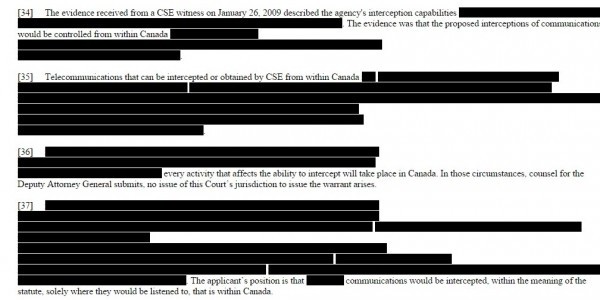
The Supreme Court will rule if a federal spy agency can stretch the truth in monitoring citizens’ activities outside the country. Justices agreed to hear an appeal in which the Canadian Security Intelligence Service was accused of misleading a judge to obtain warrants. Court records censor essential details of the case: “If CSIS is not being truthful, that would be a problem”.