
The CBC is straying from its mandate by “chasing advertisers” with pop programming, says one of the nation’s largest film producers. Executives with Entertainment One described the CBC as almost unique among public broadcasters in failing to make domestic films a staple of TV fare: ‘They showed Toy Story 3; really?’
More Rail Noise Complaints
A federal regulator has dismissed complaints from White Rock, B.C., in one of the longest running disputes between communities and railways: noise. The Canadian Transportation Agency ruled Burlington Northern Sante Fe Rail Co. breached no laws in shuttling coal trains through town, often in early-morning hours: “A situation like White Rock is exactly what we don’t want in the future”.
Pay $250K For Season Tickets
Federal agencies have spent more than a quarter-million dollars on NHL season tickets and other sporting perks, including two Crown corporations – Canada Post and VIA Rail – that cut core services due to large deficits, records show: “This is disconcerting”.
Warmer & Wetter: Changing Climate Rewriting Standards
Climate change poses a serious risk to schools, hospitals and other public buildings in Canada’s North, says the Standards Council of Canada. The organization in two reports proposes new standards for the National Building Code to avert collapsing roofs and cracking foundations: “The future of the North is at stake”.
Need Data On Cash Crimes
Cabinet should establish a national tracking system to monitor unreported commercial cybercrime, says a confidential Department of Public Safety report. The research warned internet fraud will “remain a pervasive and increasingly sophisticated threat” without a national program: ‘We need data’.
Oil Fall Costs $4.8B This Year
Falling oil prices may cost the federal treasury $4.8 billion in lost tax revenue this year, says the Parliamentary Budget Office. Authorities said the price collapse in itself should not scuttle cabinet’s plan to balance the budget for the first time since 2007: “Their choices are limited”.
Cabinet Faces Fishery Protest
The Department of Fisheries face renewed protest over a cabinet proposal to open up British Columbia’s roe herring fishery over the objection of First Nations and the department’s own regulators: “That’s the conflict”.
Court Weighs Right To Strike
The Supreme Court will issue a key ruling Friday on public employees’ right to strike. The case involves a Saskatchewan law, echoed in federal legislation, granting cabinet virtually unchecked powers to restrict employees’ ability to withdraw services: “We will be closely examining that decision”.
Red Tape Cuts Are ‘Message’
Cabinet is a world leader in red tape reduction though savings to date account for less than one-tenth of one percent of the federal budget, according to the Treasury Board president. Tony Clement appealed for passage of a bill to curb growth in regulations: “What is the message we are sending?”
All Quiet On Union ‘Conflict’
Cabinet remains quiet over a “developing conflict” within the RCMP over a Supreme Court order allowing police to unionize. Authorities yesterday made no mention of regulatory compliance with the Court judgment as the House opened its 2015 sitting: ‘They have such a hate-on for unions’.
Say Big Rail Breached Quotas
Canada’s two largest railways have fallen behind delivery of freight cars to Prairie terminals despite federal quotas on grain shipments, say farm groups. The Agricultural Transport Coalition estimated CN and Canadian Pacific delivered only 89% of hopper cars ordered since September: ‘There’s a tremendous lack of transparency’.
MPs To Kill Mini-Climate Bill
MPs are expected to vote tomorrow to kill a private bill to curb “urban heat islands” blamed for micro-temperature gains in large cities. Cabinet described the bill as a federal intrusion in municipal affairs: “The issue is not widely known or highly publicized”.
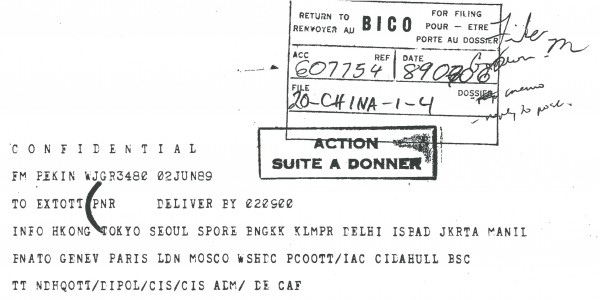
Embassy Feared 1989 Chinese Raid Say Confidential Memos
Canadian diplomats feared Chinese troops would “invade” their embassy in Beijing in the aftermath of the 1989 Tiananmen Square massacre, according to newly-released records. Dramatic Telex messages cabled by embassy staff back to Ottawa cite atrocities in the tumult after the mass shootings, including public executions and the retrieval of bodies from a Beijing canal.
Telexes marked CONFIDENTIAL were released by Library & Archives Canada under Access To Information. The messages run to thousands of pages, documenting Beijing’s summer of upheaval 26 years ago as students massed in the central square and were shot by the People’s Liberation Army on June 4, 1989. The embassy described the killings as “savage”, recounting the eyewitness account of one survivor interviewed by diplomats.
“An old woman knelt in front of soldiers pleading for students; soldiers killed her,” the embassy reported; “A boy was seen trying to escape holding a woman with a 2-year old child in a stroller, and was run over by a tank”; “The tank turned around and mashed them up”; “Soldiers fired machine guns until the ammo ran out”. So many bullets were fired at Tiananmen “they ricocheted inside nearby houses, killing many residents,” the account continued.
“It may be years before the true story is known,” the embassy wrote; “The era of darkness may be long.”
In a June 7, 1989 message, diplomats wrote they were contacted by Chinese officials demanding to know if any dissidents had sought refuge in the embassy amid mass arrests of protestors. Staff estimated 10,000 people had been arrested in Beijing alone, including two employees of IBM who were jailed for sending faxes from the company’s office.
“They enquired whether the Canadian Embassy in Peking had been approached by Chinese students seeking asylum,” the Telex reads; “Officials are in a quandary how to respond as they fear that if the Embassy takes them in, soldiers could invade the premises and remove them.”
Earl Drake, then-Canadian ambassador to China, said he couldn’t recall sending the Telex, but noted cable traffic was high during the crisis. “I have no recollection of sending such a message, but there was so much going on at that time that others may have sent it without clearing it with me,” said Drake, 86, who retried to Vancouver after leaving the foreign ministry.
“In any event, the issue did not arise because no Chinese students asked for asylum with us,” Drake said. The Department of External Affairs did waive immigration regulations for ex-protestors with family in Canada.
“The country is now being controlled by a group of vicious elderly generals and the government is run by people who will blindly follow their orders. The situation looks grim at best,” the embassy wrote in a June 15 message.
Shots & Cheers
Canadian diplomats in secret cables condemned China’s Communist Party leadership as “octogenarian”, a “gerontocracy”, “bereft of any credible claim to legitimacy” and led by “Emperor Deng” – President Deng Xiaoping, then 85. Deng appeared “increasingly feeble”, the embassy wrote: “He is said to be lucid”. One Telex reads, “An Australian doctor who has talked to a physician friend of Deng’s urologist confirms that Deng has for some time been suffering from prostate cancer”; “Deng has been taking cortisone treatments, which accounts for his puffy face”; “This may induce periods of hyper-activity”.
In other messages, staff lamented the “astounding stories of corruption at the highest levels” in China: “The Swiss Ambassador, himself an ‘Old China Hand’, told us that over the past few months every member of the Politburo Standing Committee has approached him about transferring very significant amounts of money to Swiss bank accounts. For obvious reasons, he has urged us to guard this information with the utmost care”.
Diplomats reported to Ottawa that insider information became difficult to find following the massacre: “One of the unfortunate results of the current situation is an inability to talk to many former Chinese contacts who, if they have not already fled the country or are not under arrest, now prefer not to talk with foreigners,” reads an August 2 Telex.
The embassy continued to recount blood-curdling incidents. One evening in Beijing, staff reported a series of seven shots were heard from the city’s Agricultural Exhibition Hall: “Shots were spaced at one-minute intervals and followed by what appeared to be cheers from a throng of people” – suggesting public executions had taken place.
“They are now entering a period of vicious repression during which denunciations and fear of persecution will terrorize the population,” reads one note.
Another Telex reported bodies had been fished from a Beijing canal: “Unconfirmed reports indicate they were soldiers who had been garroted.” More than a thousand executions were rumoured to have taken place in the Chinese capital, though diplomats wrote: “It is impossible to confirm these figures.”
“The situation looks grim at best and potentially disastrous,” the embassy reported; “It was probably thought that the massacre of a few hundreds or thousands would convince the population not to pursue their protests. It seems to be working.”
“Chinese we talk to despair about the future of their country,” diplomats concluded.
Most of the Telexes are unsigned. Ambassador Drake in his 1999 Memoirs Of A Prairie Diplomat recounted the summer of 1989 as “the most dramatic events of my life”. The government evacuated 550 Canadians after the massacre; recalled Ambassador Drake; and initiated Mandarin-language broadcasts on Radio Canada International. Then-foreign minister Joe Clark condemned the shootings as “senseless” and “brutal”.
By Tom Korski 
Price Probe Eyes Dep’t Stores
Retail giants Hudson’s Bay Co. and Sears Canada face demands they hand over records on pricing and profit margins in a federal anti-trust probe of the multi-billion dollar mattress business. Attorneys for the Competition Bureau asked that a federal judge compel the companies to surrender documents, alleging “false or misleading” advertising: ‘It’s a strategy known as ‘high-low’ pricing’.
Urge Action On Utility Threat
A Senate panel is pressing Transport Canada to launch a national program to counter a leading threat to essential infrastructure – not terrorists, but backhoes. The Senate energy committee said regulators should mandate a standard call-before-you-dig system similar to a U.S. program enacted a decade ago: “They asked, who is going to pay for this?”