
The Privy Council has declined comment on why it hired the wife of a heavily-subsidized publisher to act as a “senior advisor.” David Skok, editor of The Logic, said he would play no role in coverage of the Liberal government that hired his spouse and paid his news site millions: “We don’t make editorial decisions based on whether it will secure us such funding.”
Must “De-Colonize” Science
All federal scientific research should be Indigenous focused, says a Department of Natural Resources report. “How can we as public servants be actors in reconciliation?” it asked: “Ideally, the decolonization of research implies full Indigenous ownership of research. However it is still hard.”
Internet Age Limit OK: Study
Canadians widely support a cabinet bill to restrict social media access for children under 16, according to federal focus groups. A minority questioned enforceability and whether “this type of policy could ultimately lead to increased censorship of the internet.”
In Observance Of Labour Day
Blacklock’s Reporter pauses today for the 132nd observance of Labour Day in tribute to Canadian workers nationwide. We will be back tomorrow — The Editor
Sunday Poem: “Lake Effect”
Bluster and energetic,
Apoplexy,
Burn brightly in
The polity.
Mustered against.
The shore,
Signs and wonders,
Manifest.
The agreements.
Lie dormant.
Below the waves,
In situ.
And a cold, COLD wind,
Freezes the bones,
Of those waylaid by,
The Storm.
By W.N. Branson

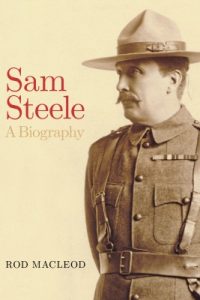
Book Review: The Honest Policeman
It’s unfashionable today to recall the settlement of the West as a romantic era. Yet not every sodbuster was an agent of genocide, and very many sincere people dedicated their lives to building up a young country with genuine affection for the land and its people. When Sam Steele lay on his deathbed in England in 1919, he asked that they bury him in Winnipeg where he started his career as a $1.25-a day constable with the North-West Mounted Police.
Well into the 1950s, generations of Canadian schoolchildren remembered Sam Steele as the most famous policeman in the country. He was renowned not for any extraordinary crime-busting exploit but as an honest lawman in an era of hornswogglers. Steele was famous enough that he published his 1914 memoirs Forty Years In Canada, and his son Harwood in 1956 recounted Steele’s life in The Morning Call, “a truly wretched book” filled with many factual errors, writes historian Rod Macleod, professor emeritus at the University of Alberta.
Macleod fills the gap with Sam Steele: A Biography, a colourful true-to-life account of the man and his incredible era. Macleod captures a land we left behind when Western Canada was a blank space on the 19th century map interrupted only by remote outposts: Fort Garry, Fort Macleod, Fort Calgary, Fort Edmonton.
Steele at 26 joined a Mounted Police trek from Winnipeg to Edmonton. Today it is a 14-hour drive. It took them four months, riding with two field guns and 93 cattle butchered for meat along the way. “The routine was one of very early starts,” writes Macleod. The trekkers rose at 4 am and rode all day through heat and cold.
Professor Macleod recounts a visit by Governor General Lord Stanley to Alberta’s Blood Reserve in 1889: “The Governor General and his entourage arrived in Lethbridge by train but from there they traveled in carriages and slept in tents for a couple of days. There were only nine people in the party but they certainly did not travel light; Steele had to provide a mounted escort and fourteen four-horse teams for the party and their baggage.” Later Lord Stanley relaxed with a wolf hunt in the foothills. Much later he invented the Stanley Cup.
Steele achieved fame in the Yukon gold rush acting as police, court and customs officer among hard-drinking prospectors on the Alaska frontier. Steele himself could down a quart of whiskey at a sitting but was so scrupulous in his professional duties it made him a national hero.
In Yukon Territory Steele decreed no prospector could make his way to the gold camps without six months’ worth of supplies – a ton of food – and none could depart without paying a 10 percent federal royalty on mining profits. “What on earth right have a few thousand foreigners to take out of the country that there is in it for nothing?” wrote Steele. “We provide them with officers, peace, order and law and must the rest of the people of Canada pay for that?”
Sam Steele: A Biography captures the land when it was all big sky and windswept Prairie, and rugged people trying to create a nation.
By Holly Doan
Sam Steele: A Biography, by Rod Macleod; University of Alberta Press; 320 pages; ISBN 9781-77212-4798; $39.99
Dep’t Denies Art Was Stolen
The Department of Crown-Indigenous Relations says it doesn’t believe any managers meant to steal paintings, jewelry, sculptures or other works that vanished from a $14.4 million Indigenous art collection. It is not known what happened to scores of artworks used to decorate the department’s regional offices: “This went on for decades.”
Hi Speed Rail Is Popular: PM
Canadians nationwide have “strong interest” in a proposed $90 billion regional high speed railway in Eastern Ontario and Québec, Prime Minister Mark Carney said yesterday. In-house cabinet research shows taxpayers are wary of the venture managed by publicly-owned Alto Corporation: “I’m speaking to all Canadians.”
Lose Bid To Hide Nazi Files
A federal judge yesterday ordered Heritage Minister Marc Miller to release portions of censored files on Nazi fugitives in Canada. The Federal Court dismissed a range of excuses invoked by Miller’s department and Library and Archives Canada in refusing to name names: “What could possibly be in it that still needs to be declassified so many decades later?”
Fine Maritime Casinos $632K
Two Maritime casino operators yesterday were fined a total $631,538 for breach of the Proceeds Of Crime And Terrorist Financing Act. The latest penalties follow a series of checks on the gaming industry by the Financial Transactions and Reports Analysis Centre: “Violations were found during the course of a compliance investigation.”
Bakers’ Petition For Nt’l Day
Home bakers yesterday launched a federal petition drive to have Parliament proclaim National Butter Tart Day. The all-Canadian pastry is an indelible part of the country’s “culinary and cultural heritage,” wrote petitioners: “The butter tart is a cherished Canadian dessert.”
No Big Impact, Says Macklem
A widening tariff war with the United States including a 50 percent Canadian surcharge on smartphones will not have “a big ongoing impact” on the economy, Bank of Canada Governor Tiff Macklem yesterday predicted. Macklem said workers and businesses alike were taking higher costs in stride: “Businesses, workers, they’re adjusting.”
Say Charity Starts At Home
Canadians are divided over aid to Cuba, according to in-house Privy Council research. Federal focus groups said that, while some were sympathetic with Cubans facing food shortages, Canada should first aid working poor at home: “Canada should primarily be focused on providing assistance to those living in Canada.”
Calls Referendum ‘Truly Vile’
Questions pending in an October 19 referendum by Alberta’s United Conservative Party government are “truly vile,” says Senator Paula Simons (Alta.), a Liberal appointee. One question seeks abolition of the Senate: “We must turn the light on these nine dark questions.”
Extend 10¢ Gas Tax Holiday
Cabinet yesterday extended a 10¢ federal gas tax holiday into 2027. Conservative MPs had sought the measure for months: “Every penny we can get reduced in taxes is a penny in the pockets of the people who earned it.”