
The federal Liberal Party’s national director testified he did “not know” if Chinese Communist Party agents helped elect a Liberal MP in 2019. Azam Ishmael’s comments came under rapid-fire questioning at the Commission on Foreign Interference: “I don’t know. I don’t know. I don’t know.”
MPs Investigating Jasper Fire
MPs by unanimous vote have ordered committee hearings into the Jasper, Alta. fire. Cabinet has blamed climate change though records show Parks Canada managers had a “big concern” regarding forest management: “I saw with my own eyes the destruction.”
Deportee Costs $16M Yearly
The Canada Border Services Agency will bill taxpayers the equivalent of more than $16 million a year to temporarily hold deportees in jails, figures show. Costs include “compassionate detention conditions” like daily access to doctors, nurses and psychologists: “They have received due process upon due process.”
Rogers Petitions For Subsidies
One of the nation’s largest telecom companies is petitioning MPs for the same newsroom subsidies paid to newspapers. Rogers Communications Inc. said excluding TV and radio employees was unfair: “Who is to say that print is more important?”
A Poem: “Finish Your Meal”
Canadians throw out
35 million tonnes of food
each year.
Much of it edible.
If only there were ways
to produce more wisely,
consume more responsibly,
redirect surplus.
It is evening, and
my cat stares at me.
Her bowl is half full,
but
she won’t touch it.
These salmon-and-chicken bites
– perfectly edible –
are leftovers from the morning.
She wants fresh.
By Shai Ben-Shalom

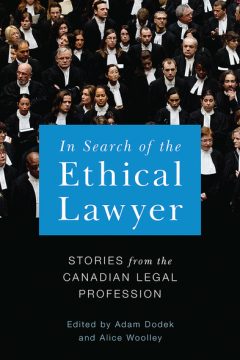
Review: Marks For Honesty
Lawyers are unloved and jokes are legion: how does a lawyer sleep? First he lies on one side, then he lies on the other. “In the public’s mind lawyers are not only adept at the dubious arts of manipulation and double dealing, but also moral hypocrites because they defend these practices in the brazen name of ‘professional ethics,’” write editors of In Search Of The Ethical Lawyer. “Along with used car dealers and telemarketers, lawyers are considered to be the least trustworthy and least respected of all professions.”
Yet there is no criticism of barristers that has not been made by barristers themselves. They are capable of raw self-analysis that’s rarely practiced by journalists, morticians, accountants or any other trade you can think of. It speaks to plain integrity and a passion for the profession. Imagine a volume In Search Of The Ethical Engineer written by engineers.
Editors Adam Dodek of the University of Ottawa law faculty, and Alice Woolley of the University of Calgary, present this candid and credible account of the lawyer’s trade. The anecdotes are intriguing, sandwiched between two book-end pieces that perfectly illustrate public outrage over the legal profession’s reputed inability to see the ethical forest for the trees on the one hand, and its tiresome enforcement of cheese-paring rules.
First, the trees.
Ethical Lawyer recounts the story of attorney Kenneth Murray of Newmarket, Ont., defence counsel for serial killer Paul Bernardo. In 1993, as police wound up a search of Bernardo’s home, they contacted Murray to retrieve Bernardo’s personal belongings from the house before it was bulldozed. Did Bernardo have any keepsakes? Well, yes, a collection of six videotapes hidden above a bathroom light fixture in which he and Karla Homolka documented their crimes. It remains a mystery why police were never able to find the tapes though they spent ten weeks ransacking the house.
Lawyer Murray retrieved the tapes and stored them in his office safe for 17 months as Homolka pled to a lesser charge of manslaughter in the deaths of two schoolgirls. “He should have realized at an early stage that he was out of his depth,” Ethical Lawyer observes; “Murray did no favour to his client, himself or the legal profession generally.”
“There is no happy ending to a sordid saga like this one,” authors conclude. Homolka today is a free woman, Bernardo remains in prison, Murray was acquitted of obstruction of justice and never heard from again. Ethical Lawyer observes, “The most appropriate and ethical course would have been for Murray to inform Bernardo that, if he retrieved the tapes, he would likely be under an obligation to hand them over to police.”
Book-ending this appalling case is the saga of Gerry Laarakker, a likable attorney from Vernon, B.C. In 2009 Laarakker railed against “sleazy operators” after an Ontario litigator threatened to sue the parents of children arrested for shoplifting unless they paid $522 in damages. The claim was bogus, Laarakker thought, and the threat unseemly: “extortion by letterhead,” he called it. Lawyers for retail stores were “preying on people’s embarrassment and naiveté” and attempting to “pry some money out of the pockets of some of the humiliated parents.”
It was a strong protest, too strong for the Law Society of British Columbia which ordered Laarakker to pay $4,500 in damages and costs for breaching a Canon Of Legal Ethics that states lawyers’ conduct among colleagues must be “characterized by courtesy and good faith.”
By any cold analysis the outcomes in the two cases are contradictory and incomprehensible. In Search Of The Ethical Lawyer attempts to decipher the secret handshakes that govern the profession. “The stories in this book are not stories of ‘great men.’” editors write. “Without a rich and rigorous understanding of the personal, social, structural and cultural circumstances in which they arise, one cannot have a meaningful conversation about the ethical challenges of legal practice.”
It’s a worthwhile conversation. Ethical Lawyer is an intriguing place to start.
By Holly Doan
In Search Of The Ethical Lawyer, edited by Adam Dodek & Alice Woolley; University of British Columbia Press; 272 pages; ISBN 9780-7748-30997; $34.95
Gov’t Polled On Air Surtaxes
The Department of Environment commissioned in-house polling that asked Canadians if they were willing to take fewer flights or pay a green surtax on air tickets. The research made no mention of frequent travel by public office holders: “The climate crisis is the greatest challenge of our time.”
Minister Changes His Story
Employment Minister Randy Boissonnault yesterday admitted conducting private business while a member of cabinet. Testifying at the Commons ethics committee, Boissonnault contradicted claims he had no dealings with an Edmonton import firm that paid him $220,000: “Do you think Canadians are stupid?”
Systems Worked, Says Miller
Immigration Minister Marc Miller yesterday said he is confident security checks on foreigners are reliable despite three being arrested on terrorism charges in the past three months. “We are confident in our security screening,” Miller told the Commons public safety committee.
Ask MPs To Release Nazi List
Cabinet should unseal all secret records on Nazi fugitives in Canada and make the digitized documents available to the public, says B’nai Brith Canada. The group in a petition to the Commons finance committee said it was essential to waive confidentiality on enemy combatants and collaborators: “Allow Canadians to fully appreciate and move on from Canada’s Nazi past,”
Court Upholds Budget Power
Taxpayer-funded groups have no right to subsidies and cannot claim Parliament has “an obligation to consult each and every stakeholder” impacted by cuts, a federal judge has ruled. The Federal Court decision follows forecasts that broad funding cuts are now inevitable: “We saw that before.”
Lib Senator Edits Press Article
A Liberal-appointed senator says the government has a duty to correct media thinking. Senator Lucie Moncion (Ont.) acknowledged she successfully called up edits to an article by a political opponent published in the subsidized press: “We had to remain vigilant.”
Whistleblower Names Lib MP
Liberal MP George Chahal (Calgary Skyview) last night did not comment after being named by a whistleblower for failing to act on complaints of irregularities at a federal agency. The disclosure came at the Commons public accounts committee: “His subsequent refusal to engage forced us to spend the next five months trying and failing to contact various agencies.”
Accuses Cabinet Of Cover-Up
Prime Minister Justin Trudeau and his cabinet knowingly misdirected investigations of foreign interference under a “mountain of process,” the Commission on Foreign Interference was told yesterday. “We have become a foreign interference playground,” testified Conservative MP Michael Chong (Wellington-Halton hills, Ont.), a target of Chinese agents.
Feds Still Send Aid To China
Cabinet continues to send foreign aid to China, new records show. The Department of Foreign Affairs detailed millions in aid under a Fund intended to promote LGBTQ rights: “I don’t believe Canadian taxpayers should be sending any money to China.”



