
Student loan write-offs are still running past $160 million a year despite interest waivers and generous repayment terms, says a federal report. Auditors blamed hard times: ‘Borrowers’ difficulties are the result of precarious and unstable financial situations.’
‘No Records’ On $8B Blunder
The Canada Revenue Agency says it has “no records” divulging who made an $8 billion mistake in mismanaging a pandemic relief program, according to Access To Information files. Revenue Commissioner Bob Hamilton had testified it was “a decision by the government” but would not name names: “It’s very difficult to know what will be left at the end of the day.”
Challenge Press On Coverage
Media, politicians and experts have concealed the failure of Canada’s “safe supply” drug policy, says Opposition Leader Pierre Poilievre. He made the remarks in a kindergarten playground near Montréal’s first federally-subsidized injection site that opened April 15: “You guys repeat the same language you get from the radical Liberal-NDP activists and bureaucracy.”
“Equality Fund” Lost Millions
Auditors disclose a federal “Equality Fund” launched with a $300 million taxpayer grant promptly lost a tenth of its value in poor investments. The money was supposed to help women in Third World countries: “Poor market conditions impacted the early returns on gender lens investments.”
Feds Disclose Database Snoop
An in-house investigation has disclosed unauthorized snooping through Department of Immigration files in one of the largest electronic databases held by the Government of Canada. Managers found an unnamed employee breached the Privacy Act: “Corrective measures are being taken.”
Gov’t Rated Poverty By Race
Filipinos have the lowest poverty rates in the country and Arab Canadians and First Nations the highest, says a Department of Social Development briefing note. Managers calculated poverty rates by race following criticism by an Alberta think tank that depictions of the poor were misleading: “We recognize poverty does not affect everyone equally.”
A Poem: “The Winner Is…”
The Heart and Stroke Foundation
is holding its annual lottery.
Among the prizes –
prestigious, stainless steel BBQ grills.
Your burgers, steaks, hotdogs, and ribs,
will be juicier, more flavourful than ever.
By Shai Ben-Shalom

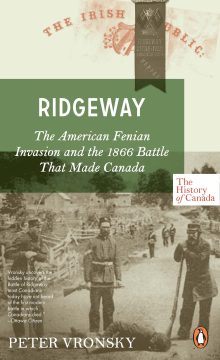
Book Review: The One-Day Battle
Peter Vronsky made his reputation writing about the psychology of homicidal sociopaths. Serial Killers: The Method and Madness of Monsters (2004 Berkley) and Female Serial Killers: How And Why Women Become Monsters (2007 Berkley) were well-received by the gore-loving community and set Vronsky on track to becoming a successful crime writer.
Instead Vronsky enrolled in the University of Toronto’s history department as a PhD candidate. His research focused on the Battle of Ridgeway, the culmination of the 1866 Fenian invasion of Canada.
Vronsky had chosen fertile ground. The battle, the last fought in the Great Lakes basin, was almost forgotten, rating a line or two in Canadian history texts. The battlefield itself was poorly marked, though undisturbed. Yet Ridgeway was an important spur to the Confederation movement.
During the United States Civil War the Union and Confederacy recruited soldiers from the streets of Dublin and the worn-out Irish countryside with the promise of cash and citizenship. Thousands enlisted. Most shared a hatred of Great Britain and its empire including pre-Confederation Canada. The war’s end left an army of jobless, motivated and trained soldiers.
On June 1, 1866 more than 1,000 Fenians crossed the Niagara River from Buffalo, N.Y. and took the town of Fort Erie. Their plan? March inland and seize the Welland Canal at Port Colborne, then carry onto Brantford, Ont. and cut the main line of the Grand Trunk Railway.
Here, the plot grew vague. Fenians considered they might exploit their conquests in Canada, or force the United Kingdom to negotiate for Irish independence. It should have been a farce. Instead it became a debacle.
Confronting the battle-hardened Irish Civil War vets at the village of Ridgeway was a ragged band of farmers, shopkeepers and University of Toronto militia. The Canadian commander suffered a nervous breakdown in the battle. One group of 28 U of T students sent deep into Fenian-held territory was mauled. Ten Canadian militiamen died.
Vronsky is a skilled writer who ably describes the battle and the subsequent cover-up. The one remaining mystery is why so few Canadians were killed. Perhaps even Fenians, most of them seasoned soldiers, could not bring themselves to gun down boys as they ran for their lives.
By Staff
Ridgeway: The American Fenian Invasion and the 1866 Battle That Made Canada by Peter Vronsky; Allen Lane Canada; 368 pages; ISBN 9780-6700-68036; $34

Fed Contractor Sues For $64M
A federal contractor suspended in fallout from the ArriveCan scandal is suing the Government of Canada for $64 million in damages, Federal Court records show. Coradix Technology Consulting Inc. blamed federal managers and media for costing it millions in fees: ‘It was done to deflect or distract from negative publicity.’
Management Not Very Good
Poor federal management is to blame for the hiring of costly consultants, says a Department of Public Works report. The finding follows evidence that a typical government employee now answers to seven levels of management: “Yes, there is room to reduce some levels of executives.”
“A Small, Competent Gov’t”
Any future Conservative cabinet will run “a small, competent government,” Opposition Leader Pierre Poilievre yesterday told the Assembly of First Nations. His remarks followed a doubling of spending on Indigenous affairs with no proportional improvement in services, according to the Budget Office: “What does the bureaucracy in Ottawa have to teach you about good management?”
Military Members Sad, Alone
Canadian military members feel disheartened and abandoned, says in-house research by the Privy Council Office. All military surveyed said cabinet was “on the wrong track” in national defence: ‘This impacted morale including the sense of pride they once felt.’
Campus China Registry Chill
University teachers seek an exemption from a new federal law that unmasks friends of foreign agents, claiming a “chilling effect.” The appeal follows evidence documenting the reach of Chinese agents on campus: “This recruitment strategy is called ‘feed, trap and kill.'”
99% Of Contract Was Junked
Millions’ worth of ventilators bought from a Québec contractor endorsed by then-Industry Minister Navdeep Bains were junked as scrap metal, Access To Information records disclose. Fully 99 percent of ventilators delivered under a $282.5 million contract with CAE Inc. went to scrap: “I am glad we were able to support CAE.”
Jetted From Morocco To India
The Senate’s leading opponent of fossil fuels in the past year jetted more than 100,000 kilometres to climate conferences from Casablanca to Mumbai, new records show. Senator Rosa Galvez (Que.), a Liberal appointee, called climate change “the greatest challenge of our time.”