Chinese Canadians face new “nativist and xenophobic” discrimination, claims Liberal-appointed Senator Yuen Pau Woo (B.C.). The Senator was granted standing at the China inquiry but did not participate in hearings that exposed illegal activities by Chinese Communist Party agents: “Do you have any ties with the Chinese regime?”
Paid A Third Of Dairy Farms
A third of dairy farmers received direct subsidies under a 2017 trade pact, says a Department of Agriculture audit. Milk producers were promised federal aid after cabinet increased imports of tariff-free European cheese: “Supply management is the system the dairy sector has chosen for itself and the government respects and supports this choice.”
Poem: “Chilly This Morning”
There are many ways
to tell someone
that you have absolutely nothing
to tell him.
Commenting about the weather
is one such way.
By Shai Ben-Shalom

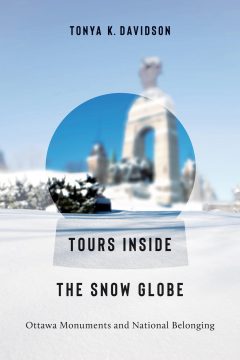
Book Review: The Unfrozen
Ottawa has more statues than any city in the land. As public art and political statements they run the gamut: haunting, contrived, tiresome, outrageous and wonderful, like the exhausted figure of Harold Fisher, head bowed, that’s survived a hundred winters on Carling Avenue.
Fisher as mayor built one of Canada’s first municipal hospitals in 1924, an era when surgery meant charity wards for the poor and spas for the wealthy. Ratepayers placed Fisher and his free public hospital in a cornfield where land was cheap. Surrounding acres over time became one of the prettiest collections of pre-war bungalows in a neighbourhood still called Civic Hospital. Fisher’s inscription reads: “If you would see his monument, look around you.” Beautiful.
Tours Inside the Snow Globe is fresh and intriguing, an investigation of statuary written at the close of an era that saw street protestors decapitate John A. Macdonald. Only a sociologist could explain what happened. Luckly, author Tonya Davidson is one of those.
“Monuments are touchable and they are touched,” writes Davidson. “Monuments seem fixed but they move.” They “produce certain effects of belonging and to inspire disgust, nostalgia and dissent throughout their lives.”
The point is not to agree. Where you may see Mayor Fisher as a monument to good government, Associate Professor Davidson might see stolen First Nations lands. Let the argument begin! Tours Inside The Snow Globe makes the compelling argument that, left or right, statues matter.
“Monuments are deeply important, which is why they should stay or go, and they are also not enough, not everything, nor are they necessarily precious,” Davidson explains. But they are more than stone and metal: “The rituals performed at monuments are entirely driven by emotion. Monuments are effectively charged urban sites, secured and moved by nostalgia and other desires.”
“People seem to be much more attached to monuments than they are, for example, to reading books of history or visiting museums,” writes Davidson, a self-described monument scholar. “Monuments are about the present, and in the present they are alive, dynamic, fleshy even; they are sites of communion.””
An example: Officialdom’s reaction in 2022 when Freedom Convoy protestors decorated a statue of Terry Fox with a ball cap and Canadian flag upside down, the maritime symbol of distress. “Unacceptable,” said the mayor. “Defacement,” said the CBC. “Horrified,” Finance Minister Chrystia Freeland told reporters. “We saw that terrible picture of the Terry Fox statue desecrated and I have to tell you my kids were just shocked.”
Tours Inside The Snow Globe is part chronicle, part walking tour. It critically examines Canadiana from the Boer War Memorial financed by schoolchildren’s pennies to the 1911 Parliament Hill statue depicting Young Canada as a strikingly buxom woman in a toga that today is “featured in many contemporary selfies.”
“There’s the Monument to Fallen Diplomats in the western part of Ottawa that marks the spot where Turkish diplomat Atilla Altikat was murdered in 1982” – a shooting that remains unsolved – “and the location on Sparks Street where Thomas D’Arcy McGee was assassinated,” writes Davidson. Contrived, outrageous or haunting, monuments “are often mobile in surprising and destabilizing ways.”
By Holly Doan
Tours Inside the Snow Globe: Ottawa Monuments and National Belonging, by Tonya Davidson; Wilfrid Laurier University Press; 330 pages; ISBN 9781-7711-26021; $38.30
Says Newsrooms Will Vanish
Canadian news will vanish if private TV networks fail, the CEO of Bell Canada Enterprises yesterday told the Commons heritage committee. “Without a Canadian broadcasting system there will be no news except maybe the CBC,” testified CEO Mirko Bibic: “We need to figure out how to keep Canadian news alive.”
CEO Defending $8M Bonuses
The Canada Infrastructure Bank “has really hit its stride,” Ehren Cory, the Bank’s $600,000-a year CEO, told the Commons transport committee. MPs questioned why bonuses ate up a fifth of the Bank’s operating revenues last year: “Do you think that’s justifiable?”
Critics Ridicule Spanking Bill
Critics on the Commons justice committee yesterday ridiculed a New Democrat bill to regulate parents’ discipline of children in the home. Conservative MP Frank Caputo (Kamloops-Thompson, B.C.), a father of three and former Crown prosecutor, questioned whether a tap on the wrist would be criminalized: “When should a parent be subject to criminal law?”
Fear Labour Bill Goes Too Far
A proposed ban on replacement workers in the federal private sector will give small union locals disproportionate control over the Canadian economy, employers yesterday told MPs. Business and farm groups asked the Commons human resources committee to repeal or rewrite Bill C-58: “This is a bad idea.”
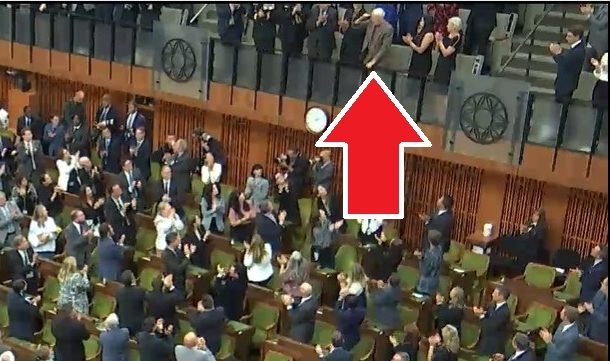
Waffen SS Ovation Horrifying
The Commons’ standing ovation for a Nazi collaborator was horrifying, the Canadian Polish Congress yesterday told the House affairs committee. MPs continue to investigate the September 22 incident that saw VIP treatment for a member of the Waffen SS, a criminal organization: “There is no ambiguity.”
‘Inappropriate’ To Expel MP
Prime Minister Justin Trudeau yesterday testified it “wasn’t appropriate” to expel MP Han Dong (Don Valley North, Ont.) from the Liberal caucus though he was under security surveillance. Trudeau said he assumed it was up to Elections Canada to determine whether Dong had contacts with foreign agents: “Did you ask for further investigation?”
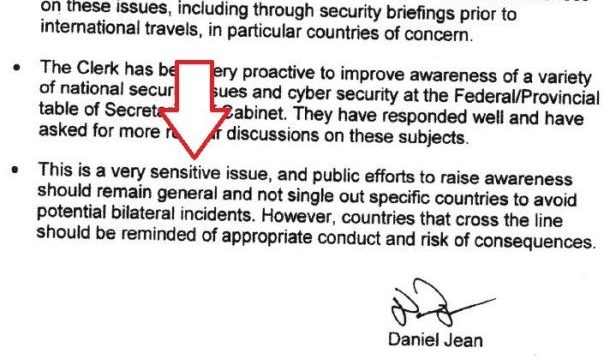
Don’t Mention China: Memo
Cabinet aides in a secret 2017 memo told Prime Minister Justin Trudeau to avoid public criticism of China despite evidence Communist Party agents were committing crimes in Canada. Cabinet was attempting to negotiate a Chinese free trade pact at the time: “This could be deemed illegal by Canadian courts.”
Focused On Russia Not China
Federal election monitors were supposed to keep a lookout for Russian agents not Chinese, Government House Leader Karina Gould said yesterday. No Russian agents were ever found while cabinet received numerous warnings of illegal activities by the Communist Party of China: “The primary focus was really on Russia.”
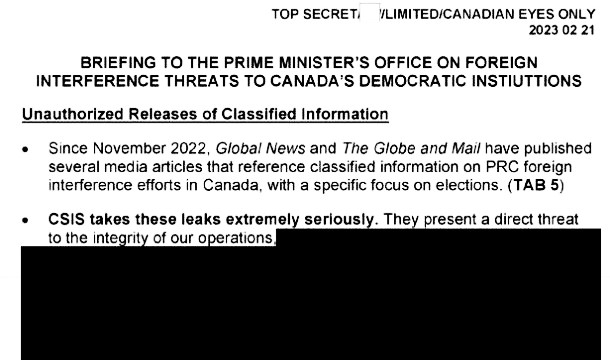
Here Is The Midnight Memo
The China inquiry tomorrow meets in special session over a censored, top secret memo proving the Prime Minister’s Office was warned of illegal activities by Chinese agents. Federal lawyers did not disclose the document until late last Sunday evening after crucial witnesses had already testified: “The question would be, why?”
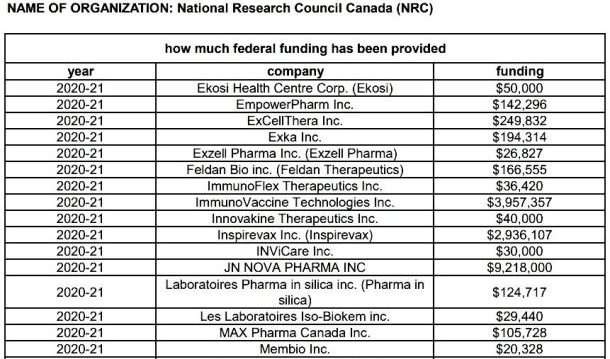
Paid $85.8M To Pharma Firms
The National Research Council paid out more than $85 million in subsidies to pharmaceutical companies from the start of the pandemic, records show. Staff at the time complained of overwork in processing payments: “How much federal funding has been provided?”

PM Kept MP In Gov’t Caucus
Prime Minister Justin Trudeau’s office in 2019 was told MP Han Dong (Don Valley North, Ont.) was under security surveillance but kept him in the Liberal caucus, records show. Trudeau’s chief of staff in 2023 had denied the subject was ever raised: “I am not quite sure what is being referred to.”