
Young Canadians, women and British Columbians and Ontarians are the biggest climate change worriers, says in-house research by the Department of Environment. The findings follow an earlier federal report that most young people feel frightened, sad and helpless about global warming: ‘How worried are you?’
Like The Customers To ‘Stick’
Canadian banks use “customer stickiness” techniques to prevent clients from comparison shopping, says a Competition Bureau report. The practice makes it difficult for any new rival to challenge the nation’s Big Five banks, it said: “There are frequently direct costs associated with customer switching.”
In Observance Of Labour Day
Blacklock’s Reporter pauses today for the 129th observance of Labour Day in tribute to Canadian workers nationwide. We will be back tomorrow — The Editor
Poem: “This Is Your Captain”
Welcome aboard Federal Government Airlines.
Our flight
will be two hours longer than usual
as we’re still looking to repair
the left engine,
following last year’s inspection.
Navigation should be smooth
with our new compass,
obtained yesterday
from an identical aircraft
at the Aviation Museum.
Refreshments will be served
to those sitting
in odd-numbered rows only.
In case of a pressure drop inside the cabin,
oxygen masks will be available
for a fee.
Should you need help with the clogged toilets,
our one crew member
will be delighted
to assist you.
You’ll also be happy to know
that we’re balancing our budget this year!
Thank you for flying with us.
By Shai Ben-Shalom

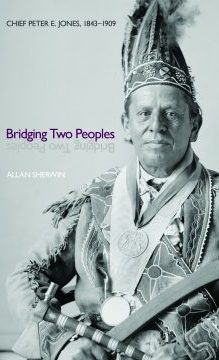
Book Review: A Victorian Tragedy
Dr. Peter Edmund Jones is the most interesting Canadian you never heard of. His accomplishments were many, yet he died in poverty. He left a mark in science and public affairs, yet stumbled in drunkenness and despair.
The son of a Mississauga chief and English mother, Jones was the first Status Indian to graduate from a Canadian medical school, Queen’s University in 1866. His thesis was “The Indian Medicine Man.” Jones was the first to publish an Indigenous newspaper in Canada, The Indian, in 1886. He was a chess master, an archaeological advisor to the Smithsonian Institute, a political organizer for John A. Macdonald, a federal Indian agent.
“Jones appears to have been a romantic who felt his early success would carry him onwards,” writes biographer Allan Sherwin. Of course this could only end badly. To read Bridging Two Peoples is to sense the creep of petty humiliation and raw bigotry that crushed this Victorian romantic in the end.
When Jones married a widow with three sons in 1873 he could not legally adopt his own stepchildren since Status Indians were unable to file applications in court. When Jones was appointed an Indian agent in 1888 he was paid 40 percent less than white agents. When he retired in 1903 Jones was reduced to suing the Grand Trunk Railway for $10 after a boorish conductor threw his wife off a train for refusing to sit in a second-class car.
Biographer Sherwin, a professor emeritus of neurology at McGill University, crisply recounts the life of this extraordinary man. “He believed that effort and education would enable Aboriginals to compete with their Euro-Canadian neighbours, and he tried to act as a bridge between them,” writes Sherwin. “Dr. Jones had made the mistake of trying to act as leader of his people from outside the reserve.”
Of the many indignities was an 1875 item in the Toronto Mail that characterized Indians as a low, lazy, treacherous race. “I am one of the Mississaugas,” wrote Jones, the band chief and a practicing physicia. “There is not in Canada a tribe of Indians more clean, industrious, and sharp in business, than are my people…Our women are treated as much like ladies as the wives of the white farmers about here.”
Jones died penniless in Hagersville, Ont., his savings lost to failed ventures and the alcoholism that cost his dismissal as an Indian agent in 1897. “The sale of alcohol to Indigenous peoples was a crime under federal law, but an exception might be made in the case of a valid prescription,” recounts Sherwin. “According to Indian Affairs’ records, Dr. Jones did purchase alcohol on behalf of his patients and, like many doctors of that era, was subjected to temptation.”
Jones, in the end, self-destructed. In Victorian Canada he could have done no less.
By Holly Doan
Bridging Two Peoples: Chief Peter E. Jones, 1843-1909 by Allan Sherwin; Wilfrid Laurier University Press; 270 pages; ISBN 978-1-55458-633-2; $29.95
Guilbeault Silent On Slavery
Environment Minister Steven Guilbeault’s department yesterday praised China for environmental leadership without mentioning its use of slave labour to make solar panels. A member of Guilbeault’s own caucus earlier noted China used slaves to export renewable energy products: “41.7 percent of polysilicon used to produce solar panels, for all the environmentalists in the House, comes from Xinjiang.”
Judge Resumes Ethics Probes
Federal conflict investigations yesterday resumed with the appointment of Interim Ethics Commissioner Konrad von Finckenstein, 78, a retired federal judge. A vacancy had forced a four-month halt to ethics probes: ‘Our hands were tied until there was a new Commissioner.’
Facebook Posts Not A Crime
A Freedom Convoy sympathizer yesterday won an Ontario Court of Justice dismissal of a mischief charge over his Facebook posts. Other protesters also faced police charges targeting social media messages: ‘They peacefully exercised their Charter rights.’
Blaming Capitalists For Fires
Capitalism is to blame for the August wildfire season, the Communist Party of Canada said yesterday. A Party periodical People’s Voice said trees planted by capitalist forestry companies were more susceptible to fire than other trees: ‘The trees are pinnacles of so-called capitalist efficiency.’
Polled Tighter Pesticide Rules
Federal regulators polled Canadians on support for tighter controls on pesticides, records show. “Most Canadians continue to hold negative associations with pesticides,” said an in-house report: “What is needed? Is it when a large group of people die?”

Gun Buyback Plan In Trouble
The Department of Public Safety acknowledges stiff resistance to its national buyback of prohibited firearms as costly and pointless. An in-house report confirmed fewer than half of owners would voluntarily surrender their firearms and 12 percent will never comply: “I am a responsible owner.”

Historic Plane Needs A Home
Federal curators at the Canadian Aviation and Space Museum yesterday confirmed they are “deaccessioning” a century-old flying boat that survived a National Geographic expedition to the Amazon rainforest. The Museum said it has no room for the mahogany artifact: “It has been decided.”
39% Of Desk Phones Unused
So many federal employees now work from home that more than a third of the government’s desk phones are “not being used,” according to records. Fully 15 percent have been permanently disconnected: ‘We define ‘dormant’ phone lines as lines that have been assigned and activated but are not being used.’
Calls Inflation A Fact Of Life
A federal arbitrator yesterday cited the rising cost of living in awarding VIA Rail engineers a combined 10.5 percent wage increase over three years, more than the railway offered. Inflation was a fact of life for the first time in generations, said Canada Labour Code arbitrator William Kaplan: “It is fair to say that interest arbitrators have not had to contend with significant inflation since the early 1980s.”
Frowned When Lawyers Do It
Misleading and “ridiculous” testimony is disappointing when it comes from a lawyer, Tax Court has ruled. The finding came in the case of a barrister whose testimony “bordered on the ridiculous” in challenging a reassessment of his tax returns: “He is a lawyer with over 40 years at the bar.”