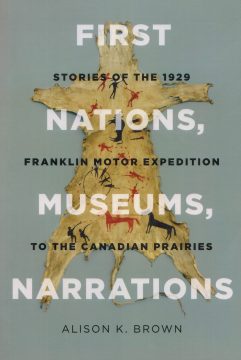
There were two Franklin Expeditions. One is acclaimed by Parks Canada which spent millions scanning the floor of the Arctic Ocean in search of 19th century English shipwrecks. The other is documented through the passion and extraordinary research of a lone anthropologist, Alison Brown of the University of Aberdeen. The resulting First Nations, Museums, Narrations is intriguing and profound.
In June 1929 a band of researchers left Winnipeg to document what they believed were the vanishing First Nations of the Prairies. Canada’s Indigenous population had been decimated by disease and misfortune and numbered some 107,000 people. “Now or never is the time in which to collect from the natives what is still available for study,” noted a director of the Geological Survey of Canada. Anthropologists believed the end was near. “Indigenous people were thought to be assimilating or dying out,” writes Brown.
The 1929 group called itself the Franklin Motor Expedition for the car they drove, a 1928 six-cylinder Franklin sedan. The team numbered two Australians and a former staffer from New York’s Museum of the American Indian. They spent three months travelling from reserve to reserve, speaking with elders and purchasing artifacts.
Armed with a 16mm film camera and a cash budget, the trio collected everything from the trivial to the priceless: a hide scraper made from Massey-Harris tractor parts, a pair of moccasins picked up at a Banff gift shop, sacred bark, a mink skin medicine bag and Blackfoot dog travois, eagle bone whistles used in Sun Dance ceremonies, drums, scrolls and spectacular headdresses and a Sarcee cougar hide painted with exquisite pictographs.
At Little Pine Nation one researcher paid 25¢ for a grass whisk used in a sweat lodge. A colleague recalled members of the tribe laughed over the sale: “They though he could have gone and picked the grass and tied it together himself.”
The result was the largest single collection of Canadian Prairie Indigenous artifacts ever assembled in a British museum. Some artifacts were sold to local curators to help finance the trip, but the bulk of 680 artifacts was deposited at Cambridge.
The last surviving member of the Franklin Motor Expedition died in 1990. And that was it, until the trove was rediscovered by Alison Brown as she poured over the collection for a museum catalogue in 1998, “an in-house document that was not intended to reach out to First Nations,” Brown notes. “I soon discovered no one from the First Nations visited by the Franklin Motor Expedition had ever been to Cambridge to see the collection. This was not due to a lack of interest; people simply did not know it was there.”
Impressed by the collection and its odd history, Brown retraced the route of the 1929 expedition from Calgary to Swan Lake, Man. She spent months combing public and private archives, interviewing First Nations members and contacting descendants of the expedition members.
Here the rich narrative becomes jarring. Was the Franklin Motor collection an irreplaceable gift to archaeologists or mere plunder? Did researchers salvage artifacts that would have been lost to civilization or simply barter with poor First Nations whose sacred cultural possessions were scorned as cigar-store trinkets?
Brown notes the Indian Act outlawed potlatches and healing ceremonies. Even participation in the Sun Dance at a summer festival was punishable by a $25 fine and a month in jail. “Pieces such as the many ceremonial items collected by the expedition may have been sold because their keepers desperately needed money,” Brown writes.
Collectors “sincerely believed their actions were justified,” First Nations, Museums concludes, but it was never that simple. “First Nations people participated in the gradual commodification of materials that they would previously have treated very differently. This commodification – and the resultant exchange of artifacts for cash – has enabled museums to assert that the actions of collectors in the past were legal and valid, and that people who sold artifacts did so of their own free will. By contrast, First Nations critics of this argument point to the harsh realities of life for their ancestors and the combination of economic conditions and challenges to traditional belief systems that made it difficult to resist the approaches of collectors.”
First Nations, Museums is a fascinating, unsettling account of the one Franklin Expedition that Canadians never hear of. It makes it impossible to enjoy a museum in quite the same way again.
By Holly Doan
First Nations, Museums, Narrations: Stories of the 1929 Franklin Motor Expedition to the Canadian Prairies, by Alison K. Brown; University of British Columbia Press; 305 pages; ISBN 9780-7748-27263; $34.95