
The Canadian Armed Forces will never achieve equity hiring targets at current rates, says a military journal. Department of National Defence research has showed visible minorities and immigrants considered military careers a “last resort.”
Military Asked About Camps
The Department of National Defence yesterday said it had nothing to do with a federal notice that prompted rumours of “quarantine camps.” Enquiries from alarmed MPs were forwarded to the military, internal emails show: “This is the second time I’m seeing this topic come through an MP’s office.”
Blocked Pipeline Hearings 6-5
The Commons natural resources committee by a 6-5 decision blocked a vote to investigate the collapse of the $8 billion Keystone XL pipeline project. Opposition MPs expressed anger after Liberal and New Democrat members adjourned debate with a snap vote: “We just did. We can and we did.”
Just ‘Estimates’ On Vaccines
Anticipated monthly vaccine deliveries are “estimates” only and are not included in confidential $4.6 billion contracts with manufacturers, says Public Works Minister Anita Anand. MPs on the Commons health committee said it is mathematically impossible for cabinet to meet its vaccination targets: “No one in their right mind believes in the math you are telling us.”
Bookmakers’ Bill Hits Delays
Promoters of a bill to legalize bookmaking in Canada accuse cabinet of slowing the repeal of a Criminal Code ban on single-event sports betting. Cabinet introduced its repeal bill three months ago then pushed it down the parliamentary calendar: “In fact if anything, it has slowed it down.”
Can’t Refuse Border Drivers
Canadian drivers returning home from the U.S. may be asked to prove they’re Covid-free though they cannot be barred from entering the country, says Public Safety Minister Bill Blair. Cabinet will impose new regulations on travelers at land crossings but with plenty of advance warning, he said: ‘All Canadians have a constitutional right of entry.’
90% Called It Home: Research
Ninety percent of immigrants to Atlantic Canada under a 2017 pilot program stayed in the region for love of the place and its people, says federal research. Eighty percent said they had no plans to ever leave: “More than half reported they liked their community.”
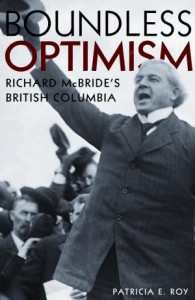
Review: Rogue Premier Of B.C.
They don’t make British Columbia premiers like they used to. Richard McBride was the first to build his own navy, the first to create a university. “Any complaints?” he asked voters.
McBride was so sentimental that, when confronted by a petitioner with a son in the penitentiary – “He is only a boy, Mr. McBride, and meant no harm” – he gave the woman $20. He was a glad-handing spendthrift who cheerfully accepted a case of Old Curio Whiskey from lobbyists, and told British Columbians: “Let everyone wear a smile.”
In Boundless Optimism biographer Patricia Roy captures the forgotten genius and sinfulness of this flawed man who campaigned by stagecoach, and ruled B.C. for three terms at the turn of the 20th century.
In McBride’s time the population of his province grew ten-fold. His life marked the opening of a territory vast as an empire, with timber, coal and peach orchards.
If B.C. was big, then bigness was a criterion for the premiership. McBride fit.
“I am always devoted to the interests of British Columbia, first, last and always and all the time,” he said in 1908. A Toronto Telegram reporter assigned to cover the premier’s speeches recounted, “When you’ve done shouting, ‘Be loyal to the party,’ and, ‘if you can’t boost don’t knock,’ you have all he said in half an hour.”
Of course there was more. Author Roy, professor emerita of history at the University of Victoria, documents the premier who was as hard-driving as the era.
He created the University of British Columbia in 1908, and in 1915 bought his own navy – two U.S.-built submarines. Without them, McBride told the legislature, “Vancouver and Victoria would have been subjected to a bombardment by German warships.”
McBride was a Conservative of contradictions. He had a Chinese cook but cursed Asian immigration; “Nothing would be left undone to make British Columbia a white man’s country,” he said.
McBride had six daughters but opposed votes for women, and restricted his wife to the sole function of wearing pretty gowns at tea parties. He was an attorney and real estate speculator, but could not balance a cheque book and left his own province nearly bankrupt. “He was a poor financial manager,” notes Roy.
McBride was never prosecuted for corruption, yet prospered as if by miracle. He never earned more than $10,000 a year as premier, yet rode in a chauffeured $3,000 Cadillac, sent his daughters to private schools and hired a household staff. When visiting London, he rang up a $620 bill at the Savoy hotel – the equivalent of $13,000 today.
“McBride’s enemies alleged that he had acquired an immense ‘fortune’ by ‘mysterious’ means, but there is no evidence of this apart from some ‘perks,’” Roy concludes.
The McBride era is vanished in B.C.; voters today expect honesty and financial competence. Yet, to read Boundless Optimism is to relive the gaslight era when the land was young, and rogues were tolerated.
By Holly Doan
Boundless Optimism: Richard McBride’s British Columbia by Patricia Roy; University of B.C. Press; 428 pages; ISBN 978077-4823-890; $32.95

No Bid To “Influence” Bains
An Ontario company that emailed then-Industry Minister Navdeep Bain’s office for help with a multi-million dollar contract proposal yesterday said there was “no attempt to influence here whatsoever.” Email records show Bains directed staff to press the company’s case: “I was surprised to see these emails.”
Contracts Are Secret ‘By Law’
Public Works Minister Anita Anand yesterday said she agreed to secrecy in approving $4.6 billion worth of contracts with vaccine manufacturers. MPs on the Commons industry committee questioned why Canada’s pandemic vaccination rate trails countries like Israel, Spain, Italy and Belgium: “It’s pretty clear Canada did a relatively poor job both in negotiations and in pandemic preparedness.”
Royal Bank Is Fined $350,000
The Royal Bank, largest in the nation, yesterday was fined $350,000 for breach of consumer protection regulations. “The problem was longstanding,” wrote Commissioner Judith Robertson of the Financial Consumer Agency of Canada: “The extent of harm for an individual cannot be readily estimated.”
Testimony Omitted Résumé
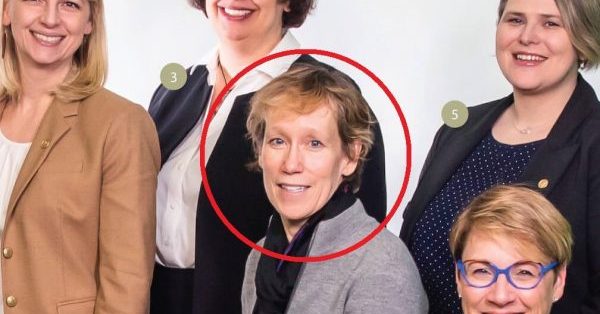
Karen Jensen, a former corporate lawyer who spent years fighting equity claims by underpaid women, yesterday lamented the toll litigation takes on workers. Jensen is now Pay Equity Commissioner: “I saw personally the toll pay equity litigation took on all those involved.”
Constitution Survives By 10-1
The Commons Indigenous affairs committee yesterday voted 10 to 1 for the Constitution. MPs rejected a Bloc Québécois proposal to delete reference to the supreme law from Canada’s citizenship oath: “They tried.”
Office Skirted Contract Rules
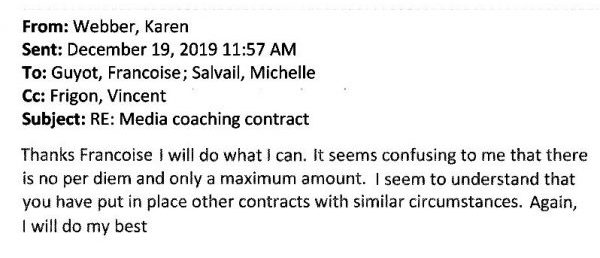
The Office of the Auditor General “directed” a sole-sourced contract to a Liberal lobbyist by narrowly skirting rules on open bidding, records show. Terms of the lump-sum contract were so peculiar one employee called it “confusing.”
Act Bans ‘Preferential’ Cases
Ex-Industry Minister Navdeep Bains yesterday declined comment on whether he acted on behalf of campaign donors in “pressing” a company’s proposal to sell China-made masks to the government. The Conflict Of Interest Act forbids cabinet ministers from giving preferential treatment to acquaintances: “Ministers are in a position of power and have a responsibility to ensure this power is exercised fairly.”