The number of homeless in shelters nationwide jumped 12 percent in a year, according to figures detailed in a Department of Infrastructure briefing note. No reason was given. Cabinet budgeted more than a half billion a year to aid the homeless: “Homeless people rarely have a fixed address, therefore are difficult to count.”
Liberals Promise $6B Tax Cut
Prime Minister Mark Carney yesterday called a tax-time election on a promise of savings for every federal taxpayer in the nation. The measure, estimated to cost $6 billion, follows a Liberal leadership rival’s appeal that the Party “be honest with Canadians” over deficit spending: “It’s easy to say we’ll give you this and we’ll give you that, but let’s be clear: We do have a deficit.”
Obscure Law Pays The Bills
Cabinet must resort to a little-used law to run the prisons, pay the Army and keep passenger trains running during the election campaign. All budgeted funds voted by Parliament expire a week from today at midnight: “A minister must report an expenditure is urgently required.”
Liberal Vote Down To 1 Or 2
Liberals won as few as one or two votes at numerous polls in the last federal byelection, newly released records show. Elections Canada on Friday certified poll boxes from a December 16 byelection in what had been a Liberal-held riding in suburban British Columbia, Cloverdale-Langley City: “It has not been an easy day.”
Little Support For CBC Boost
Taxpayers have no appetite for large increases in CBC funding as proposed by the Department of Canadian Heritage, says a Liberal Senate appointee. Senator Andrew Cardozo (Ont.), a longtime CBC supporter, recommended in a report that the Crown broadcaster be considered an essential service but without additional millions: “There does not appear to be a public appetite as such for a significant increase.”
Feds Tighten Russia Transfers
Cabinet in its last act of office Saturday enacted new regulations to slow or effectively freeze cash transfers to Russia. Bank and wire transfers are now subject to meticulous background checks regardless of the amount, said the Department of Finance: ‘Treat every transaction, regardless of the amount, as high risk.’
Poem: “Lo! A Bureaucrat!”
Lo! A bureaucrat,
Alights upon the scene,
The power to redact and enact,
With countenance so serene.
Nary a T nor an I,
Can be allotted,
And by piercing eye,
Crossed and dotted.
Oh! Who can contend?
With the dreadful intellect,
That by flick of pen amend,
The very wishes of the elect.
Freighted with humility,
And treated so reverent!
But alas, weighted with duty,
It thus burdens our servant.
The Gray Glory of the Bureaucrat!
Doth mark on the Kings account,
Supreme over the autocrat,
EXPENSES NOT APPROVED
By W.N. Branson 
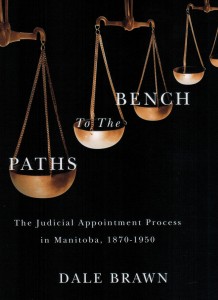
Review: How To Become A Judge
Canadians like to think of our judiciary as a meritocracy, in the same manner we have a naïve faith that oncoming motorists will stay on their side of the white line. Of course, car wrecks happen all the time.
Professor Dale Brawn examines who’s behind the wheel in Canadian courts. The result is a beautifully-researched and entertaining study of 80 years of judicial appointments in a single province, Manitoba, from 1870 to 1950. Brawn chooses his subject well. Manitoba was for years the lone outpost of the judiciary on the Prairie frontier.
Judges were by degrees brilliant and mediocre, studious and alcoholic, a grab bag of “pretty fair lawyers” and political fixers. One appointee was rated as having “but a small amount of brains and knows absolutely no law.”
“The Manitoba judiciary played a key role in bringing the prairies into Confederation,” notes Paths To The Bench; “They sat on the region’s highest courts during a time when the nation was undergoing a period of rapid social, economic and legal transformation. Judges in the late nineteenth century were responsible for laying down a legal foundation on which frontier societies were built, and their judgments gave shape and form to the institutions of the day be legitimating the social order”.
Who were these judges? Typically wealthy, married, Protestant corporate lawyers with a membership in the Masonic Lodge and a father-in-law in the legislature. Professor Brawn recounts the 1928 correspondence of one judge who advised his son on how to make the bench: Get elected to town council, take up curling; join all the important golf clubs and become a Mason.
He recounts too the jottings of MP Ralph Maybank, a longtime Liberal fixer who managed federal appointments in the province till recommending himself to the bench in 1951: “We must settle on any Liberals at all. I repeat that – any Liberals at all,” Maybank wrote.
And mind the Catholics. “The French have two ideas,” Maybank told a friend. “The first is that one of their own ought to be appointed and, of course, they have all history on their side. The second is that if they can’t get one of their own they won’t have an Irish Catholic. They say if they surrender their position to an Irish Catholic, the Irish Catholics will always thereafter insisted that they are entitled to that representation on the bench as a minority right. Of course my own view is that all this business about choosing judges because they are Catholics either French or Irish or English is all damned nonsense.”
No Jews were allowed till 1952. “If a Jew were given an appointment which a French-Canadian ought to have…their rage would know no bounds,” Maybank wrote. The latent anti-Semitism of judicial appointments continued long afterward. When Supreme Court Chief Justice Bora Laskin died in 1984 the Globe & Mail awkwardly described him as “the first ethnic Canadian to hold the top judicial post”. Laskin was born in Thunder Bay.
Most importantly, judicial appointees lobbied very hard for the post. They buttonholed MPs and served on commissions, ran as director of the livestock association or Children’s Aid Society, perhaps published a scholarly work. “Lawyers have long known that it is in their professional, political and social best interest to make themselves known to others,” Brawn writes; “While not everything they did was self-serving, much was.”
Paths To The Bench documents the courts of the kerosene era, but readers are forgiven for wondering if much has changed. In Brandon a genial attorney named Joe Mullally once ran a storefront office handling wills and divorces. Joe agreed to serve as director of the Legal Aid Society. Twice he ran hopeless Liberal campaigns for Parliament. In a 1983 Brandon byelection Mullally finished third – there were only three candidates – and lost by 14,000 votes. “It hurts a little,” Joe told a reporter. On Pierre Trudeau’s last week in office in 1984 he named Mullally to the Court of Queen’s Bench.
By Holly Doan
Paths To The Bench: The Judicial Appointment Process In Manitoba 1870-1950, by Dale Brawn; University of British Columbia Press; 320 pages; ISBN 9780-7748-26761; $32.95
Give Me Big Mandate: Carney
Prime Minister Mark Carney yesterday said he needs a “strong and clear mandate” from voters. Carney is expected to call a snap vote this weekend rather than face Parliament Monday: “You can see the action.”
Gov. Macklem Predicts Crisis
Canadians should expect weaker growth, higher costs and more uncertainty due to Trump tariffs, Bank of Canada Governor Tiff Macklem said yesterday. His remarks coincided with new Canadian Federation of Independent Business data indicating 19 percent of small business owners plan summer layoffs: “We now face a new economic crisis.”
No Carbon Tax Layoffs Here
The Canada Revenue Agency yesterday would not explain why it was keeping hundreds of employees in its carbon tax unit since Prime Minister Mark Carney announced he was “eliminating” the consumer charge. A battalion of clerks was hired to process revenues and rebate cheques: “What were the annual costs?”
Media Just One Big Fed Dep’t
Growing subsidies will turn much of Canadian media into a federally controlled Crown corporation “if not a department of government,” an Ottawa think tank said yesterday. The Macdonald-Laurier Institute in a report by a former Calgary Herald publisher warned media reliance on taxpayers’ aid was corrosive and self-defeating: “This is no way to maintain public trust in journalism.”
Senators Claim Jewish Crimes
Four Liberal-appointed senators yesterday signed an anti-Israel petition accusing Jews of genocide. The petition singled out soldiers and air crew of the Israeli Defence Forces with allegations of atrocities: “This will not soon be forgotten.”
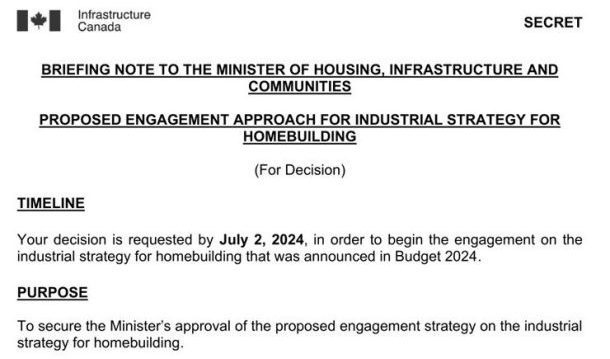
Feds Knew Target Was Faked
Cabinet in a secret internal memo last June 18 acknowledged it could not meet its housing target despite repeated promises to the public. The memo is dated two months after cabinet promised its housing plan was “unlocking the door to the middle class for millions.”

Lib Activists Deny Meddling
A federally-sponsored advocacy group yesterday admitted to contacting a convention hall over its rental of space to a group critical of the Liberal Party. The taxpayer-subsidized Canadian Anti-Hate Network acknowledged making the call but denied acting at the government’s direction: “We are a completely independent organization.”