
An MP who quit the government caucus over concealment of public salaries is prodding Parliament to endorse even greater disclosure. Independent legislator Brent Rathgeber proposed the government publish the salary of any employee who’s paid the same as an MP at $160,000 a year: “I might as well double down.”
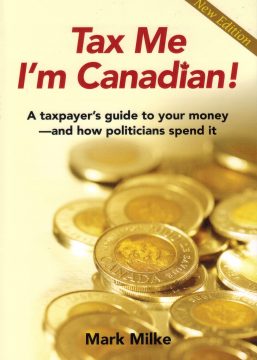
Review: The Usual Suspects
It is always fresh to view the nation from a different perspective. Author Mark Milke explores Canada’s story without mentioning French explorers or the building of the Canadian Pacific Railway. His is a tax-eye view.
Who is not wiser on learning the first Canadian tax was a 50 percent export levy on beaver pelts for top hats? Or that Alberta pioneered the gas tax, 2¢ a gallon, in 1922. Or that Ontario municipalities levied local income tax under the 1850 Assessment Act of Upper Canada. Or that tax brackets peaked at 98 percent on millionaires’ wartime income in 1944.
Tax Me I’m Canadian! is a crisp accounting of revenue measures since the pre-Confederation era. Milke correctly notes the first federal income tax was never promised as temporary – Parliament was nearly broke at the time, 1917. Nor is it unconstitutional as claimed by “bizarre” theorists and conspiracy buffs. “If I had a buck for every time that someone emailed or called to insist that ‘the federal government cannot legally collect income tax,’ I would have long ago retired to sip red wine in an expensive villa in southern Italy,” Milke writes.
Yet there is less.
Tax Me I’m Canadian! at its worst is a roundup of the usual suspects – Québecers, aboriginals, New Democrats, unions – who Milke blames for sponging off the middle-class. The author is a senior fellow at the Fraser Institute. The lament is tired, and panders to the Fraser Institute’s most enthusiastic advocates.
Does Canada really need a Farm Income Protection Act that pays growers a $22,500 annual grant when rising farm income is at a record high? Milke has no comment.
Does Imperial Oil really need free medicare for its 4,800 employees at taxpayers’ expense at the same time it pays dividends to shareholders? Milke is silent.
Does it really make sense to offer suburbanites toll-free roads when local governments complain the nation has a $171 billion infrastructure “deficit”? Milke, nyet.
Tax Me I’m Canadian! perpetuates an unfortunate myth that bloated governments conspire to steal from the many to reward a contemptible few. In truth, Canadian taxes are high because the majority of electors will not accept the alternative is exorbitant user fees that will hit ‘em where they live.
As the late Don Blenkarn, former chair of the Commons finance committee, once put it: “Everyone says they want to cut the deficit, but there was not an election I saw where somebody did not come out offering something.”
By Holly Doan
Tax Me I’m Canadian! By Mark Milke; Thomas & Black; 169 pages; ISBN 9780-9687-91523; $21.95 
Court OKs Drug Price Cap
The Supreme Court today upheld one province’s bid to regulate the cost of generic drugs. The ruling is expected to set a regulatory pattern nationwide, a legal analyst told Blacklock’s. Justices in a unanimous 7-0 judgment concluded Ontario was within its rights in attempting to enforce a price cap by banning rebates paid to pharmacies by drug manufacturers.
Now For Sale: 50,000 Acres
Legislators are questioning a little-noticed bill that would see Natural Resources Canada sell nearly 50,000 acres of pristine wilderness for coal mining. The property has been preserved as Crown land since 1905, and borders an area protected from mining by the B.C. legislature: ‘Beautiful — it’s also an area well-known for high quality coal.’
Bullets A Hazard Says Enviro Dep’t
Environment Canada says hunting ammunition may pose an ecological hazard.
The department is reviewing the environmental impact of lead bullets, estimating tons of the material litter forests and shooting ranges nationwide.
Industry officials noted lead remains a popular, inexpensive ingredient in ammunition, but said there was no evidence lead posed an environmental risk.
“There is a big push on this from the lefties in the States,” said Kurt Thomas, an ammunition manufacturer.
“The military shoots off tons of this,” said Thomas, president of Canadian BDX of Black Diamond, Alta. “How many trillions of rounds of lead were fired in Belgium in World War One, yet their farmland is productive and the people are healthy.”
Environment Minister Leona Aglukkaq did not comment.
Aglukkaq’s department proposed to study “patterns of lead ammunition from hunting and sport shooting activities” and their effect.
Firearms have left more than 1,000 tonnes of lead in the environment, officials estimated. The department proposed a study of practices in Japan, South Korea, the European Union and United States. The State of California last month became the first in America to restrict lead in hunting ammunition.
“There is no issue here; this is a political correctness issue,” said Tony Bernardo, acting executive director of the Canadian Sporting Arms & Ammunition Association. “California spews millions of tons of lead into the air from diesel and jet fuel; that is far more prevalent than any lead from hunting ammunition.”
Bernardo said numerous shooting clubs in Canada have reclaimed lead from firing ranges without any evidence of environmental harm.
“It’s not like it goes into the water table and floats downstream,” said Bernardo. “We’ve had several ranges that are very conscious of this issue and have repeatedly tested their soil and nearby water sources for contamination – without result.”
The international study is scheduled for completion in 2015.
In 1999, Environment Canada banned the use of lead shot in National Wildlife Areas, and restricted its use nationwide by hunters of all species of migratory birds and water fowl with the exception of murres, woodcock and band-tailed pigeons, and mourning doves.
“The Government of Canada has committed to further reducing the exposure of lead,” Environment Canada reported in a notice; “Lead is associated with risks to human health, including developmental neurotoxicity, neurodegenerative, cardiovascular, renal and reproductive effects. Known environmental hazards of lead include toxicity to birds, fish and crustaceans.”
By Tom Korski
MPs To Probe Rail Safety
Cabinet is requesting that MPs undertake a winter-long report on rail shipments of dangerous goods with a mandate to suggest reforms in 2014. The “starting point” will be the fatal Lac-Mégantic wreck, said the vice chair of the Commons transport committee: “What’s going to happen in the next 12 to 15 years?”
My Bad On Budget Blunder
The Department of Finance has formally apologized for mistakenly doubling taxes on credit unions. Senior officials told the Commons finance committee they were sorry for the mistake, which required an Act of Parliament to remedy: “We do apologize for that error.”
“We Are Watching”
Agriculture Canada is keeping an eye on railways’ performance in shipping the first bumper crop since Parliamentary passage of a rail service reform bill. The department said it is “closely monitoring” the shipment of this year’s Prairie harvest following complaints of haphazard service: “They know we are watching.”
‘Doing My Bit At McDonald’s’
Bank of Canada Governor Stephen Poloz says the notion of retirement is now so vague he has acquaintances working past 65 to meet expenses. Poloz told a Senate committee he’s concerned by trends in the nation’s aging population: “I too know people who have decided to stay in the workforce longer than they originally planned.”
Labour Bills Rewritten In Secret, Officials Tell MPs
Federal staff acknowledge landmark revisions to labour laws were written without consulting any business, union or legal analyst. Critics caution the amendments upset decades-old policies on right-to-strike and workplace safety: “It seems kind of a curious way to make policy.”
There Oughta Be A Law
The Department of Fisheries is levying $815,000 in new fees on B.C. aquaculture but stopped short of proposing national legislation to standardize fish farming practices across Canada. The drafting of a fee schedule followed years of study: “How are we supposed to make any progress on the real issues?”
A Lac-Mégantic Legacy
Transport Canada is ordering railways to publicly report shipments of dangerous goods through towns and cities. However more substantial amendments to the Rail Safety Act are still awaiting the outcome of a probe of the Lac-Mégantic wreck, said the transport minister: “I expect we’ll talk about it some more.”
No Promise On Subsidies
Social Development Minister Jason Kenney says cabinet is “giving people the shelter they need”, but would not commit to renewal of subsidies for 200,000 low-income households. Advocates caution that tenants may face eviction without federal support of below-market rents: “Are we going to tackle this problem?”
Euro Pact A Good Catch?
A Euro trade pact is needed to stem a 20% decline in transatlantic seafood exports, the Fisheries Council has told MPs. The industry group called the tentative agreement “a game-changer” for producers of B.C. salmon, Prairie pickerel, and Atlantic shrimp, lobster and mackerel: “Right now we’re not in the game.”
Anti-Piracy Bill Thrashed
Industry Minister James Moore is silent on withering criticism from business over a federal anti-counterfeiting bill. Executives and attorneys told a Commons committee the legislation is so clumsy it would be simpler for property owners to buy counterfeiters’ goods and destroy the shipments: “I just don’t have any comment on that right now.”