
Senator Yuen Pau Woo (B.C.) predicts a McCarthyist witch hunt with Parliament’s passage of a bill mandating public disclosure of Canadians lobbying for foreign governments. Fellow Liberal appointees in the Senate ridiculed Woo’s claim: “What advice would you give to Chinese Canadians who want to build good ties with their motherland?”
Military Short Billions: Report
Canada must spend billions more to meet its minimum NATO commitments, says the Commons national defence committee. The recommendation follows remarks by Defence Minister Bill Blair that it “is a challenge for Canada” to achieve the same funding targets as the U.S., United Kingdom and other allies: “Meet the Alliance’s two percent defence spending target.”
Still Recovering $1.6M In Pay
Federal managers are still attempting to recover about $1.6 million worth of wages mistakenly paid to employees while they were on strike in 2023, records show. Management blamed paperwork errors: “What was the total amount mistakenly paid out?”
I Share Content Too: Freeland
Finance Minister Chrystia Freeland says she routinely shares password-protected news stories with friends. Freeland’s remarks followed a Federal Court ruling won by Department of Justice lawyers that permits password sharing, a Canadian first.
“As you guys know I used to be a journalist,” Freeland told reporters. “I still read two newspapers every day in print and take pictures of the articles that I share with people.”
Freeland did not name her subscriptions. The finance minister was previously deputy editor of the Globe & Mail.
“We work for you guys,” Freeland told reporters. Her comments were in response to an unrelated question from Canadian Press.
“I am a huge believer in the value of the work that all of you guys do, the work of professional, salaried journalists,” said Freeland. She did not elaborate.
Federal lawyers on May 31 won a court judgment approving Canadians’ sharing of passwords to paywalled media content. The ruling came in a Blacklock’s lawsuit against Parks Canada for ignoring repeated warnings and “plainly visible” terms and conditions against sharing passwords without payment or permission.
Evidence showed Genevieve Patenaude, a Parks Canada manager, bought a single Blacklock’s password and then emailed it to any co-worker who asked, at least nine people, “if you ever need to access any Blacklock’s article.” Parks Canada had 2,160 employees at the time.
Patenaude refused to answer Blacklock’s when asked what she did with the password and later testified she was confused. Blacklock’s lawyers argued Parks Canada’s misconduct was unethical and a clear violation of property rights under the Copyright Act.
“Enormous Implications”
The Federal Court ruled anyone who believed they had a “legitimate business reason” could share a password to access paywalled media content. Michael Geist, Canada Research Chair at the University of Ottawa, called the ruling a “huge win” for people who wanted free content with “enormous implications for libraries, education and users more broadly.”
Blacklock’s argued its password system was standard in the news business. Globe & Mail executives in 2020 testimony at the Commons finance committee said newsrooms had no choice but to sell passwords to paywalled content. “The majority of our revenue comes from the 120,000 digital subscribers and 110,000 print subscribers who currently pay to consume our journalism,” testified then-publisher Philip Crawley.
“The cornerstone of our business is not advertising which is a revenue stream that shrinks each year,” said Crawley. “No, the present and the future of the Globe is founded on readers and users paying for our content. More than 60 percent of our revenue comes from subscriptions, print and digital. Advertising revenue is now only 33 percent.”
Crawley said the Globe sold passwords and “put that reporting behind the paywall to drive subscriptions.” Copyright protection was “very important,” he said.
The Commons heritage committee in a 2019 report recommended that cabinet tighten the Copyright Act to protect creators from haphazard sharing “when the work is commercially available.” Nothing for sale should be copied without payment or permission, said the report Shifting Paradigms.
“This is not just a clinical report,” Liberal MP Julie Dabrusin (Toronto-Danforth), then-chair of the heritage committee, said at the time. “Creators talked about the impact on income they need to keep producing the works that we love.” Cabinet never acted on the report.
By Staff 
Gov’t Rethinks Climate Claim
Environment Minister Steven Guilbeault yesterday banned the sale of lightbulbs once touted by his department as climate-friendly energy savers. Compact fluorescent bulbs in fact contained toxic mercury blamed for poisoning the environment: “There are probably 100 million of these bulbs in Canada.”
Will Discuss Hopes & Dreams
Liberal MPs will spend the summer talking to voters “about their hopes and dreams,” Government House Leader Steven MacKinnon said yesterday. MacKinnon made the remarks to reporters as the Commons adjourned for a 13-week summer recess: “At what point is it time to change?”
Feds Put Iranians On Blacklist
Cabinet yesterday adopted an all-party recommendation of the Commons justice committee to blacklist the Islamic Revolutionary Guard Corps as a terrorist group. It did not comment on a committee proposal to immediately “expel the estimated 700 Iranian agents operating in Canada.”
Feds Paid Twitter Critic $68K
A University of Alberta economist who used his Twitter account to ridicule Conservatives as “idiots” and “sociopaths” received more than $68,000 in sole-sourced federal contracts, records show. Economist Andrew Leach yesterday said he made no secret of his work: “Are we governed by idiots beholden to sociopaths?”
Calls China A Climate Helper
China is “helping” fight climate change by manufacturing solar panels, says Deputy Foreign Minister David Morrison. MPs expressed astonishment at his remarks, noting Chinese panels are made by slave labour and prohibited from being imported under Canadian trade law: “They are actually helping; Chinese production is helping countries around the world transition off dirty fuels.”
36K Students Were ‘Refugees’
More than 36,000 foreign students have claimed refugee protection in Canada, records show. The figures covering the period from 2018 identified five universities and colleges with the highest number of refugee claims: “That isn’t the sign of a healthy system.”
Bill’s Making History: Senator
The Senate has passed into law a first-ever federal ban on replacement workers in strikes and lockouts. Senator Frances Lankin (Ont.), a longtime union executive, called it the historic fulfillment of labour rights sought since Confederation: ‘I hope you feel the weight of history.’
Too Much Paperwork: Survey
Federal hiring practices are buried in paperwork, says a Public Service Commission survey of government managers. Nine out of 10 rated it “burdensome.”
Doctors Have Plenty: Minister
Doctors have “huge advantages under our tax system” and can afford to pay more, Health Minister Mark Holland said yesterday. His remarks followed a warning from the Canadian Medical Association that changes to capital gains tax rates would cost most doctors nationwide: “A nurse should not be paying a higher marginal tax rate than a multimillionaire.”
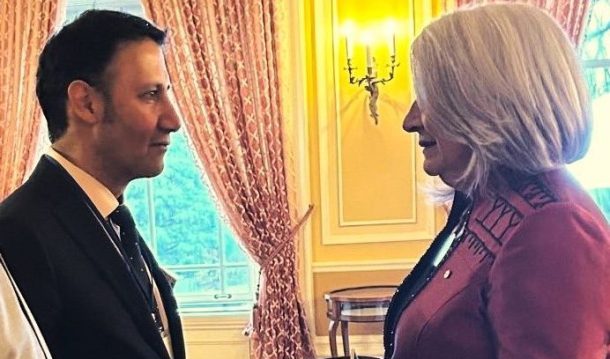
Rideau Hall Called The Gov’t
Governor General Mary Simon had staff contact Attorney General Arif Virani’s deputy before holding a conference in support of a Liberal bill on internet censorship, records show. “The Governor General is a force for good in this country,” Virani wrote in denying partisan interference.
Bank Predicts Fallout To 2027
Interest rate hikes will make many mortgage holders poorer for years to come, a Bank of Canada report said yesterday. Researchers estimated by 2027 disposable incomes for borrowers will be lower on average: “Pressure on consumption from rate hikes could last longer than the rate hike cycle itself.”



