
Liberals seeking a fourth term face tight contests nationwide “including in my riding,” Public Works Minister Jean-Yves Duclos said yesterday. Duclos made his remarks while speaking to reporters about a June 24 byelection in one of the safest Liberal seats in the country: “If it is close, what does it say?”
Senator Upset By Security Bill
Liberal appointee Senator Yuen Pau Woo (B.C.) yesterday said he feared Canadians in “regular contact with a foreign state agent” will be targeted under a new security bill. Woo earlier reacted angrily when asked by reporters if he was a Chinese Communist Party agent: “It is deeply insulting.”
Inflation Hikes Poverty Rates
The cost of living has overtaken years of progress in lowering poverty rates, says a federal report. The Department of Social Development counted almost a half million Canadians who fell into poverty due to inflation: “Inflation coupled with lagging household incomes has led to affordability pressures.”
Employers Fear More Strikes
Employers’ groups yesterday said a federal ban on use of replacement workers may lead to more strikes and lockouts in rail, marine shipping and other sectors. Parliament is preparing to pass a replacement worker ban under Bill C-58 An Act To Amend The Canada Labour Code: “Would this bill not bring equilibrium to labour relations?”
Eat Your Yogurt: Researchers
The Department of Health is rewriting regulations to permit vitamin D supplements in yogurt similar to fortified milk. Federal data confirm as many as seven percent of Canadians have a vitamin D deficiency due to long, dark winters: “For example, at 52 degrees north in Edmonton, no synthesis of vitamin D occurs in the skin between October and March.”
“$8B And You Don’t Know?”
Environmental benefits of an $8 billion subsidy program for industry are unknown, Department of Environment managers yesterday told the Commons public accounts committee. Conservative MP Dan Mazier (Swan River-Dauphin, Man.) expressed outrage: “You are so flippant about it. You don’t even care.”
This Will Be Law September 1
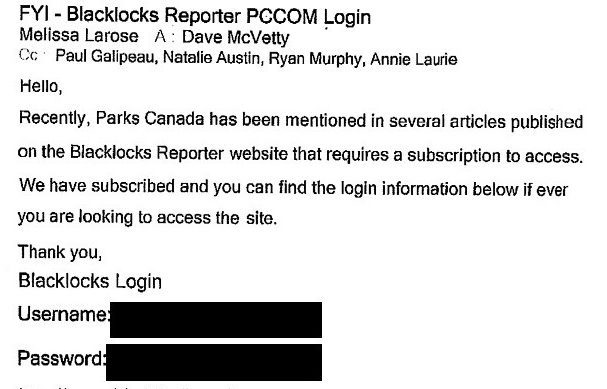
Blacklock’s shareholders issued the following statement: The Attorney General and a federal judge are enacting new rules allowing password sharing. This impacts all internet users nationwide. It follows a Federal Court decision in Blacklock’s Reporter v. Attorney General, case number 2024 FC 829.
This is the law by September 1 without an appeal. The ruling runs to 67 pages but the key paragraph is number 136. What does it mean? Here are the answers:
Can I share my passwords? Yes, so long as you can think up some “legitimate business reason.” You don’t have to literally be in business. This is up to you. One legitimate business reason could be saving money on passwords.
What type of password can I share? Any kind at all. The rule applies to any ordinary password to websites, newspapers, video and music services, library databases, scientific or technical journals, peer-reviewed periodicals, you name it.
What if terms and conditions say I can’t share? It doesn’t matter. The judge ruled Blacklock’s terms were “plainly visible” and clearly prohibited password sharing without permission. Blacklock’s even sent the password buyer two written notices with a number to call if they intended to “share or distribute content.” The judge dismissed it as irrelevant.
How many times can I share my password? As often as you like. The Parks Canada manager in the case shared her password with every co-worker who asked, at least nine people. Could those nine people each share the password with nine of their friends? Of course. Parks Canada at the time had 2,16o employees.
Michael Geist, Canada Research Chair at the University of Ottawa, called the ruling a “huge win” for people who don’t want to pay for content on the internet. There are “enormous implications for libraries,” he wrote. The University of Toronto Library serves 97,000 students. Under the new rule, password sharing mushrooms from 9 to 900 to 97,000 without payment or permission.
Doesn’t this have consequences for companies that rely on passwords? Yes, it is catastrophic.
Will Blacklock’s appeal this ruling? We are a small business like a million others. We have spent eight years and $538,665 fighting the Attorney General and Federal Court to uphold property rights. FC 829 should be appealed to the Supreme Court, but large corporations and trade associations relying on electronic commerce cannot leave it to Blacklock’s alone to litigate the definition of “password” in Canada in the digital age.
Parties interested in joining an appeal with financing should contact counsel: Scott Miller, c/o MBM Intellectual Property Law. 275 Slater Street, 14th Floor, Ottawa K1P 5H9.
The deadline is Friday, August 30 at 6 pm Eastern. After that moment, password sharing is law.

Vows ‘No Lobby’ Tax Reform
Any future Conservative cabinet would appoint a lobby-free tax reform committee, Opposition Leader Pierre Poilievre said yesterday. He made the pledge as Conservatives opposed an $18 billion increase in capital gains taxes: “Get ahead by working hard.”
OK Capital Gains Tax 208-118
The Commons yesterday by a 208 to 118 vote passed a Ways And Means Motion to raise capital gains tax revenues. Finance Minister Chrystia Freeland called it a blow for tax fairness against multimillionaires, a claim disputed by critics: “Almost 50 percent of the people impacted by this tax otherwise make less than $100,000 a year.”
175,000 Mortgages A Concern
Superintendent of Financial Institutions Peter Routledge yesterday told MPs he is “very concerned” about interest rate shocks facing tens of thousands of mortgage borrowers. Some homeowners will see payments jump 50 percent on average, he said: “That is a very significant shock.”
Bill To Fix ‘This Crazy World’
A federal ban on replacement workers in case of strikes or lockouts will bring “certainty in this crazy world,” Labour Minister Seamus O’Regan said yesterday. The bill reflects the power and influence of Canadian labour, he said: “They are asking for more.”
Paid $233K For Ghostwriters
The Canada Revenue Agency last year paid more than a quarter million to distribute fake “news” articles written by employees, records show. Two dailies were among the newsrooms that published the Agency’s handout stories as legitimate items: “The purpose of these articles was to inform Canadians.”
CBC Fading Online: Research
New data show the CBC draws just 11 percent of social media engagement nationwide, the poorest performance of any Canadian television network despite $1.4 billion in annual subsidies. The CBC has a thousand employees posting content online: ‘Five Canadian media outlets attract the most engagement.’
Find The Spies, Declares MP
All parties yesterday pledged support for a Bloc Québécois motion to unmask foreign spies in Parliament. “What more will it take for us to act?” asked MP René Villemure (Trois-Rivières, Que.), sponsor of the motion: “We can’t keep making empty speeches.”
Calls McKinsey Just The Start
Irregularities in sole-sourced federal contracts to McKinsey & Company point to widespread “disregard for the rules,” Auditor General Karen Hogan said yesterday. Hogan told MPs her auditors also encountered federal employees too frightened to disclose what they knew of misconduct in contracting: “Yes, they are afraid of reprisals.”



