
A secret 1986 federal task force proposed cabinet consider selling the Royal Canadian Mint. Access To Information records released yesterday indicate the proposal was reviewed by cabinet as part of a privatization drive: “The strategy is for the government to divest itself of those assets which are no longer fulfilling public policy objectives.”
Bank Warning On Gas Prices
The Bank of Canada says it is worried by rising gas prices and will hike interest rates again this fall “if needed.” The Bank yesterday held its prime rate on interbank loans at five percent, the highest in 22 years: “With the recent increase in gasoline prices, inflation is expected to be higher in the near term.”
Disregards 27,000 Complaints
The Financial Consumer Agency of Canada did not follow up any of more than 27,000 consumer complaints it received against banks in the past five years, Access To Information records show. Parliament created the Agency to “protect the rights” of bank customers. Judith Robertson, cabinet’s $285,000-a year Commissioner responsible for the Agency, refused an interview: “Thank you and have a nice day.”
Eggs Up 10%, Margarine 16%
Food costs continue to rise faster than the headline inflation rate, Statistics Canada figures showed yesterday. Prices of the most basic family staples were running at 10 to 18 percent more year over year ahead of today’s Bank of Canada interest rate announcement: “We have been surprised.”
CRTC Vetoes 12% Cable Hike
The CRTC yesterday rejected a 12 percent increase in rates for “skinny basic” cable and satellite TV. Data show more than a million Canadians subscribe to $25 monthly packages introduced in 2015: “I can’t remember the last time I’ve had a $25 bill for television.”
Charter Right To Clown Pants
A ban on clown pants for police on duty has been struck down by a Québec judge. Wearing irregular clothing to illustrate labour grievances is a constitutionally protected act of free expression, ruled Québec Superior Court: “It protects not only accepted opinions but also those which disturb, even those which shock.”
Savers Didn’t Need Subsidy
Canadians most likely to save for their children’s education don’t need subsidies to do it, new data show. Parliament has paid out grants to savers for nearly two decades: ‘Families more likely to save for postsecondary education had higher incomes and owned a home.’
Warning On Pharmacare Tax
The Department of Health warns taxpayers are “sensitive to cost considerations” of pharmacare, citing a Fraser Institute poll indicating Canadians won’t pay more taxes for universal public drug insurance. Prime Minister Justin Trudeau promised to pass a pharmacare bill by year’s end under a vote deal with New Democrat leader Jagmeet Singh: “Support fell by almost half to 40 percent if the program was to be financed by an increase in the GST.”
Admit Passports Mismanaged
An internal federal memo admits mismanagement was to blame for extraordinary delays at the passport office. Half of employees were sent to work from home and 20 percent quit during the worst of the backlog last year, said the memo: “There needs to be a crack of the whip, big time.”
Sudden Rush On News Bill
Heritage Minister Pascale St-Onge in a regulatory surprise says enforcement of the Online News Act will begin by year’s end, scrubbing months of public consultation. St-Onge in a legal notice Saturday acknowledged the timing was “aggressive” and “accelerated.”
Young Most Scared: Fed Data
Young Canadians, women and British Columbians and Ontarians are the biggest climate change worriers, says in-house research by the Department of Environment. The findings follow an earlier federal report that most young people feel frightened, sad and helpless about global warming: ‘How worried are you?’
Like The Customers To ‘Stick’
Canadian banks use “customer stickiness” techniques to prevent clients from comparison shopping, says a Competition Bureau report. The practice makes it difficult for any new rival to challenge the nation’s Big Five banks, it said: “There are frequently direct costs associated with customer switching.”
In Observance Of Labour Day
Blacklock’s Reporter pauses today for the 129th observance of Labour Day in tribute to Canadian workers nationwide. We will be back tomorrow — The Editor
Poem: “This Is Your Captain”
Welcome aboard Federal Government Airlines.
Our flight
will be two hours longer than usual
as we’re still looking to repair
the left engine,
following last year’s inspection.
Navigation should be smooth
with our new compass,
obtained yesterday
from an identical aircraft
at the Aviation Museum.
Refreshments will be served
to those sitting
in odd-numbered rows only.
In case of a pressure drop inside the cabin,
oxygen masks will be available
for a fee.
Should you need help with the clogged toilets,
our one crew member
will be delighted
to assist you.
You’ll also be happy to know
that we’re balancing our budget this year!
Thank you for flying with us.
By Shai Ben-Shalom

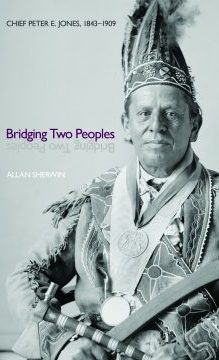
Book Review: A Victorian Tragedy
Dr. Peter Edmund Jones is the most interesting Canadian you never heard of. His accomplishments were many, yet he died in poverty. He left a mark in science and public affairs, yet stumbled in drunkenness and despair.
The son of a Mississauga chief and English mother, Jones was the first Status Indian to graduate from a Canadian medical school, Queen’s University in 1866. His thesis was “The Indian Medicine Man.” Jones was the first to publish an Indigenous newspaper in Canada, The Indian, in 1886. He was a chess master, an archaeological advisor to the Smithsonian Institute, a political organizer for John A. Macdonald, a federal Indian agent.
“Jones appears to have been a romantic who felt his early success would carry him onwards,” writes biographer Allan Sherwin. Of course this could only end badly. To read Bridging Two Peoples is to sense the creep of petty humiliation and raw bigotry that crushed this Victorian romantic in the end.
When Jones married a widow with three sons in 1873 he could not legally adopt his own stepchildren since Status Indians were unable to file applications in court. When Jones was appointed an Indian agent in 1888 he was paid 40 percent less than white agents. When he retired in 1903 Jones was reduced to suing the Grand Trunk Railway for $10 after a boorish conductor threw his wife off a train for refusing to sit in a second-class car.
Biographer Sherwin, a professor emeritus of neurology at McGill University, crisply recounts the life of this extraordinary man. “He believed that effort and education would enable Aboriginals to compete with their Euro-Canadian neighbours, and he tried to act as a bridge between them,” writes Sherwin. “Dr. Jones had made the mistake of trying to act as leader of his people from outside the reserve.”
Of the many indignities was an 1875 item in the Toronto Mail that characterized Indians as a low, lazy, treacherous race. “I am one of the Mississaugas,” wrote Jones, the band chief and a practicing physicia. “There is not in Canada a tribe of Indians more clean, industrious, and sharp in business, than are my people…Our women are treated as much like ladies as the wives of the white farmers about here.”
Jones died penniless in Hagersville, Ont., his savings lost to failed ventures and the alcoholism that cost his dismissal as an Indian agent in 1897. “The sale of alcohol to Indigenous peoples was a crime under federal law, but an exception might be made in the case of a valid prescription,” recounts Sherwin. “According to Indian Affairs’ records, Dr. Jones did purchase alcohol on behalf of his patients and, like many doctors of that era, was subjected to temptation.”
Jones, in the end, self-destructed. In Victorian Canada he could have done no less.
By Holly Doan
Bridging Two Peoples: Chief Peter E. Jones, 1843-1909 by Allan Sherwin; Wilfrid Laurier University Press; 270 pages; ISBN 978-1-55458-633-2; $29.95